When Anti-Cancer Drugs Become Classifiers: A Data Scientist's Observations on Cancer Treatment

A data scientist reframes cancer treatment as a classifier fighting the worst class imbalance.
A stage IV cancer data scientist uses the confusion matrix to reinterpret his treatment: true positives are killed cancer cells, false positives are toxicity, false negatives cause relapse. Oncology's history becomes a precision-recall trade-off, with ADCs sharpening the boundary. For metastatic disease, the goal shifts from cure to control, and each therapy line is the next split of a decision tree under incomplete information.
A data scientist with stage IV cancer reinterprets his own treatment in the language of machine learning: chemotherapy, radiation, targeted therapy, and antibody-drug conjugates are all, in essence, answering the same binary classification question—should this cell be killed or spared? His body is the dataset.
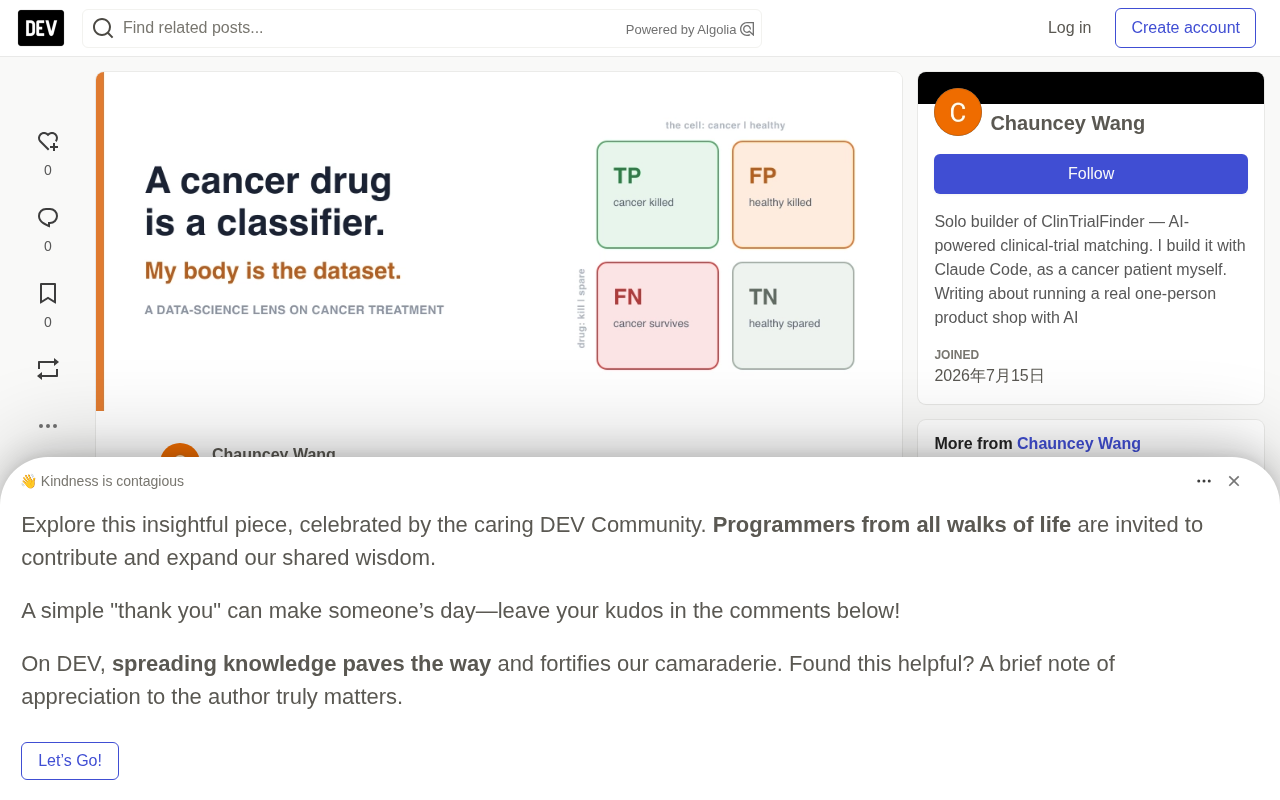
The Four Cells of the Confusion Matrix Correspond to the Full Costs and Benefits of Treatment
Treating anti-cancer therapy as a classifier is not a metaphor. In 2014, Lawlor et al. formally proposed the "cancer drug as classifier" framework in PLOS ONE to design more selective drugs. The author has lived inside it for two years and sees a different landscape from within.
True positive: cancer cells are killed. This is the treatment effect, tumor shrinkage—and the only outcome everyone hopes for.
False positive: healthy cells are mistakenly killed. This is toxicity. Every false positive has a name: hair loss, plummeting blood counts, mouth sores, neuropathy in the feet. Side effects are not an incidental byproduct of treatment; they are the false positive rate made flesh.
False negative: cancer cells survive. This is the most ruthless property of the classifier—a single false negative, one surviving cell still capable of proliferating, is enough to rebuild the entire tumor. Months later, it quietly cancels out all the true positives you were once proud of. Worse, under drug pressure, cells can acquire resistance they did not originally have, and the classification problem after relapse is often harder than the initial one.
True negative: healthy cells are correctly spared. The silent majority—no one celebrates them, but they are the reason a patient can still walk between infusions.
The confusion matrix is a standard tool for evaluating binary classification models, presenting a 2×2 table of the four combinations of predicted results and actual labels: true positive (TP), false positive (FP), false negative (FN), and true negative (TN). In medical screening and diagnosis, these four cells correspond to correctly detecting a patient, falsely flagging a healthy person as a patient, missing a patient, and correctly ruling out a healthy person. Two core metrics derive from this: precision = TP/(TP+FP), measuring "the proportion of those classified as positive who are truly positive"; and recall (also called sensitivity) = TP/(TP+FN), measuring "the proportion of truly positive cases that are successfully detected." The two typically trade off against each other, and adjusting the classification threshold moves the balance point between precision and recall. The F1 score is their harmonic mean, used for a combined measure. In scenarios with extreme class imbalance (such as rare diseases or cancer cell detection), precision is naturally low, because even a small false positive rate among a vast number of negative samples produces a considerable absolute number of false alarms—this is precisely the statistical root of the "high specificity, low precision" phenomenon described in the article.
Precision and Recall: Another Way to Write a Century of Oncology
Oncologists do not say precision and recall, but a century of anti-cancer drugs has been pursuing these two things.
When the goal is cure, recall must approach perfection. In most machine learning problems, 0.9 is acceptable; but here, 0.9999 can still fail—because that 0.0001 survived and is dividing. This is why treatment is so brutal: you are not aiming for "roughly right," you are striving not to miss a single one.
And a single systemic drug cannot achieve this goal. A drug in the bloodstream reaches the whole body but kills incompletely—broad coverage, mediocre recall. So cure is often an ensemble model: induction chemotherapy shrinks the tumor to reduce burden, surgery or radiation clears the bulk within its region with near-perfect recall, and systemic therapy sweeps up the stragglers. Each classifier covers another's blind spots.
Precision is the part the body pays for. Chemotherapy is a classifier with very low precision, and its decision rule is almost brutally crude—"kill everything that divides rapidly"—so the false positives are precisely the rapidly dividing healthy tissues: the intestinal lining (nausea), hair follicles (hair loss), bone marrow (collapsing blood counts). The side effect profile is a readout of a coarse decision boundary.
The two trade off against each other, and this trade-off is cancer treatment itself. Increase the dose to raise recall, and precision falls, toxicity rises, until false positives begin to threaten the patient's life. What oncologists call the "maximum tolerated dose" is precisely: how far you can trade precision for recall before the false positives become fatal.
The entire history of anti-cancer drug development is a campaign to raise precision without sacrificing recall—to make the boundary sharper, catching cancer cells while sparing healthy ones. Targeted therapies select mutations carried only by cancer cells; antibody-drug conjugates tether a targeted antibody to a chemotherapy warhead, using engineered features to bring the poison closer to cancer cells. Closer, but not exclusively—the payload still leaks en route, the target still exists on some healthy cells, and neuropathy in the feet is proof that false positives never reach zero.
Immunotherapy, by contrast, retrains the classifier itself. Cancer partly evades the immune system's classifier by "looking like self." Checkpoint inhibitors release the brakes on this classifier. When the retrained immune system starts over-attacking healthy tissue it now labels as foreign, colitis, pneumonitis, and thyroiditis appear—these autoimmune side effects are precisely the false positives of the immune classifier.
And all of this runs on the worst possible class imbalance. Cancer cells are a tiny fraction of the body's cells. So a drug can have high specificity—sparing the vast majority of healthy cells and keeping the false positive rate low—yet because healthy cells overwhelmingly outnumber cancer cells, the absolute number of healthy cells it kills can still exceed the cancer cells. High specificity, low precision: this is the hallmark of a rare positive class, and why even relatively selective drugs can make a person feel systemically poisoned.
A Case in Point: The Drug in the Arm
The drug the author is using, becotatug vedotin, is an antibody-drug conjugate: an antibody that recognizes EGFR, linked to the cytotoxic payload MMAE. MMAE is a microtubule poison, too toxic to administer intravenously on its own; the antibody's job is to make an otherwise unusable warhead usable, delivering it where it is needed.
"Where it is needed" is not a single feature. For the drug to kill a cell, multiple conditions must hold simultaneously: EGFR on the surface for the antibody to grab, the entire conjugate internalized and digested to release MMAE, the cell dividing when the poison arrives, and no pump expelling the drug. The true feature is the conjunction of these conditions—EGFR and internalized and dividing and not effluxed—and this is precisely the source of its selectivity: almost no healthy cell satisfies all conditions at once, so false positives fall. This is also where resistance hides: cells escape by violating any one condition—shedding the antigen, entering dormancy, or learning to efflux the drug.
Its Phase III trial compared it with standard chemotherapy (capecitabine or docetaxel). Docetaxel attacks the very same machinery MMAE attacks—microtubules—only as a mirror image. The warhead is not novel; what changed is the aiming: a sharp feature versus a crude one.
In classifier language, the results are exactly what a sharper feature should deliver: compared with chemotherapy, becotatug vedotin's response rate is about 2.5 times higher (30.2% vs 11.5%), time before cancer progression roughly doubled (median progression-free survival 5.8 vs 2.8 months; hazard ratio 0.63), and overall survival showed a trend toward prolongation at interim analysis (17.1 vs 12.0 months; hazard ratio 0.73, not yet conclusive)—all in patients who had already received two or more prior lines of therapy (ASCO 2025, Abstract LBA6005). It does not win with a more violent poison, but with a better boundary.
Those numbers describe a population, not a prophecy. The median is a fact about several hundred strangers; what the drug does in the author's body is read from scans and side effects, not from survival curves. But it is the drug in the author's arm because, in that population, a sharper feature beat the doctor's best crude feature.
An antibody-drug conjugate (ADC) is an engineered biologic composed of three parts: a monoclonal antibody targeting a specific tumor-associated antigen, a highly toxic cytotoxic payload, and a chemical linker connecting the two. Its design logic is "precise delivery"—the antibody recognizes and binds antigens on the cancer cell surface, the complex is internalized into the cell, and the linker is cleaved or degraded in the lysosomal environment, releasing the payload to kill the cell. MMAE (monomethyl auristatin E) is a tubulin inhibitor that is extremely toxic and lacks selectivity when free, making it impossible to administer systemically on its own; hence it is chosen as an ADC warhead. An ADC's efficacy depends on antigen expression specificity, internalization efficiency, linker stability, and payload potency; its off-target toxicity comes from premature linker cleavage in the bloodstream (payload leakage), low-level antigen expression in healthy tissues, and the "bystander effect" (payload spreading to neighboring cells after release). Understanding this structure helps grasp the argument in the article that "the true feature is the conjunction of multiple conditions."
The Objective Function Changes After Spread
Everything above assumes you are fighting for a cure—pushing recall toward 1, because one survivor can rebuild the tumor. This is curative intent: early-stage disease, adjuvant therapy, scenarios where "disappearance" is still possible.
The author is not in that scenario. The cancer has metastasized. For some, even metastasis leaves a narrow path to cure: oligometastatic disease, a few deposits that can be ablated one by one. But the author's is widespread metastasis, where the arithmetic changes—not because the drugs are weaker, but because the ensemble model has lost its best members. Surgery and radiation achieve near-perfect recall within a region but cannot reach systemically seeded microscopic disease. Remove the local steps, and only broad but imperfect systemic classifiers remain—used alone, they cannot reach 1. Recall of 1.0 is no longer the author's realistic goal; durable control is.
The objective function has changed. Rather than trying to correctly classify every cell in one shot, it is running a control problem—keeping tumor burden down, keeping false positives (the toxicity to be endured long-term) tolerable, and letting the classifier run for as long as possible. False negatives are no longer something to drive to zero; the author acknowledges them; the fight now is about what they are allowed to do and how much physical cost it takes to keep them in check.
Every Line of Therapy Is the Next Split of a Decision Tree
A classifier need not be a single decision. Stringing them together yields a decision tree: a series of splits, each acting only on the data that survived the previous split. This is the essence of lines of therapy. First-line treatment makes a cut; the relapsed cancer is, by definition, the subset of cells that fell in that drug's false negative region—the ones it could not separate out. So when the author chooses the next line, he is choosing the next split in the tree, and it acts only on the survivors.
This quietly dictates a rule every oncologist follows: do not choose a drug with a boundary similar to the last one. A split highly correlated with the one already made brings almost no new information—the cells it could cut out are already gone, and what remains is precisely the part that kind of feature cannot touch. This is cross-resistance, in the language of trees: conditional gain near zero. This is why the next line usually changes mechanism rather than reloading a cousin of the drug that just failed, and why stacking combinations—making several splits at once, each covering cells the others miss—always weighs the cost of each new cut to healthy tissue.
But two things break the tidy picture. First: the data is not fixed. Each split changes the distribution. It kills sensitive cells, leaving—enriching—resistant ones. You are not fitting a tree on a static dataset, but splitting a population that reshapes itself and responds adversarially to every cut. Each line selects for the clones that beat it. Changing mechanism is the counter—a new feature the survivors have not yet been selected against can buy back some lost ground. How much depends on the new mechanism's independence: swap one cytotoxic drug for a close relative, and the survivors' general tolerance—drug efflux, dormancy, disabled self-destruction—carries straight over; hand the killing to something with entirely different rules, such as the immune system, and the reset can go much deeper.
Second: these splits are chosen almost blind. In a true decision tree, you know every feature value and label and can compute which split has the greatest gain. The author cannot. He does not fully know which features the tumor carries—molecular readouts are incomplete, and snapshots go stale. Response odds are borrowed from trial populations that do not represent him. So it is not maximizing information gain, but maximizing expected information gain under deep uncertainty—sometimes choosing a line not because it is most likely to work, but because it will teach him what he is fighting. Exploration versus exploitation, at the highest stakes.
A decision tree is a supervised learning model that recursively partitions data: at each node, the algorithm selects a split condition from candidate features that maximizes class purity, divides the data into subsets, and repeats the process on the subsets until a stopping condition is met. Common metrics for split quality are information gain (based on entropy reduction) or Gini impurity decrease. Under ideal conditions, the algorithm can evaluate all features and thresholds and choose the split with the greatest gain. But in practice it often faces incomplete information, biased samples, and distribution drift, requiring a trade-off between exploration (trying splits with unknown information value to acquire new information) and exploitation (choosing the split with the greatest currently estimated gain)—this is the origin of "expected information gain" and the "exploration-exploitation dilemma." Decision trees are sensitive to the training data distribution; if the data itself changes because of past splits (e.g., treatment selects for resistant subclones), the model's assumptions break, connecting this to sequential decision problems in online learning or adversarial environments.
The Break: I Cannot See the Confusion Matrix
You never see this confusion matrix. You cannot count cells.
The entire four-cell reality is inferred from two blurry shadows. Recall is read from scans—tumor shrinkage means many true positives, roughly, at the aggregate level. Precision is read from your own body—feeling sick is the false positive rate translated into symptoms. And the cell you most need to know about is entirely invisible: the false negative. The one cancer cell that survived the last infusion, quietly dividing as the author writes these words. Minimal residual disease testing is a blurry attempt to peek at that false negative rate—did any cells escape?—even though it, too, cannot see a single cell.
The classifier runs on billions of cells in the author's body; months later, he is told the approximate recall in a radiology report, while precision is continuously learned through bodily sensation. The confusion matrix that determines lifespan is computed in the dark, and the author sees only shadows on the wall.
Minimal residual disease (MRD) testing refers to using highly sensitive methods (such as flow cytometry, PCR, or next-generation sequencing) to look for the extremely small number of cancer cells remaining in the body after treatment, with sensitivity as high as one in one hundred thousand to one in a million. It is far more sensitive than imaging (CT, PET)—imaging can only see masses at the millimeter scale or larger, while MRD testing attempts to capture circulating tumor DNA or abnormal cells in blood or bone marrow. In hematologic malignancies, MRD has become a key indicator for efficacy assessment and relapse prediction; in solid tumors, circulating tumor DNA (ctDNA) testing is gradually being used to monitor relapse risk. However, MRD testing still has clear limitations: limited sensitivity, so a single cell may still be missed; detection rates vary widely across tumor types; a positive result does not necessarily mean relapse will occur, and a negative result does not equal cure. Hence the article calls it "a blurry attempt to peek at the false negative rate"—it narrows the blind spot but cannot truly illuminate the confusion matrix.
The Best Classifier May Not Exist Yet
What makes control worth attempting is that the set of available classifiers is not fixed. Every year, oncology delivers better classifiers—drugs with sharper features, mechanisms that did not exist at diagnosis. The drug now in the author's arm was not available to him at the start. The frontier—the best boundary anyone has yet been able to draw between cancer and the author—keeps moving outward, slowly and unevenly, but it moves.
So for a metastatic patient, control is not just maintaining a tolerable state for its own sake, but buying time against a moving frontier—staying in the game long enough for a better classifier to arrive. The loss function is not just "keep the tumor down," but "keep the tumor down until the tools improve." Every month is a month closer to a feature that changes the math. It is a bet, not a promise—better drugs may come too late—but it is the bet the whole strategy rests on.
And one cannot wait passively. Better classifiers may already exist—in trials that have not reached the author's clinic, in classes of drugs his oncologist has not yet considered, in research conducted in another country. So part of the work, the part the author can truly control, is search: continuously scanning the frontier for a sharper boundary than what has been offered. When the classifier at hand is failing, searching is the move with the greatest remaining upside. It is no coincidence that the author decided to build an AI tool that matches patients with clinical trials.
The Names of Things
Knowing the name of the thing trying to kill you is reassuring. Treatment is not a mystery or a punishment. It is a classifier operating under the worst class imbalance, paying for false positives with the author's own healthy cells. Side effects are its precision problem. Relapse is its recall problem. And when cure is no longer a realistic goal, the author's treatment is not an attempt to win the classification, but simply to keep the classifier running, tolerably, for as long as possible. "Precision oncology" is this long campaign, sharpening the boundary enough to buy back more time.
Every anti-cancer drug is a classifier. The body is the dataset. And the one cell that matters most—the one that escaped—is invisible to both sides.
One-line Summary
A data scientist reinterprets cancer treatment through confusion matrices and classifier language, mapping efficacy, toxicity, and relapse onto the trade-off between precision and recall.
Paragraph Summary
A stage IV cancer data scientist reinterprets his treatment through machine learning's confusion matrix: true positives are cancer cells killed, false positives are healthy cells mistakenly killed (i.e., toxicity), false negatives are surviving cancer cells that cause relapse, and true negatives are healthy cells correctly spared. A century of oncology can be seen as a trade-off between precision and recall—the maximum tolerated dose is the clinical embodiment of this trade-off. Antibody-drug conjugates improve precision through sharper features, as supported by Phase III data for becotatug vedotin. For patients with widespread metastasis, the objective function shifts from cure to control, and lines of therapy are like the next split of a decision tree, with the data distribution changing with treatment and information incomplete. The author emphasizes that the true confusion matrix is computed in the dark, and the patient sees only shadows on the wall.
Related articles

NVIDIA's 30,000 Developers Use Cursor, Code Commit Volume Triples
Cursor engineer Chris Diaz breaks down five organizational gaps blocking enterprise AI coding scale—strategy, risk tiering, governance, metrics, and operating model. NVIDIA's 30,000 developers use Cursor daily, tripling code commits while defect rates stay flat. The key: rewrite the SDLC, not add tools.

Ponytail: Giving AI Coding Agents a Senior Engineer's Mindset
Ponytail is a free GitHub tool that injects a senior engineer's mindset into AI coding agents, making them ask whether code is even necessary first. According to TamilDeck, it can compress 200 lines of AI-generated code to 30, cutting token costs, with support for Cursor rules and Claude Code skill integration—though security review still requires human oversight.

Complete Guide to Connecting Cursor AI to the GitHub MCP Server
A step-by-step guide to connecting Cursor AI to the GitHub MCP server: create a personal access token, configure mcp.json, store the token in the ENV block, and verify with a PR query.