When Do Rankings Beat Signs? Gradient Direction Recovery under Even Nuisance
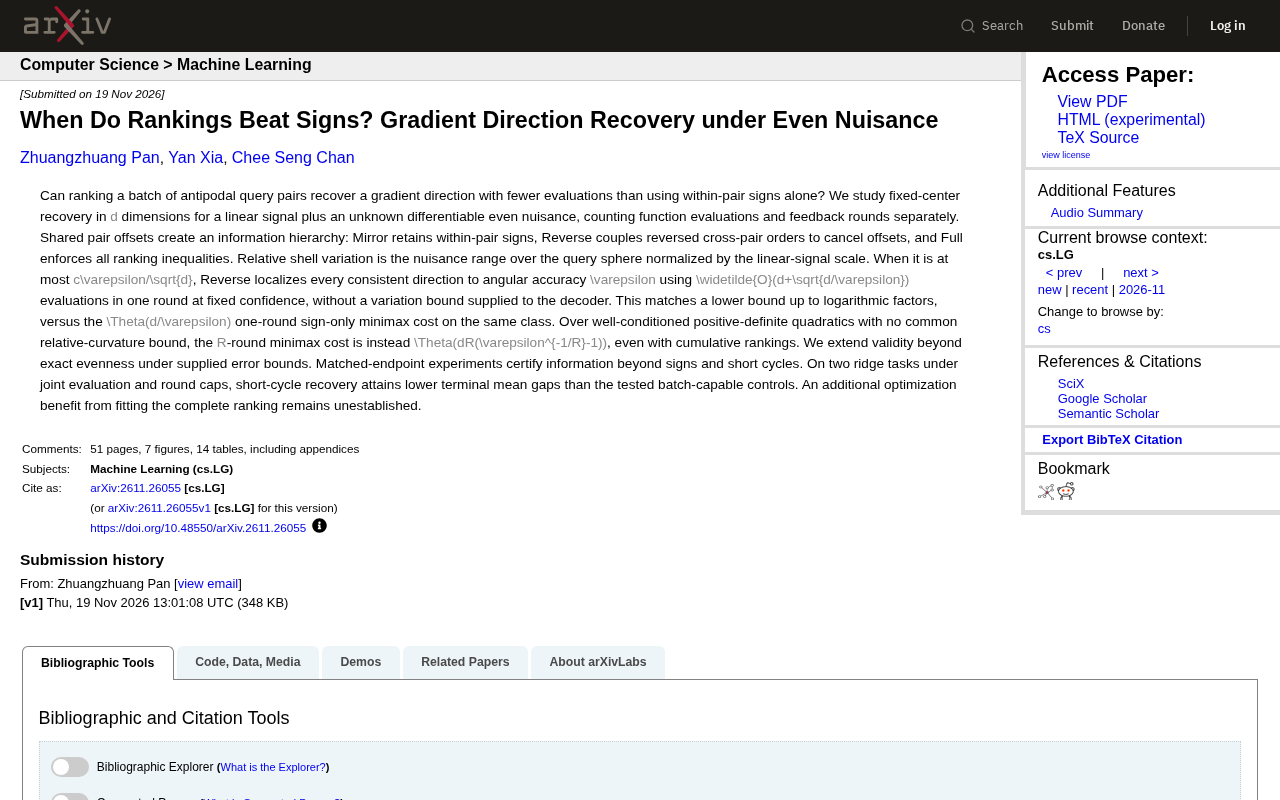
The paper proves that under even-symmetric nuisance, ranking queries recover the gradient direction with fewer evaluations than sign queries.
This paper studies gradient direction recovery: in a d-dimensional space, observations consist of a linear signal plus an unknown differentiable even nuisance. The authors introduce relative shell variation to characterize nuisance strength and analyze the information hierarchy of the Mirror, Reverse, and Full ranking strategies. The core result: when relative shell variation is at most cε/√d, the Reverse strategy achieves angular accuracy ε in one round with Õ(d+√d/ε) evaluations, matching the lower bound and significantly beating the sign-only Θ(d/ε). For well-conditioned positive-definite quadratics without a common curvature bound, the R-round minimax cost is Θ(dR(ε^{-1/R}-1)), so the ranking advantage requires multiple rounds. Ridge regression experiments show short-cycle recovery achieves a lower terminal average gap than batch control methods, though the optimization benefit of full rankings is not yet established.
In gradient estimation, comparing the signs of a pair of antipodal queries is a common practice—but can ranking an entire batch of queries recover the gradient direction with fewer evaluations? A theoretical study, When Do Rankings Beat Signs? Gradient Direction Recovery under Even Nuisance, systematically analyzes this question.
Problem Setup: Linear Signal and Even Nuisance
The paper studies a fixed-center recovery problem: in a d-dimensional space, observations consist of a linear signal plus an unknown differentiable even nuisance. An even nuisance means the nuisance function satisfies f(x)=f(-x), which in practice corresponds to a class of symmetric noise or nonlinearity. Evaluation counts and feedback rounds are counted separately, since their costs differ in distributed or bandwidth-constrained settings.
The authors introduce "relative shell variation" to characterize the strength of the nuisance: it is a normalized measure of the range of the nuisance function on the query sphere relative to the scale of the linear signal. This quantity determines the boundary of the advantage of ranking queries over sign queries.
The minimax framework is the cornerstone for understanding the theoretical guarantees in this paper. In statistical decision theory, minimax means minimizing the estimation risk under the worst-case parameter configuration—that is, taking the supremum over the parameter space and then the infimum over estimators. The "minimax cost" mentioned in the paper refers to the minimum amount of resources any algorithm needs to achieve angular accuracy ε under the worst nuisance function, given a constraint on the number of evaluations or rounds. This framework ensures that the conclusions do not depend on the specific form of the nuisance and are therefore universal. Meanwhile, "consistent direction" means the angle between the recovered direction and the true signal direction is at most ε, and "fixed confidence" typically means a success probability of at least 1-δ (with δ a constant). These terms together define the rigor of the theoretical results.
Information Hierarchy: Mirror, Reverse, and Full
Shared pair offsets create an information hierarchy. The Mirror strategy preserves the signs within pairs; the Reverse strategy couples the reversed cross-pair orderings to cancel the offsets; and the Full strategy enforces all ranking inequalities.
These three strategies correspond to different degrees of information utilization. Intuitively, Full exploits the most ranking information, but the paper's analysis shows that, under a specific nuisance strength, Reverse already suffices to achieve near-optimal evaluation complexity.
Core Theoretical Result: The Evaluation Advantage of Reverse
When the relative shell variation does not exceed cε/√d, Reverse can, in a single round and with fixed confidence, localize every consistent direction to angular accuracy ε, requiring Õ(d+√d/ε) evaluations, and the decoder does not need to know the variation bound in advance. This complexity matches the lower bound up to logarithmic factors.
By contrast, the single-round minimax cost using only within-pair signs is Θ(d/ε) for the same class of problems. In other words, ranking queries yield a significant improvement in evaluation count, especially when d is large or ε is small.
Round Trade-offs in the Quadratic Setting
For well-conditioned positive-definite quadratics, absent a common relative curvature bound, the R-round minimax cost is Θ(dR(ε^{-1/R}-1)), even with cumulative rankings. This indicates that under more complex nuisance structures, the advantage of rankings requires multiple rounds of feedback, and there is a trade-off between the number of rounds and accuracy.
Lower bound in this paper refers to the information-theoretic minimum number of evaluations—that is, the number of queries any algorithm (regardless of computational power) must consume given accuracy ε and confidence. The paper proves that the complexity of the Reverse strategy, Õ(d+√d/ε), matches the lower bound up to logarithmic factors, meaning the strategy is near-optimal in evaluation efficiency. Here the Õ notation hides polylog(d/ε) factors, a common asymptotic notation in theoretical computer science. In contrast, the Θ(d/ε) lower bound for signs alone shows that ranking information indeed brings a substantial reduction in complexity; in particular, when ε is small, the improvement of the √d/ε term over d/ε can be as large as a factor of √d.
Extension Beyond Exact Even Symmetry
The paper also extends the effectiveness beyond exact evenness, still guaranteeing recovery performance when an error bound is provided. This enhances the robustness of the theoretical results and brings them closer to practical situations where the nuisance is not strictly symmetric.
Experimental Validation: Matched Endpoints and Ridge Regression Tasks
Matched-endpoint experiments confirm that ranking queries carry information beyond signs and reveal the existence of short cycles. On two ridge regression tasks, under joint constraints on the total number of evaluations and the number of rounds, short-cycle recovery achieves a lower terminal average gap than the batch-capability control methods tested.
However, the authors also explicitly state that the additional optimization benefit of fitting the full ranking has not yet been established. This means that the advantage of ranking queries currently manifests mainly in the evaluation efficiency of direction recovery, rather than directly translating into improved downstream optimization performance.
Practical Implications and Open Questions
This research provides theoretical guidance for query design in gradient estimation: when the nuisance has even symmetry and small relative variation, ranking queries can substantially reduce the number of function evaluations. But realizing this advantage depends on the nuisance structure—in more complex settings such as quadratics, multiple rounds of feedback are needed.
For applications such as zeroth-order optimization in machine learning, gradient compression in federated learning, and black-box adversarial attacks, this result suggests that when the evaluation budget is limited, carefully designed ranking queries may be more efficient than simple sign comparisons. However, how to translate the gains in direction recovery into end-to-end optimization benefits remains an open question.
Zeroth-order optimization is a class of methods that optimize using only function values (rather than gradients), widely used in black-box adversarial attacks, reinforcement learning, and hyperparameter tuning. Its core is to estimate gradients through finite differences or random direction sampling, and each function evaluation has a cost. The ranking query strategy in this paper falls within the query design of zeroth-order optimization: by comparing the rankings of a pair of antipodal queries rather than just their signs, one can obtain a more accurate direction estimate under the same evaluation budget. Gradient compression in federated learning, meanwhile, focuses on how to reduce the amount of gradient information transmitted when communication bandwidth is limited; the evaluation-efficiency advantage of ranking queries can be likened to "achieving the same accuracy with fewer communication rounds," which is consistent with the paper's approach of separating offline evaluation counts from feedback rounds.
One-line Summary
The paper proves that under even-symmetric nuisance, ranking queries can recover the gradient direction with fewer evaluations than sign queries.
Paragraph Summary
This paper studies gradient direction recovery: in a d-dimensional space, observations consist of a linear signal plus an unknown differentiable even nuisance. The authors introduce relative shell variation to characterize nuisance strength and analyze the information hierarchy of three ranking strategies: Mirror, Reverse, and Full. The core result is that when the relative shell variation does not exceed cε/√d, the Reverse strategy achieves angular accuracy ε in a single round with Õ(d+√d/ε) evaluations, matching the lower bound and significantly outperforming the Θ(d/ε) of signs alone. For well-conditioned positive-definite quadratics without a common curvature bound, the R-round minimax cost is Θ(dR(ε^{-1/R}-1)), and the advantage of rankings requires multiple rounds of feedback. Experiments on ridge regression tasks verify that short-cycle recovery achieves a lower terminal average gap than batch control methods, but the optimization benefit of full rankings has not yet been established.
Related articles

Airplane Seat Upgrades: Width Matters More Than Legroom
Research finds airplane seat width matters more than legroom: one inch of width equals four inches of legroom. Learn how space invasion affects comfort and why we misjudge the source of discomfort.

Three Hidden Settings That Save 20,000 Tokens Every Time Claude Code Starts
A YouTube creator shares three Claude Code configuration tricks—disabling the Artifact tool, trimming built-in skills, and stopping Claude.ai skill sync—saving about 18,000 to 22,000 tokens per startup, with a breakdown of where each saving comes from.
Amazon and Meta in Talks to Unblock AI Agent Muse, a Turning Point in the E-Commerce AI Gateway Battle
Amazon and Meta are negotiating to lift the two-month blockade on AI agent Muse. This analysis examines why e-commerce platforms are wary of AI agents, the potential industry impact of a deal, and the platform access challenges facing AI agent commercialization.