When Does External Guidance Actually Help LLM Reasoning? The Bias-Variance Theory Behind GA-GRPO

GA-GRPO quantifies when external guidance helps LLM reasoning and gives a closed-form optimal weighting rule.
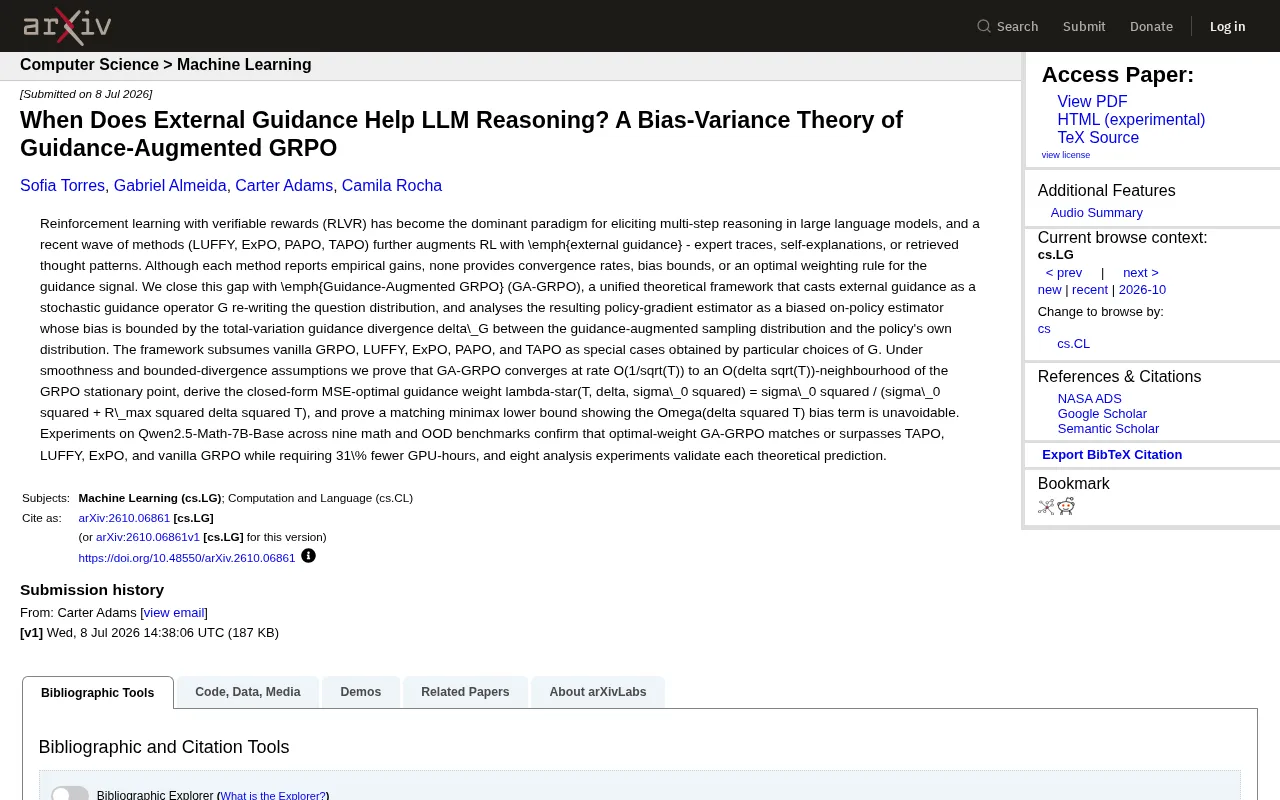
The paper *When Does External Guidance Help LLM Reasoning?* proposes GA-GRPO, a unified framework that models external guidance as a stochastic operator, subsuming LUFFY, ExPO, PAPO, TAPO, and vanilla GRPO. It proves three core results: guidance converges at O(1/√T) but only to a biased neighborhood; a closed-form optimal weight λ* prescribes an annealing schedule favoring guidance early and down-weighting it later; and the Ω(δ²T) bias is unavoidable by a matching minimax lower bound. Tested on Qwen2.5-Math-7B across nine benchmarks, GA-GRPO matches or surpasses all baselines while cutting GPU costs by 31%.
Reinforcement learning-driven multi-step reasoning has become the dominant path to improving large language models, and a wave of recent methods—LUFFY, ExPO, PAPO, TAPO—have taken this further by introducing "external guidance" in the form of expert trajectories, self-explanations, or retrieved reasoning patterns. Each of these methods reports experimental gains, yet none has answered a fundamental question: under what conditions does external guidance actually help? And what is the optimal weight to assign it?
A new paper titled When Does External Guidance Help LLM Reasoning? offers a systematic theoretical answer, proposing a unified framework called Guidance-Augmented GRPO (GA-GRPO)—the first of its kind to provide convergence rates, bias bounds, and optimal weighting rules for this class of methods.
The Core Problem: Guidance Brings Gains, But Also Bias
Reinforcement Learning with Verifiable Rewards (RLVR) has become the leading paradigm for eliciting multi-step reasoning from large models. On top of standard practice, researchers have tried injecting various forms of external knowledge to speed up or improve training. Intuitively, expert trajectories can help the model "take shortcuts," but there's a cost that has long been overlooked: when the guidance signal diverges from the model's own sampling distribution, policy gradient estimates become biased.
Prior methods like LUFFY, ExPO, PAPO, and TAPO all tuned hyperparameters empirically and reported gains, but lacked any quantitative characterization of "how large is the bias" or "when should we trust the guidance." This is precisely the theoretical gap GA-GRPO aims to fill.
Background: What is GRPO? GRPO (Group Relative Policy Optimization) is the current mainstream RLVR training algorithm, proposed by the DeepSeekAd team as a lightweight alternative to PPO. Its core idea is to sample a group of outputs for the same question and use relative rewards within the group—rather than absolute rewards—to estimate the advantage function, thereby eliminating the need for a value network and significantly reducing training cost. Standard GRPO is fully on-policy: the samples used to estimate gradients are drawn entirely from the current policy, ensuring unbiased estimation. When external guidance is introduced, however, some training samples come from expert trajectories or retrieved reasoning chains. Since these samples were not generated by the current policy, importance weights deviate from 1, introducing systematic bias into the policy gradient estimates. This is the inherent tension between "external guidance" and on-policy algorithms.
The Unified Framework: Modeling External Guidance as a Stochastic Operator
The key insight of GA-GRPO is to abstract external guidance as a stochastic guidance operator G that rewrites the distribution over problems. The originally on-policy policy gradient becomes a biased on-policy estimator under guidance.
The paper proves that the magnitude of this bias is controlled by a "guidance divergence" δ_G—the total-variation (TV) divergence between the guidance-augmented sampling distribution and the model's own distribution. The larger the divergence, the farther the guidance is from the model, and the larger the bias.
The elegance of this framework lies in its generality: by choosing different operators G, vanilla GRPO, LUFFY, ExPO, PAPO, and TAPO all become special cases. In other words, these seemingly different methods are, at their core, just different choices of the guidance operator.
Background: Total Variation Distance Total Variation (TV) distance is a classical measure of the difference between two probability distributions, defined as the maximum difference in probability that the two distributions assign to any measurable set—ranging from 0 (identical distributions) to 1 (completely disjoint supports). In reinforcement learning, TV distance is often used to quantify the bias introduced by importance sampling: the larger the TV distance between the sampling distribution and the target distribution, the larger the upper bound on the bias when estimating expectations of the latter using the former. GA-GRPO uses TV distance to define the "guidance divergence" δ_G, directly establishing a quantitative link between "how far the guidance is from the model" and "how large the bias is," making it possible to compare the bias risk of different guidance methods on a common scale.
Three Core Theoretical Results
Under assumptions of smoothness and bounded divergence, the paper establishes three noteworthy results:
Convergence Rate and Bias Neighborhood
GA-GRPO converges at a rate of O(1/√T) to an O(δ√T) neighborhood of the GRPO stationary point. In other words, guidance can accelerate training, but the algorithm ultimately settles within a "bias ball" determined by the divergence—it does not converge exactly to the unbiased objective.
Closed-Form Solution for Optimal Guidance Weight
This is the most practically valuable result. The paper derives the optimal guidance weight that minimizes mean squared error (MSE):
λ*(T, δ, σ₀²) = σ₀² / (σ₀² + R_max² · δ² · T)
This formula reveals a clear dynamic: early in training (small T) when the model's own variance is high (large σ₀²), one should rely more on external guidance; as training progresses and the cumulative effect of guidance bias (δ²T) grows, the guidance weight should be gradually reduced. This provides a theoretical basis for a "guidance annealing" strategy.
The Bias-Variance Tradeoff Unfolded This formula is essentially the bias-variance tradeoff applied to sequential training. The numerator σ₀² represents the variance of the model's own gradient estimates—early in training, the model's outputs are highly stochastic and gradient noise is large, so external guidance acts as a low-variance "anchor" that effectively reduces estimation error. The R_max²·δ²·T term in the denominator represents the accumulated cost of guidance bias over time: each training step accumulates bias in the direction of the guidance signal, and this penalty grows with the number of steps T. When the ratio of these two terms determines the weight, the strategy naturally transitions from "heavy guidance early" to "trust yourself later," forming an adaptive annealing schedule. This is consistent with the intuition behind engineering practices like learning rate scheduling and momentum decay—but here it yields a concrete analytical form, enabling direct computation of the optimal λ at each step without grid search.
A Matching Minimax Lower Bound
The paper also proves a matching minimax lower bound, showing that the Ω(δ²T) bias term is unavoidable. This means that as long as there is any divergence between the guidance distribution and the model's own distribution, a bias cost must be paid—no weighting scheme can eliminate it entirely. This result fundamentally defines the capability boundary of external guidance methods.
Background: Minimax Lower Bounds A minimax lower bound is a standard tool in theoretical computer science and statistics for proving the "performance ceiling of any algorithm." It states that no matter how an algorithm is designed, in the worst case it must incur at least a certain level of error or cost. When the paper proves that the bias term Ω(δ²T) satisfies a minimax lower bound, it means this cost is not caused by a flaw in any particular algorithm design—it is an intrinsic hardness of the problem itself. Even with a theoretically optimal guidance weighting strategy, as long as there is a TV distance δ between the guidance distribution and the policy distribution, the accumulated bias after T training steps will inevitably reach the order of δ²T. The practical implication: if the quality of the guidance source is low (large δ), longer training will actually amplify bias. In such cases, one should decisively reduce the guidance weight or stop using external guidance entirely, rather than continuing to rely on empirical tuning.
Experimental Validation: Matching or Better Performance, 31% Fewer GPU Hours
Beyond theory, the paper validates its approach on Qwen2.5-Math-7B-Base across nine mathematical and out-of-distribution (OOD) benchmarks. Results show that GA-GRPO with optimal weights matches or outperforms TAPO, LUFFY, ExPO, and vanilla GRPO, while requiring 31% fewer GPU hours.
Equally important, eight additional ablation experiments independently verify each theoretical prediction—making this work not just a new method, but a theoretical framework that can be repeatedly tested against experimental evidence.
Why This Work Matters
The current landscape of LLM reasoning training is saturated with empirical tricks that lack theoretical grounding. GA-GRPO's significance lies in several dimensions:
- It brings a scattered collection of guidance-augmented methods under a single mathematical framework, making them directly comparable;
- It provides an actionable formula for dynamically adjusting guidance weight during training, rather than relying on manual hyperparameter search;
- It uses lower bound proofs to clearly delineate the limits of external guidance, preventing researchers from wasting compute on directions that cannot be improved.
For teams designing RLVR training pipelines, this bias-variance perspective offers a principled tool for deciding "when to bring in external knowledge and when to trust the model itself."
Related articles

JobRunner MCP Server: AI Agents Can Now Fix Failed Java Jobs
JobRunner launches an open-source MCP server enabling AI agents to view cluster status, diagnose failures, and recover Java jobs—incident response from any cloud coding environment or existing agent.

MLAI Digital Launches 9 Security Agents: MCP Server Safeguards the Full Lifecycle of Agentic AI
MLAI Digital launches Security MCP Server with nine built-in specialized security agents covering vulnerability discovery, attack simulation, prompt injection detection, API and infrastructure assessment, and accelerated remediation—embedding security validation across the full Agentic AI lifecycle from development to production.

Running Isaac Lab on H100 GPUs: Exploring Better Approaches
Exploring optimization methods for running Isaac Lab on NVIDIA H100 GPUs, including MIG configuration, mixed precision, TensorRT acceleration, and community experience to improve robotics simulation and reinforcement learning efficiency.