When Should AI Assistants Proactively Suggest? Timing Is Everything

Acceptance of AI assistant proactive suggestions depends on timing and context; design must balance automation with user control.
This article explores the timing of AI assistants proactively suggesting actions before users ask. Reddit discussion shows that the same suggestion might be helpful at 9 AM but annoying during a call. The core contradiction is the tension between saving steps and causing interruptions. User acceptance is strongly correlated with task type: more welcome in structured tasks (calendar, email), more resisted in real-time calls, deep work, or sensitive operations. Design requires predictability, undoability, and context awareness, valuing user control. Future assistants may personalize timing by learning user behavior, but must address privacy and transparency. Timing is a continuum requiring continuous calibration.
In an era where AI assistants are increasingly ubiquitous, a seemingly simple yet highly controversial question has surfaced: should assistants proactively suggest actions before the user asks? A question posted by a Reddit user sparked widespread discussion—the same suggestion might be helpful at 9 AM but annoying during a phone call. Different timing leads to vastly different perceptions. Where exactly is the line?
The Double-Edged Nature of Proactive Suggestions
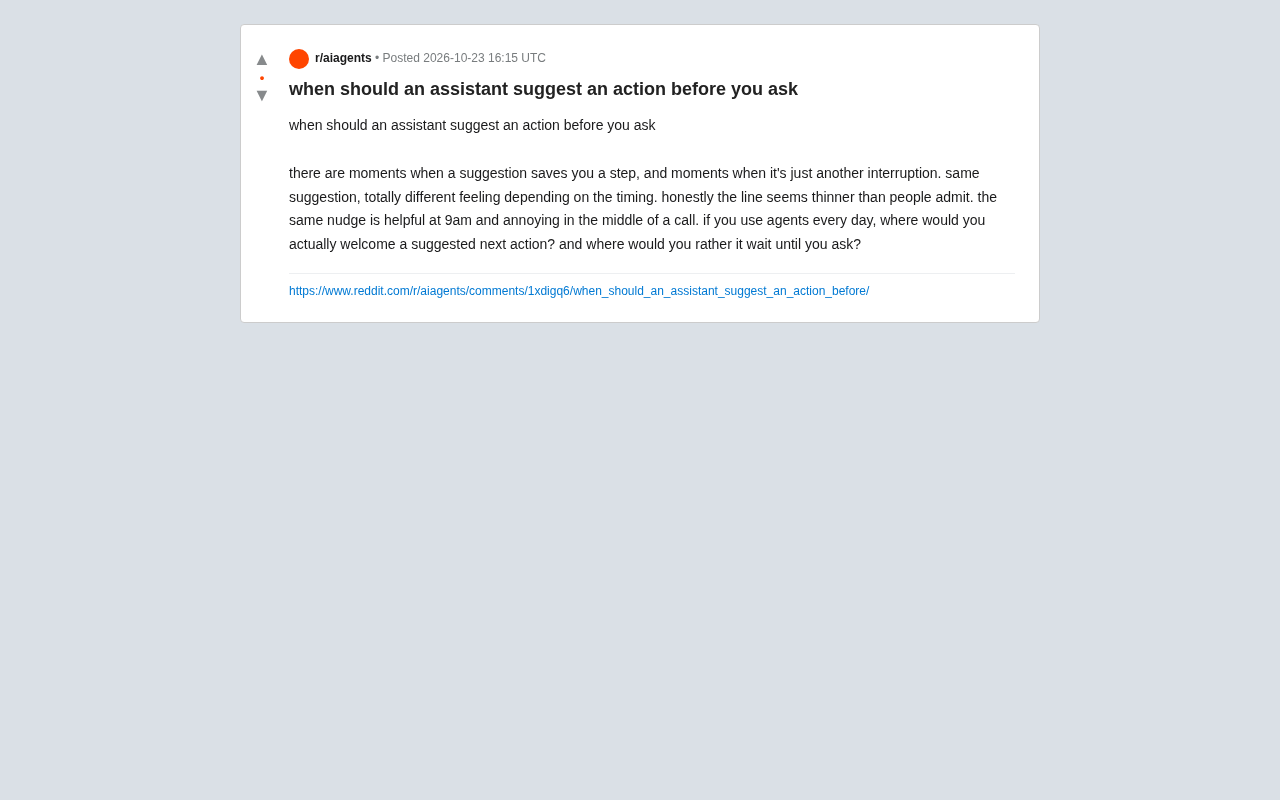
The core contradiction of proactive suggestions is that they can both save steps and become an interruption. The original Reddit post noted that "some moments a suggestion saves you a step, other moments it's just another interruption." This contradiction is not a technical issue but a matter of timing perception in human-computer interaction.
For users who use AI agents daily, the judgment criterion often depends on the state of the current task. When the user is idle or has just completed an action, suggestions may be welcomed; when the user is focused on a complex task or in a social setting, any proactive pop-up may be seen as intrusive.
Timing Awareness in the field of human-computer interaction refers to the system's ability to make real-time judgments about the user's current context, cognitive load, and task stage. It differs from simple timed triggers; it integrates activity type (call, editing, browsing), device state (mobile/desktop), and even physiological signals (such as changes in typing speed) to infer "whether this moment is suitable for intervention." Research shows that interruption cost is closely related to recovery time after task interruption: being interrupted by a pop-up during deep work takes an average of more than 15 minutes to return to the original level of focus. Therefore, proactive suggestion systems need to introduce the concept of an "interruption budget"—setting a daily limit on acceptable unsolicited prompts for each user and prioritizing suggestions at task boundaries (such as just after saving or sending an email) rather than mid-task.
The Boundary of User Expectations
According to the original post discussion, users generally agree that acceptance of proactive suggestions is strongly scenario-dependent. For example, in structured tasks such as calendar management and email processing, the assistant suggesting the next step in advance may feel natural; but during real-time calls, deep work, or sensitive operations, users prefer the assistant to wait for explicit instructions.
A user who frequently uses AI agents mentioned: "If I've just finished writing an email and the assistant prompts 'Would you like me to help you set a follow-up reminder?' I'd find it thoughtful; but if I'm in a meeting and it suddenly suggests I organize documents, I'd immediately turn it off." This difference indicates that timing awareness needs to incorporate contextual cues rather than simple time-based rules.
Key Principles for Designing Proactive Suggestions
For proactive suggestions to be truly useful, designers need to follow several principles. First is predictability: suggestions should appear at moments when users might expect to need them, not pop up randomly. Second is undoability: suggestions must be easy to ignore or dismiss without disrupting the main flow. Finally is context awareness: the assistant should be able to recognize the user's current activity type (e.g., call, editing, browsing) and adjust the frequency of suggestions accordingly.
The question raised in the original post—"Where would you genuinely welcome a suggested next action? Where would you rather it wait until you ask?"—is exactly the core that designers need to answer. There is no unified answer, but through user feedback, a rough boundary can be outlined.
Undoability is a classic principle in interaction design; in the context of proactive suggestions, it specifically means that users can reject or roll back system-initiated actions at extremely low cost. "User control and freedom" in Nielsen's ten usability heuristics emphasizes this point. Specific implementations include: presenting suggestions as non-modal notifications (such as Snackbars), providing "ignore" and "don't show again" options, and not altering the main interface layout; if the suggestion involves automatic execution (such as automatically creating a calendar event), a one-click undo entry must be retained and an operation log recorded. Undoability is critical because proactive suggestions are essentially "system agent decisions," and users need to retain ultimate control to maintain trust. Suggestions lacking an undo mechanism force users to perform additional confirmation at each prompt, actually increasing cognitive load.
Balancing Automation and User Control
The essence of proactive suggestions is the trade-off between automation and user control. Being overly proactive erodes user trust in the assistant, while being too passive makes the assistant seem sluggish. In the Reddit discussion, many users emphasized the importance of a "sense of control": they want the assistant to clearly mark suggestions as "optional" and provide a one-click ignore option.
Additionally, the presentation of suggestions affects acceptance. Non-intrusive prompts (such as a small sidebar icon or status bar text) are more tolerable than pop-ups or voice interruptions. This is especially critical on mobile devices.
Future Direction: From Rules to Learning
Currently, most assistants rely on preset rules to decide whether to proactively suggest, but the future trend is for assistants to learn timing preferences from user behavior. For example, by observing patterns in how users accept or ignore historical suggestions, the assistant can gradually personalize its suggestion strategy. However, this also brings challenges of privacy and transparency—users need to know why the assistant is making a suggestion at a specific moment.
Although the discussion in the original Reddit post was brief, it touched on the core contradiction in AI assistant design. Timing is not a black-and-white choice but a continuum that requires continuous calibration. For developers, listening to user feedback in these subtle scenarios may improve the experience more than pursuing more powerful models.
Behavior-based timing learning typically employs contextual bandit or reinforcement learning frameworks: the system treats each suggestion as an "action," with user acceptance/ignoring/dismissal as reward signals, and combines contextual features (time, activity type, historical interactions) to gradually optimize the strategy. Unlike supervised learning, these methods can balance exploration and exploitation, avoiding premature convergence to local optima. However, personalized timing models face the cold-start problem—new users lack behavioral data and must rely on general rules or group preference priors. Regarding privacy, federated learning allows models to be updated on-device without uploading raw behavioral data, which is a viable path to alleviate privacy concerns. Transparency requires the system to explain "why suggest now" in natural language, for example, "You've just finished meeting notes; would you like me to organize the to-do items?"
One-line Summary
Acceptance of AI assistant proactive suggestions depends on timing and context; design must balance automation with user control.
Paragraph Summary
This article explores the timing of AI assistants proactively suggesting actions before users ask. Reddit discussion shows that the same suggestion might be helpful at 9 AM but annoying during a call. The core contradiction of proactive suggestions is the tension between saving steps and causing interruptions. User acceptance is strongly correlated with task type: more welcome in structured tasks (calendar, email), more resisted in real-time calls, deep work, or sensitive operations. Designing proactive suggestions requires following three principles: predictability, undoability, and context awareness, while valuing user control through non-intrusive prompts and clear optionality. Future assistants may personalize suggestion timing by learning user behavior, but must address privacy and transparency challenges. Timing is not a black-and-white choice but a continuum requiring continuous calibration.
Related articles

A Single Prompt Triggers a Global PHP Security Storm: Is AI a Savior or a Hidden Risk?
A single AI prompt triggered a global PHP security crisis affecting Wikipedia and the Internet Archive. This article reviews the incident, analyzes the OpenAI-Amazon controversy, and explores the security paradox of lowered vulnerability discovery barriers in the AI era and developer response strategies.

When AI Is Taken Away: How Reliance on Shortcuts Undermines Your Problem-Solving Resilience
A study of 1,222 people found that after using AI to answer questions, once AI was removed, people gave up on more problems than a control group that never used AI. The article analyzes the impact of AI reliance on learning resilience and metacognition, and explores design implications for AI learning tools.

Carta and NewView Partner to Let Startup Employees Cash Out Equity Early
Carta and NewView Capital partner to simplify startup tender offers, helping employees sell equity early. Analysis of the mechanism, liquidity pain points, and impact.