When Your Job Becomes a Relay Between Your Boss and Claude

A viral Reddit post captures the anxiety of knowledge workers becoming mere relays between their boss and Claude.
A Reddit post about "forwarding the boss's instructions to Claude and sending the replies back" nailed a collective anxiety among knowledge workers: humans are degrading from executors to relay nodes. The article pushes back, arguing that the apparent "relay" role carries irreplaceable functions — prompt engineering, AI output quality control, and organizational judgment. The takeaway: stop being a passive messenger and become a director who amplifies professional judgment through AI.
The Reddit Post That Hit a Nerve
A post that recently sparked heated discussion on Reddit captured the situation of many knowledge workers with a single self-deprecating line: "Realizing your job is just forwarding your boss's instructions to Claude and sending Claude's replies back to your boss."
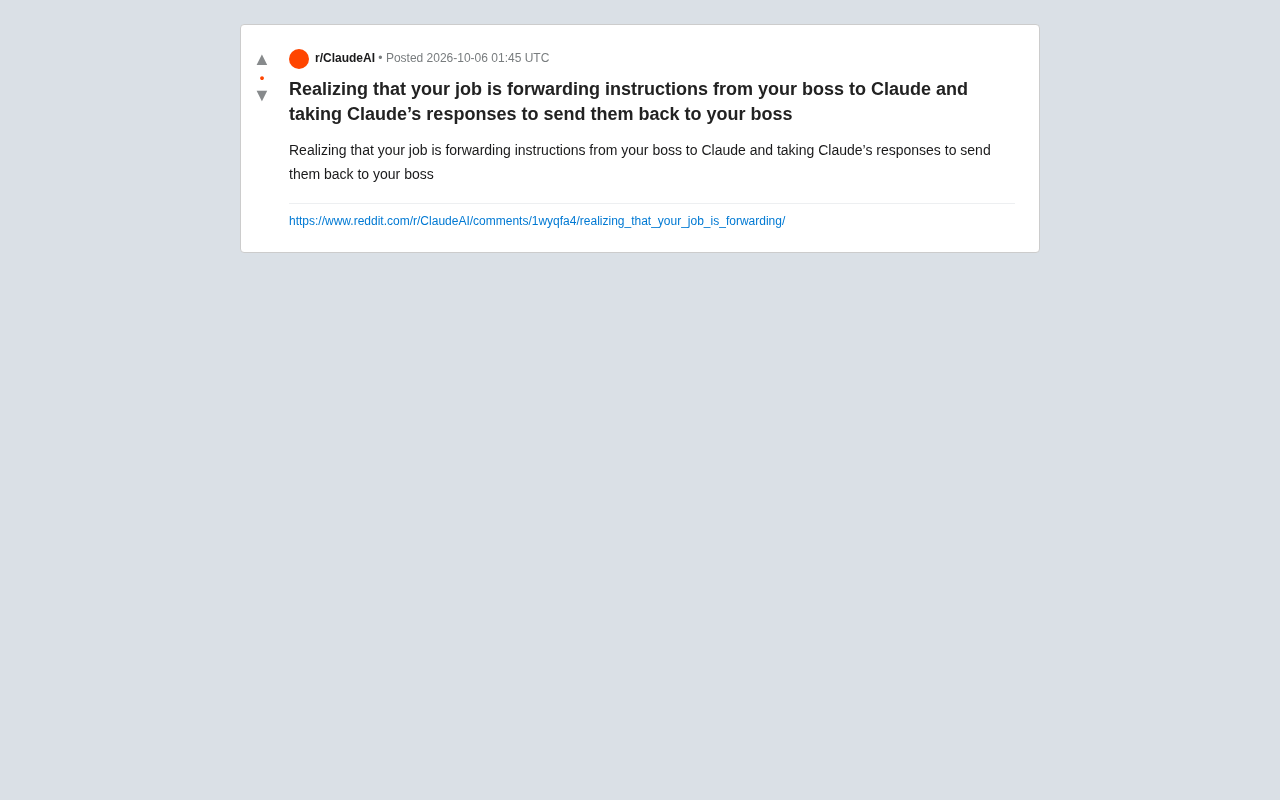
The reason this resonated so widely is that it exposes an awkward but very real scenario that has emerged as AI tools seep into daily work: the human role in the workflow is quietly degrading from "executor" to "relay node." The boss makes a request, the employee feeds it to a large language model, the model generates output, and the employee tidies it up and hands it back. Throughout the entire process, the one doing the actual "work" appears to be the AI — while the human is just copying and pasting between two ends.
The Real Shift Behind the "Human Relay" Phenomenon
This isn't just a joke. It reflects a substantive disruption that generative AI is inflicting on the structure of white-collar work. In the past, writing a report, a block of code, or an email required significant time and professional judgment from a human. Today, many such tasks can be drafted in seconds by tools like Claude or ChatGPT.
When AI can handle the bulk of content generation, the center of gravity for human value is forced to shift. The problem is this: if the core function of a given role happens to be "generating written content," and AI has largely taken over that capability, then what's left for the human is just relaying requests and checking results — exactly the "messenger" role described in that post.
What makes this position so anxiety-inducing is the sharp question it surfaces: If my job can be reduced to forwarding instructions, how much of this step is actually irreplaceable?
Is the Relay Really Worthless?
That said, interpreting this phenomenon purely as "humans being marginalized" is also a distortion. In the human-AI collaboration chain, what looks like a simple "relay" step actually carries several critical functions.
Requirements Translation and Prompt Engineering
A boss's instructions are often vague, conversational, or even self-contradictory. Translating those needs into prompts that an AI can accurately interpret is itself a skill that takes experience and craft. Good prompt engineering can make the difference between output that's excellent and output that's useless — and that's precisely where the intermediary creates value.
Prompt Engineering refers to the skill of guiding large language models toward a desired output by carefully designing the input text. Its core elements include: defining a clear role (telling the model "you are a senior attorney"), providing contextual constraints (word count, format, target audience), breaking complex tasks into sub-steps, and calibrating output style through few-shot examples. Research shows that for the same task, the gap in effectiveness between high- and low-quality prompts can be several-fold. This means that "translating requirements into language AI can understand" is gradually becoming a quantifiable professional skill — some companies have even created dedicated Prompt Engineer positions. For everyday professionals, mastering basic prompting techniques — such as structured layering, specifying explicit exclusions, and asking the model to self-reflect — is the most direct path from being a "messenger" to becoming a "translator."
Quality Control and Accountability
AI hallucinates. It makes factual errors. It generates content that sounds plausible but drifts entirely from what was asked. Having a human review, correct, and polish AI output before passing it to decision-makers is a critical safeguard. AI bears no responsibility for mistakes. Humans do.
Large language model "hallucination" refers to the phenomenon where a model generates information that appears credible but is actually incorrect or fabricated — including false citations, wrong data, and nonexistent regulatory provisions. This flaw stems from how the model works: it is fundamentally predicting "the next most likely token," not retrieving and verifying facts. Leading models have made progress in reducing hallucinations (such as through Retrieval-Augmented Generation, or RAG), but the problem cannot be fully eliminated. This is precisely the technical reason why human review remains indispensable in any workflow — passing AI output directly to decision-makers means exposing the model's error rate as a direct business risk, which in fields like law, medicine, and finance can have serious consequences.
Contextual Awareness and Judgment
AI has no understanding of internal organizational politics, historical context, or unspoken constraints. A skilled intermediary knows what content can be sent as-is, what needs adjustment, and what shouldn't be delivered at all. This kind of judgment is something AI still cannot replicate.
How Should Professionals Respond?
Though framed as a joke, this post serves as a wake-up call for all knowledge workers: when AI can handle the "generation" part of a task, humans need to find their footing in everything beyond generation.
Rather than worrying about being replaced, the better move is to proactively upgrade your role in the collaboration chain — from a passive "copy-paste relay" to a genuine "director" who knows how to command AI. That means decomposing complex requirements, designing high-quality prompts, evaluating and iterating on output, and exercising professional judgment over the final deliverable.
Those who treat AI as nothing more than a typing machine and allow themselves to regress into mere messengers do face the very real risk of being optimized out of the process. But those who use AI as a capability multiplier — letting their professional judgment and communication skills be amplified rather than replaced — will become more scarce and valuable, not less.
A Final Thought
This Reddit-style self-deprecating quip went viral because it articulated a widespread anxiety of the AI era: we're all in the process of reassessing the meaning of our work. But the answer may not be as bleak as it seems — AI replaces repetitive generative labor, not human judgment, responsibility, or creativity.
The real question isn't "Will I become a messenger?" It's "Am I only capable of being a messenger?" The first is a technological trend. The second is a choice you can actively change.
Related articles

Gemini 4 Argon Hands-On: AI Builds Board Games, Constructs Temples, and Trains Robots Autonomously
Gemini 4 Argon hands-on roundup: AI autonomously builds a desk racetrack and temple in Blender, writes a ray tracing engine, trains a humanoid robot to sink 7 shots, plus API pricing and developer access.

The Magic Octagonal Coin: Why Only 9% of People Can Predict Its Flip?
Only 9% of people can correctly predict the Magic Octagon coin flip. This article explains its spatial rotation mechanism, common cognitive pitfalls, and a new hypothesis based on Relevance Theory, exploring the limits of human spatial reasoning.

Sam Altman: AI Is Entering the Era of Scientific Discovery — Math Breakthroughs Will Replicate in Biology and Energy
Sam Altman says AI is entering the era of scientific discovery — math breakthroughs will replicate in biology, materials science, and energy to help develop new drugs and energy sources.