White Circle Post-Training Competition Partners with Hugging Face on Two Tracks
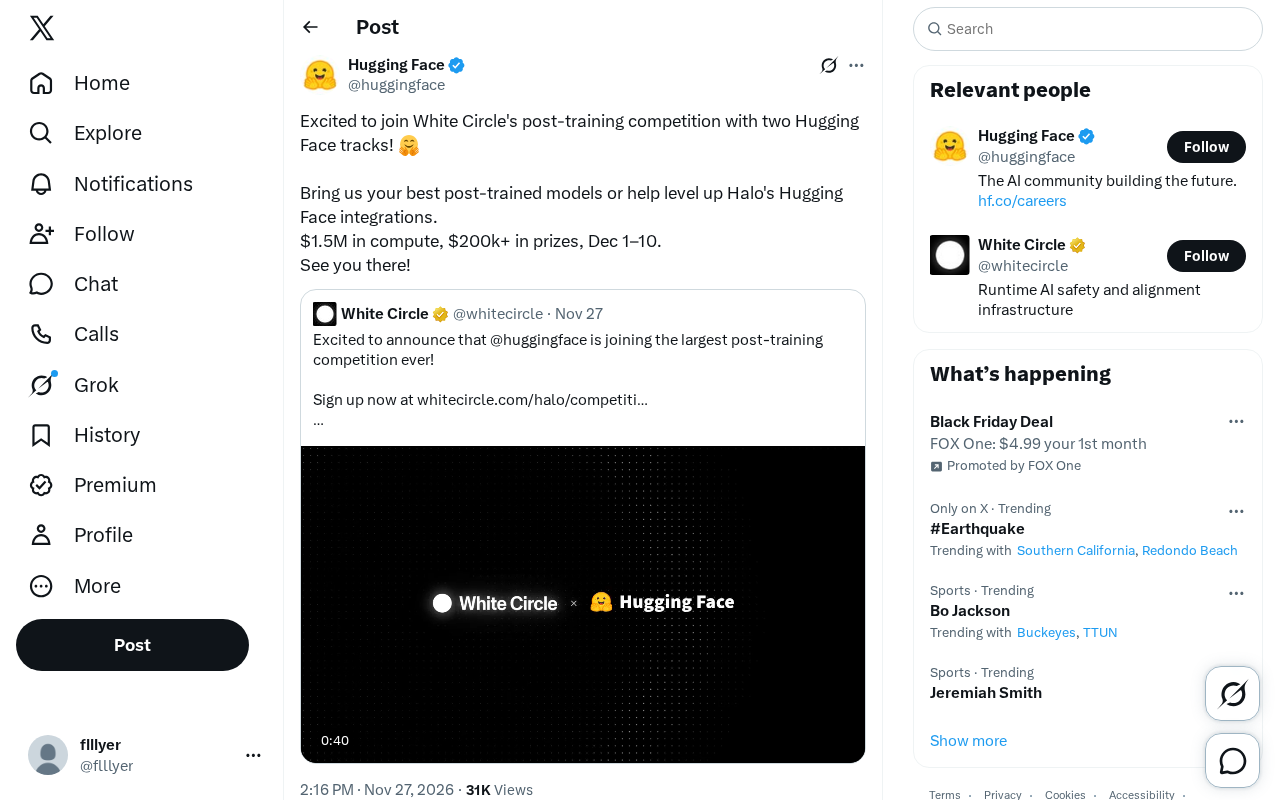
White Circle and Hugging Face launch post-training competition with $1.5M compute and $200K prizes across two tracks.
White Circle announced a post-training competition with Hugging Face, featuring two dedicated tracks and offering $1.5 million in compute resources plus over $200,000 in prizes, running December 1-10. Track one invites developers to submit post-trained models optimized via instruction fine-tuning, preference alignment, or reinforcement learning; track two focuses on engineering, improving Halo's integration with the Hugging Face ecosystem (Transformers, Datasets, Hub API). Compute rewards far exceed cash prizes, reflecting organizers' emphasis on reproducible training outcomes. The article advises model teams to document training scripts and configs thoroughly, and integration participants to first map existing documentation and pain points. Competition details, judging criteria, and submission formats await official announcement.
Competition Overview: Substantial Compute and Prize Pool
White Circle has announced the launch of a post-training competition, partnering with Hugging Face to establish two dedicated tracks. According to its official tweet, the competition offers $1.5 million worth of compute resources and over $200,000 in prizes, scheduled to run from December 1 to 10. This level of investment stands out among recent model optimization events—particularly since compute rewards far outweigh cash prizes, reflecting the organizers' preference for participants who actually run training pipelines end-to-end and produce reproducible model outcomes.
The competition's core goal is clear: solicit high-quality post-trained models while leveraging the community to improve the integration experience between Halo and Hugging Face.
Post-training competitions differ from traditional Kaggle-style evaluations in that what's assessed isn't just prediction results but the training process itself. Such events typically require submissions of model weights, training scripts, hyperparameter configurations, and data source documentation. Judges evaluate both performance metrics and reproducibility—whether others can reproduce results using the same configuration under comparable compute. Using compute credits rather than cash as the primary reward has become a common design in recent open-source model competitions: it converts rewards directly into participants' ability to continue experimenting while filtering for teams with genuine training needs, avoiding paper-only submissions. The ratio of $1.5 million in compute to $200,000 in prizes also signals that organizers value the long-term value of produced models and tooling improvements over one-time leaderboard rankings.
Two Tracks: Model Submission and Integration Optimization
According to the tweet, the two Hugging Face tracks correspond to different ways of participating.
Track One: Submit Your Post-Trained Model
The first track targets model developers, requiring participants to submit models optimized through post-training. Post-training encompasses instruction fine-tuning, preference alignment, reinforcement learning, and other methods—the critical step that determines a base model's practical usability. Organizers encourage participants to "bring your best post-trained model," suggesting that judging may focus on model performance on specific tasks, innovation in training methodology, and the degree of reproducibility.
Post-training refers to a series of optimization processes that a base model undergoes after large-scale pre-training, aimed at transforming a raw "next-token predictor" into a usable model that follows instructions, aligns with human preferences, and performs reliably on specific tasks. Common methods include supervised fine-tuning (SFT, continuing training with high-quality human or synthetic instruction-response pairs), preference alignment (such as RLHF and DPO, using human preference data to adjust output tendencies), and reinforcement learning for reasoning capabilities (such as RLVR, training models to solve problems using verifiable rewards). Post-training is critical because pre-training only endows a model with language and knowledge foundations—actual product experience (instruction adherence, refusal safety, format stability) is almost entirely determined at this stage. It is typically orders of magnitude cheaper than pre-training, making it the segment where the community and smaller teams can most easily differentiate themselves—and the reason this competition uses compute rather than pure cash as its primary incentive.
Track Two: Improve Halo's Hugging Face Integration
The second track leans toward engineering and tooling, with the goal of helping improve how the Halo product interfaces with the Hugging Face ecosystem. For developers familiar with components like Transformers, Datasets, and the Hub API, this is an opportunity to directly influence platform interoperability. Specific improvement directions weren't detailed in the tweet, but can be expected to involve model loading, inference adaptation, dataset flow, and similar areas.
The Hugging Face ecosystem comprises several interconnected components: Transformers provides unified model loading and inference interfaces, Datasets handles streaming reads and preprocessing of datasets, and the Hub API manages repositories, file versioning, model cards, and access permissions. "Integration" typically means third-party tools can complete the full chain of model discovery, download, weight loading, inference adaptation, and data flow through these components. Common pain points include unrecognized model architectures or custom code, failed loading of quantized weights, inconsistent tokenizer configurations, interrupted large-file shard downloads, and automatic adaptation errors caused by missing model card metadata on the Hub. Improving such integrations often doesn't require training resources but demands high familiarity with engineering details and APIs—and the output is more readily reusable by the community.
Participation Advice and Strategy
There's still preparation time before the December 1 start, and interested teams can approach this from several angles. The $1.5 million compute reward scale suggests training resources may be allocated based on project needs rather than distributed evenly, so planning training budgets and experiment design in advance will be advantageous. For the model track, prioritize complete records of training scripts and configurations to facilitate judging reproducibility; for the integration track, we recommend first reviewing Halo's existing Hugging Face integration documentation and known issues to identify high-frequency pain points before starting work.
Running both tracks in parallel offers a hidden advantage: teams working on models can incidentally report integration issues, while integration developers gain deeper understanding of post-trained models' actual needs—creating mutual reinforcement.
Community Signals and What to Watch
White Circle's choice to open dual tracks on Hugging Face continues the common path of open-source community competitions—trading platform traffic and compute subsidies for high-quality models and tooling improvements. Prizes exceeding $200,000 are mid-to-upper tier among similar competitions, and the appeal of compute resources is especially pronounced for independent developers lacking GPU budgets.
The tweet itself contains limited information; competition details, judging criteria, and submission formats await further official announcements. Developers interested in post-training can follow subsequent announcements from White Circle and Hugging Face, form teams early, and lock in compute usage plans.
Related articles

Differentiating the White Hemithorax: Five Causes of Complete Unilateral Thoracic Opacification
How to differentiate complete unilateral thoracic opacification (white lung sign) on chest X-ray? This article systematically reviews the five causes—complete atelectasis, massive pleural effusion, pneumonic consolidation, pneumonectomy, and mixed pattern—using the direction of mediastinal and tracheal shift as the core clue, with imaging features and CT backup for each.

Abdominal X-Ray Differentiation: Key Signs of Small Bowel Obstruction vs. Large Bowel Obstruction
Using two abdominal X-rays, this article explains the key imaging signs of small bowel obstruction vs. large bowel obstruction: air-fluid levels, proximal bowel dilation, and the presence or absence of colonic gas.

What Is the Most Likely Diagnosis for "Punched-Out" Lesions on a Skull X-Ray?
A skull X-ray shows multiple low-density, well-circumscribed radiolucent lesions with a classic "punched-out" appearance. This article explains this hallmark sign of multiple myeloma and how it differs from osteolytic metastases: metastatic lesions are usually fewer in number.