Why AI Coding Tools Haven't Delivered Real Productivity Gains: Redesigning the Software Development Lifecycle

AI coding tools fail to boost productivity because the entire software delivery lifecycle hasn't been redesigned around them.
A controlled study found developers using AI coding tools actually became 20% less productive despite feeling faster. The root cause: coding is only 10-20% of delivery time, so accelerating it alone doesn't help. Real gains require redesigning the entire lifecycle—from AI-powered requirements analysis and spec-driven development to intelligent testing, agent orchestration, and automated deployment.
When developers are urged to embrace AI coding tools and become "AI-native" developers, an unsettling research finding has surfaced: a controlled experiment with open-source developers found that those who believed AI tools made them 20% faster actually experienced a 20% decrease in productivity. This IBM Technology video dives deep into the root causes behind this paradox and presents a key insight — the problem isn't whether AI can write code, but whether we've redesigned the entire software delivery process around AI.
The Overlooked Truth: Developers Spend Most of Their Time Not Writing Code
The traditional software delivery lifecycle consists of five phases: requirements gathering, system design, coding/building/testing, stabilization/release, and operations/maintenance. This process has been running for decades, but it hides an "open secret" — the majority of a developer's time in the lifecycle isn't spent writing code, but waiting.
Developers wait for product teams to clarify requirements. Operations waits for developers to complete releases. QA waits for new builds to test. Every team, every engineer is waiting on each other across a series of fragmented tools and platforms. To make matters worse, QA environments, production environments, staging environments, and development environments are often all different.
According to years of research data from the DORA (DevOps Research and Assessment) team, in a typical enterprise software delivery process, actual coding time usually accounts for only 10-20% of the "Lead Time" from code commit to deployment. The remaining 80-90% is consumed by non-coding activities like waiting for code reviews, environment configuration, approval processes, and test queuing. This is what lean manufacturing calls "waste in the value stream" — the Theory of Constraints tells us that optimizing non-bottleneck steps won't improve overall system throughput. If coding isn't the bottleneck, speeding up coding won't speed up delivery.
When AI only accelerates the coding phase, those efficiency gains are absorbed by all the other stages, having minimal impact on the overall software delivery lifecycle. You might code three times faster, but the surrounding processes haven't changed.

Research Background: The Cognitive Gap Between Perception and Reality
The methodology of this study deserves closer examination. Published by METR (Model Evaluation & Threat Research) in early 2025, it employed a randomized controlled experiment design, recruiting 16 experienced open-source developers to complete 246 real tasks on their own maintained codebases. The key finding was "perception bias" — a significant gap between developers' subjective sense of efficiency improvement and objectively measured results. This cognitive bias is known in psychology as "Automation Bias" — humans tend to overestimate the contribution of automated tools while underestimating hidden costs like context switching, reviewing AI output, and correcting errors. This finding reminds us that relying solely on developers' subjective satisfaction to evaluate AI tool effectiveness is far from sufficient.
Two Extremes: The Traps of Over-Delegation and Under-Delegation
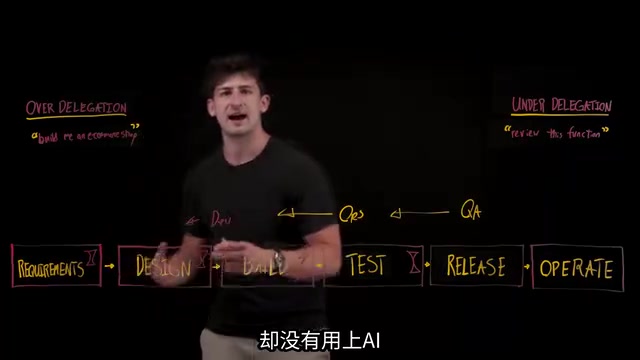
When teams try to use AI in the build phase, they typically fall to one of two ends of a spectrum.
Over-Delegation
One extreme is over-delegation: throwing a large, vague problem directly at a frontier model, like "build me an e-commerce platform." You expect it to autonomously complete the entire software delivery, but the request is full of unspecified decisions — how should payments work? How should authentication be handled? What's the logistics logic? Questions that should have been carefully considered during requirements and design phases are dumped wholesale onto the model, generating thousands of lines of unreviewed code.
This approach is virtually unworkable in production environments because code review becomes extremely slow. During the testing phase, teams spend enormous amounts of time reviewing AI-generated code, going back and forth on decisions the model made, actually slowing down the entire development cycle.
Under-Delegation
The other extreme is under-delegation: senior developers handle all planning and task decomposition themselves, inserting AI only at very specific points, like "write this function" or "check this code for SQL injection vulnerabilities." This does produce high-quality code, but the intellectually intensive heavy lifting remains 100% on humans. Requirements analysis and architecture design phases have no AI involvement whatsoever, limiting overall productivity gains.
The Core Mindset Shift: Redesigning the Entire Development Lifecycle Around AI
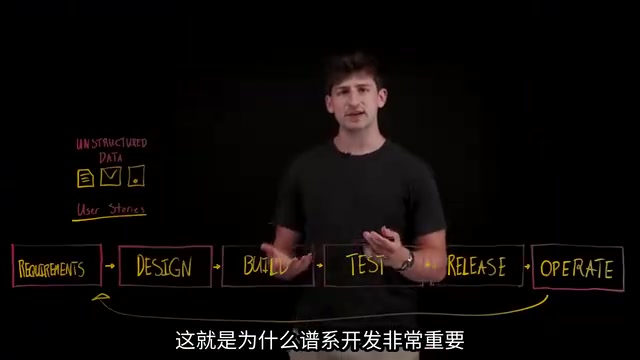
The real breakthrough isn't stuffing AI into existing processes, but redesigning the entire software delivery lifecycle around AI. Rather than pursuing more lines of generated code, focus on other high-impact areas.
AI Empowerment in Requirements and Design Phases
The vast amounts of unstructured data from surveys, user reports, emails, and stakeholder conversations — AI can synthesize and analyze these, identify user behavior bottlenecks and usage patterns, and automatically generate User Stories to drive the next iteration of features. Meanwhile, AI agents can analyze logs and bug reports to pinpoint root causes, and these insights feed back into requirements and design phase decisions — letting teams know what works in production and what fails.
Spec-Driven Development Replaces Vibe Coding
The currently popular Vibe Coding simply doesn't scale. Vibe Coding is a concept coined by Andrej Karpathy in early 2025, referring to developers describing their intent in natural language, letting AI generate code, without deeply reviewing implementation details — judging results by "vibe." If it runs, accept it; if not, ask AI to keep fixing. This approach is highly efficient for prototyping and personal projects, but faces serious challenges in enterprise production environments: lack of traceability, difficulty in code review, hard-to-detect security vulnerabilities, and rapid accumulation of technical debt.
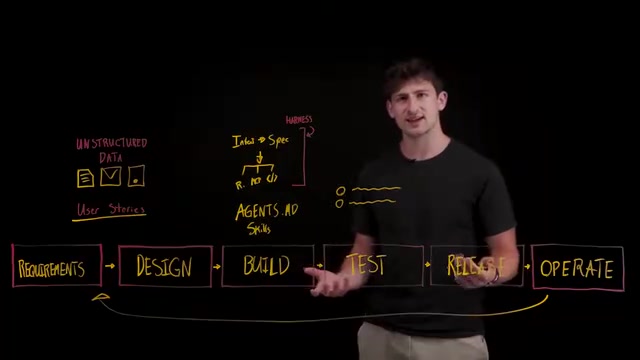
The correct approach is to focus on small, well-defined tasks using "Spec-driven Development." This isn't just breaking work into tasks — it's transforming the intent of software construction into executable specifications. Spec-driven development requires clearly defining interface contracts, behavioral specifications, and acceptance criteria before coding, making AI output verifiable and testable, thus fully leveraging AI's generation speed while maintaining quality.
Agent Orchestration: Multi-Agent Collaborative Architecture
Under the spec-driven development model, an Agent Harness can coordinate multiple sub-agents working collaboratively: one responsible for research on specific topics and dependencies, one pulling information from different data sources the team needs via MCP servers, and one handling actual code editing.
MCP (Model Context Protocol) is a protocol standard open-sourced by Anthropic in late 2024, designed to provide AI models with a unified interface for accessing external data sources and tools — similar to a USB-C standard for the AI world. Regardless of whether the underlying data source is a database, API, or file system, AI agents can access it through a unified protocol. agents.markdown is an emerging organizational AI configuration specification that allows teams to define agent behavioral guidelines, available skills, and context-sharing rules in code repositories, ensuring consistency when different teams use AI.
Additionally, through a Skills mechanism, consistent results are ensured regardless of whether the model runs locally, in a private environment, or in the cloud. This architecture borrows from microservice orchestration thinking, decomposing complex tasks among multiple specialized AI agents, each with specific tool access permissions and context windows, achieving controllable, predictable AI-assisted development.
Intelligent Testing and Deployment
Manual testing is a classic bottleneck. AI can not only generate code but also generate unique test data for unit tests directly from user stories, covering various edge cases and significantly reducing the QA team's burden. Facing the massive log data produced by applications, AI can assist in diagnosing issues — for example, quickly analyzing stack trace errors when systems crash at 3 AM.
In the deployment phase, models are already well-trained on Infrastructure as Code (IaC). IaC is a core pillar of DevOps practice, managing and provisioning computing infrastructure through declarative configuration files rather than manual operations. Writing Ansible scripts to update virtual machines, writing Kubernetes YAML to deploy containerized applications to hybrid clouds — these are entirely feasible within today's AI agent capabilities. AI's advantage in the IaC domain lies in the fact that these configuration languages are highly structured with fixed patterns, training data is abundant, and errors can be caught before deployment through dry-run and policy validation tools (like Open Policy Agent), reducing the risk of AI-generated code going directly into production.
Legacy System Modernization: A High-Value Scenario for AI Coding Tools
One particularly noteworthy use case is legacy software modernization. Those systems that have been running for years, whose original developers left long ago, that nobody truly understands — AI can explain code logic, help reverse-engineer entire systems, and provide you with a path forward. Even if you're unfamiliar with a particular programming language, AI can help you understand the purpose of the code and the function of each method.
The industry context for this scenario is worth pondering: according to multiple reports from Gartner and McKinsey, over 800 billion lines of COBOL code are still running globally, supporting core business systems in banking, insurance, government, and other critical industries. Most original developers of these systems have retired, documentation is severely lacking, creating a so-called "knowledge gap." Traditional legacy system modernization projects have a failure rate as high as 70%, primarily because the original business logic cannot be fully understood. AI's code comprehension capability offers a new breakthrough for this dilemma — large language models can explain code intent across languages, generate documentation, identify business rules, and even assist in gradually migrating COBOL to modern languages like Java or Python, significantly reducing the risk and cost of modernization projects.
A Fundamental Shift in Metrics: From Lines of Code to Delivery Outcomes
The productivity gains AI brings don't come from better models or tools, but from redesigning the software delivery lifecycle around models. The human role shifts from "writing code" to "validation and cross-team collaboration," with the core focus on eliminating friction and coordinating work across the entire lifecycle.
Metrics also need a fundamental shift: stop focusing on how many lines of code were generated, and instead focus on outcomes — How healthy is the system? What's the maintainability and complexity of the code? Is the delivery time for changes and new features shrinking? This aligns closely with the DORA metrics framework: deployment frequency, lead time for changes, change failure rate, and time to restore service — these four key metrics all measure end-to-end delivery capability, not efficiency of a single phase.
The goal of all this is not just to make developers' work easier, but to ensure that all teams collaborating with developers benefit as well.
Key Takeaways
Related articles

The Truth Behind Codex 'Build a Website in 5 Minutes': AI Isn't Creating Sites—It's Helping You Copy Them
Exposing the truth behind viral Codex 5-minute website videos: creators aren't building original sites with AI—they're copying shared prompts or scraping others' work. Learn AI coding tools' real limits.

Getting Started with AI Agent Development: A Complete Guide from Concept to Practice
A comprehensive guide to AI Agent architecture and development, covering automated marketing, intelligent customer service, and investment analysis scenarios with single and multi-agent collaboration.

The Truth Behind Codex 'Build a Website in 5 Minutes': AI Isn't Creating Sites — It's Helping You Copy Them
Exposing the truth behind viral Codex 5-minute website videos: creators aren't building original sites with AI — they're copying shared prompts or scraping others' work.