Why AI Involvement Disclosures Need More Precise Standards: A New Challenge in Open Source Community Governance

Why vague AI disclosures fail open source communities—and three fixes to build real AI transparency.
A Reddit user's suggestion exposes the flaws in current AI involvement disclosures in open source communities. This article analyzes three key improvements—separating posts from projects, quantifying AI usage percentages, and enforcing deletion of perfunctory replies—while examining the practical challenges of building genuinely effective AI transparency mechanisms.
A Reddit Post Sparks Reflection on Community Governance
As AI coding tools and large language models (LLMs) become widespread in open source communities, a new governance dilemma is emerging: when developers submit code or publish content, how should they disclose the degree of AI involvement? A recent suggestion from a Reddit user points directly at the ambiguous areas of current community management mechanisms—the existing "AI involvement" reminder mechanism is too vague, causing replies to become mere formalities that fail to provide the information the community actually needs.
Notably, this tension has a deeper contemporary context. Large language models are ultra-large-scale neural networks trained on the Transformer architecture. Represented by GPT-4, Claude, and Gemini, they can generate high-quality code, documentation, and technical explanations, and have deeply penetrated everyday development workflows. AI coding assistants like GitHub Copilot, Cursor, and Codeium already have millions of monthly active users. The Stack Overflow 2023 Developer Survey showed that over 70% of respondents are using or plan to use AI coding tools. This pace of adoption far exceeds the rate at which community governance mechanisms can iterate, creating a structural contradiction where rules lag behind reality—which is precisely the fundamental reason this post resonated so widely.
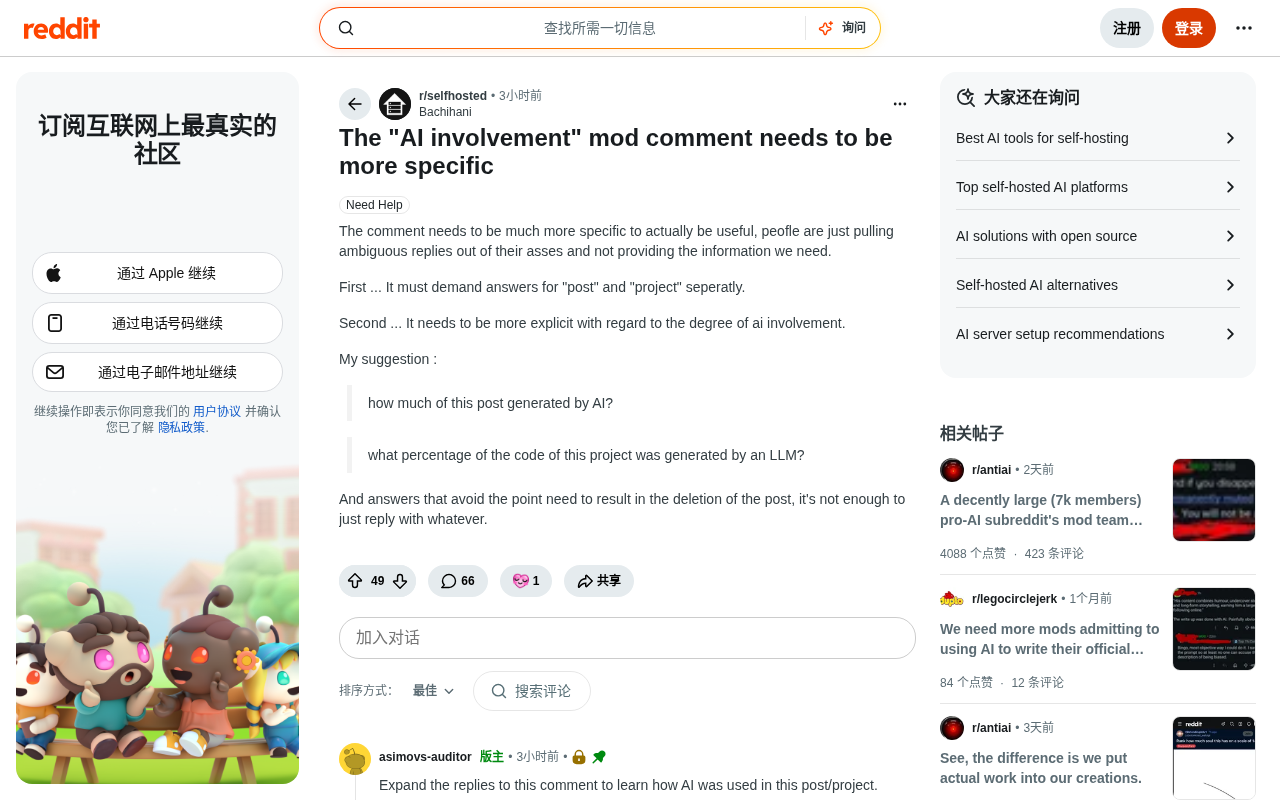
The user's core argument is very direct: many people currently just "casually give vague replies" without actually disclosing the key information. In today's world of increasingly widespread AI-assisted development, this phenomenon is becoming a weak link in the community's trust system.
Vague Disclosures Are Equivalent to No Disclosure
When handling AI-related content, many communities currently only require publishers to make a general confirmation—such as checking a box for "this content used AI" or simply replying "part of the content was AI-generated." This approach appears to solve the transparency problem, but in reality it creates new blind spots.
The poster argues that a vague reply is essentially equivalent to no reply at all. When a developer says "I used a bit of AI," readers have no way to judge what this actually means: Did they use AI to polish documentation? Or was the entire project's core logic generated by an LLM? These two scenarios differ vastly in terms of code quality, maintainability, and accountability.
Open source communities are actually no strangers to "transparency infrastructure"—this issue has historical precedents. From the GNU General Public License (GPL) in the 1980s to later license systems like Apache and MIT, the open source world established a mature set of code ownership disclosure standards. Conflict-of-interest declarations in academia, the ORCID author identification system, and the SBOM (Software Bill of Materials) standard in software supply chain security are all institutionalized answers to the question of "who produced what" in different contexts. AI involvement disclosure is essentially a natural extension of this evolutionary trajectory—only this time, the establishment of community standards lags far behind the spread of the technology.
The Practical Harms of Vague Disclosures
For open source communities, transparency about AI involvement is not only an ethical issue but also a practical engineering issue. "Hallucination" is an inherent flaw of LLMs, referring to models generating factually incorrect or logically contradictory content with high confidence. In code generation scenarios, this may manifest as referencing nonexistent APIs, generating functions that appear reasonable but contain security vulnerabilities, or incorrectly implementing cryptographic algorithms. A 2023 Stanford University study found that about 40% of the code generated by GitHub Copilot contained potential security flaws. If reviewers are unaware of the proportion of AI-sourced code, they may reduce their scrutiny, silently letting such risks into production environments.
Moreover, AI code generation raises copyright and licensing challenges that have not yet been fully resolved. Training data contains large amounts of code under copyleft licenses like the GPL, and LLMs sometimes reproduce these fragments in generated content, potentially introducing license contamination unintentionally. In 2022, GitHub Copilot was accused of generating code fragments highly similar to its training data without users' knowledge, triggering a class-action lawsuit. If project contributors do not proactively disclose high proportions of AI-generated code, project maintainers will be unable to assess potential compliance risks—which could have serious legal consequences in enterprise-level open source projects.
Vague AI involvement disclosures strip the community of its ability to make informed judgments, ultimately undermining the foundation of trust across the entire collaborative ecosystem.
Suggestion One: Distinguish Between "Post" and "Project"
The first concrete suggestion the poster offers is that AI disclosure mechanisms must treat the "post content" and the "project code" separately.
This is a rather insightful distinction. The text of the post itself (which may be AI-written) and the technical project it promotes (whose code may be human-written) are two entirely independent dimensions. The reverse is also true—a human-written post might promote a project that is almost entirely AI-generated.
If the two are conflated, the disclosure loses its guiding significance. Separating them allows readers to evaluate each independently:
- Post text: Was this introduction or explanation generated by AI? This relates to the originality and authenticity of the content.
- Project code: Are the core features human-led or AI-led? This directly relates to technical credibility.
Suggestion Two: Quantify the Degree of AI Involvement
The second suggestion is more actionable: don't stop at the binary choice of "whether AI was used," but clarify "how much was used." This is precisely the most critical gap in current AI transparency standards.
The poster provides two specific quantitative question templates:
- How much of this post's content was generated by AI?
- What percentage of this project's code was generated by an LLM?
This percentage-based disclosure approach transforms vague qualitative descriptions into comparable quantitative metrics. While being precise to a specific number is difficult in reality, even rough range estimates—such as "about 20%" or "over 80%"—carry far more practical reference value than simply saying "I used AI."
The Implementation Challenges of Quantified Disclosure
This suggestion also faces real implementation difficulties. Developers' self-assessments may not be accurate enough, and there may even be incentives to deliberately underreport. Furthermore, the line between "AI-generated" and "AI-assisted modification" is itself blurry—if a developer writes a function and then has Copilot complete and adjust it, should this count as AI-generated or human-written?
On the technical feasibility front, academia and industry have currently proposed several approaches: first, using code provenance tools to trace the historical origin of code fragments; second, using AI-generated content detection models (such as GPTZero and Originality.ai) for probability estimation, though these tools have high misjudgment rates for code; and third, relying on IDE plugins to automatically record the proportion of AI-completed code lines during development—tools like Cursor already possess such raw data. The most pragmatic near-term solution remains publisher self-reported range estimates, paired with clear definitional standards to reduce cognitive burden and improve compliance rates. These boundary issues show that quantification mechanisms need clear supporting definitions and standards; otherwise, the quantified numbers themselves may become a new round of vague statements.
Suggestion Three: Delete Posts from Those Who Give Evasive Replies
The poster's third suggestion is the most forceful: AI involvement disclosures that evade the substantive issues or offer perfunctory responses should result in the post being deleted outright.
He clearly states that "simply replying with something is not enough." This proposal touches the core of community governance enforcement—any disclosure rule without a supporting enforcement mechanism is easily rendered hollow. When perfunctoriness carries no cost, people will naturally choose to be perfunctory.
By making deletion the consequence of non-compliance, the community is effectively raising the "cost" of transparency violations, thereby forcing publishers to take their AI disclosure obligations seriously.
The Double-Edged Sword of Enforcement
However, such forceful measures also require careful weighing. An overly strict deletion policy may unfairly harm sincere but poorly-worded users, and may also burden moderators with subjective judgments—how do you define whether a reply is "perfunctory" or "sincere but imprecise"?
This pressure is especially pronounced at scale. Reddit's content moderation relies heavily on volunteer moderators, with roughly 500,000 active moderators managing millions of subreddits across the platform. Requiring moderators to judge whether an AI involvement disclosure is "perfunctory" essentially transfers complex cognitive labor onto unpaid volunteers, which is nearly unsustainable in large technical communities (such as r/programming, r/MachineLearning, and other subreddits with over a million subscribers). A more scalable direction might be: having the platform layer provide structured AI disclosure forms (forced choices rather than free text), introducing community voting and reporting mechanisms, or emulating Wikipedia's tagging system to distribute preliminary review to ordinary users. This requires clear evaluation standards and fair enforcement; otherwise, it could easily spark new controversies within the community.
A Deeper Lesson: Information Transparency Infrastructure in the AI Era
This suggestion, which appears to be merely about the details of subreddit rules, actually reflects the profound transformation the entire technical community is undergoing. As AI can generate increasingly indistinguishable content and code, "AI involvement disclosure" is evolving from an optional courtesy into infrastructure for maintaining trust within open source communities.
In the future, we may see more platforms establish standardized AI disclosure frameworks, just as academia requires conflict-of-interest declarations and the software world requires labeling open source licenses. This Reddit user's suggestion can be seen as the grassroots, spontaneous sprouting of this trend within the community.
Effective AI involvement disclosure standards require the synergy of three core principles: clear classification (distinguishing post content from project code), quantifiable degree (going beyond binary yes/no judgments), and strong enforcement (with substantive supporting penalty mechanisms). Only when all three come together can AI transparency disclosures move from formalism toward truly valuable trust tools.
Key Takeaways
Related articles

DeepCell: One-Click AI Generation of Documents, Spreadsheets, and Slides
DeepCell tops Product Hunt with one-click generation of documents, spreadsheets, and slides, using the .deepcell format for linked updates, designed for System 2 tasks like modeling and sales reviews.

Doneas: 15-Minute Daily Accountability Calls That Keep Indie Developers From Procrastinating
Doneas is a daily accountability tool for indie developers: plan tasks on Monday, join a 15-minute call with five builders each day, and log deliveries on a public progress page. This article analyzes its core mechanics, effectiveness, and potential issues around retention and matching.

Fastlane 2.0: Fully Automated AI Ad Campaigns, From Creative to Optimization
Fastlane 2.0 is an AI ad automation tool: enter your website and it learns your brand, generates video and image ads, and runs and optimizes them on Meta, TikTok, Instagram, and YouTube.