Why Are AI Bills Still Rising? The Jevons Paradox Behind a 280x Drop in Token Costs

AI per-token prices fell 280x in two years, but enterprise bills rose — the Jevons Paradox and Agent workflows are the core drivers.
The article reveals a counterintuitive phenomenon: the cost of running GPT-3.5-level AI capability fell about 280x in two years, but total enterprise AI spending keeps climbing, with one company's inference bill even tripling. The author uses the Jevons Paradox to explain this — efficiency gains don't reduce total consumption, they expand the set of scenarios worth using a resource for. Agent workflows are the core driver of bill growth, with token consumption reaching 5 to 1000 times that of simple queries. Three conclusions: don't assume price cuts reduce bills; Agent tasks are the key battleground for cost control; inference already accounts for 60%-85% of enterprise AI budgets, and optimizing inference efficiency is the core lever for controlling total cost.
A Number That "Shouldn't" Exist
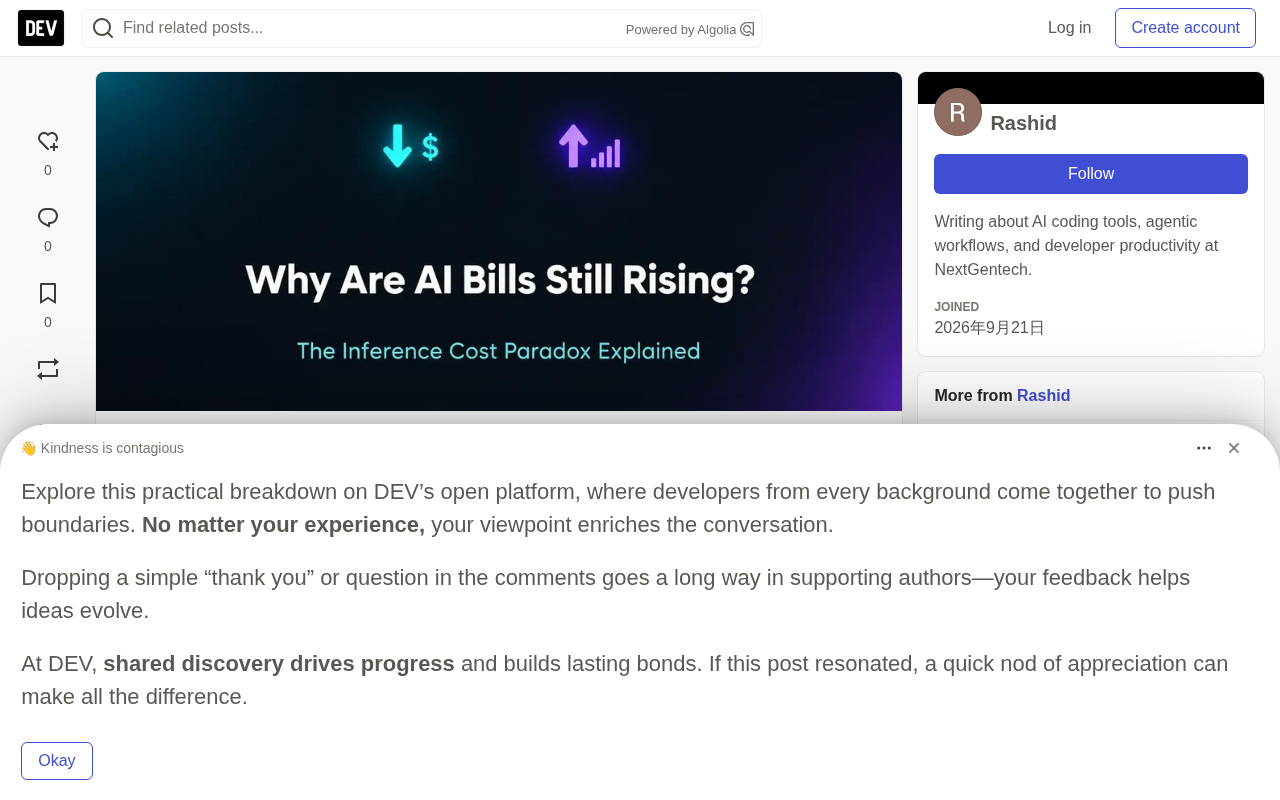
Over the past two years, the cost of running a GPT-3.5-level model has fallen by roughly 280x. According to Stanford HAI's AI Index data, a task that cost $1 in late 2022 now costs less than a cent. By normal logic, enterprise AI spending should have shrunk dramatically along with it.
But reality is the opposite. Gartner's global AI spending forecasts show that total enterprise AI spending continues to climb year over year, now reaching the trillions of dollars. An analysis tracking one company's inference bills found that even though its per-token price fell by nearly the same magnitude, its total bill tripled.
Prices are plunging, bills are soaring. This isn't a contradiction — it's an economic law older than the computer itself at work.
The Jevons Paradox: The More Efficient, the More You Consume
In 1865, economist William Stanley Jevons noticed a counterintuitive phenomenon: steam engine fuel efficiency kept improving, yet Britain's coal consumption rose rather than fell. The reason was that more fuel-efficient engines were installed in more factories, ships, and railways — efficiency didn't shrink demand, it expanded the set of things "worth using this resource for."
AI tokens are replaying this history.
When a task costs $1 in API fees, a huge number of exploratory and marginal use cases simply aren't worth trying. When the same task costs less than a cent, it becomes worth running speculatively, running multiple times to compare outputs, or embedding in a workflow that self-checks its answers. Every price cut unlocks new use cases.
According to a CIO survey, 95% of enterprises say they'll spend more, not less, when token prices fall. This isn't irrational behavior — their reasoning: since the cost per call is lower, they can do more of what they previously couldn't afford.
The full statement of the Jevons Paradox: In 1865, Jevons argued in The Coal Question that technological progress improved the efficiency of coal use, but would not reduce total coal consumption — it would increase it. The reason: efficiency gains lower the resource cost per unit of output, making more uses economically viable — and the total consumption from these new uses often exceeds the savings from efficiency gains.
In economics, this paradox falls under the category of the "Rebound Effect": savings from efficiency gains are partially or fully offset by behavioral changes and scale expansion. The rebound effect is divided into direct rebound (more consumption for the same use) and indirect rebound (saved resources redirected to other uses). In AI, both happen simultaneously: lower per-call costs make developers call more frequently (direct rebound), while unlocking previously infeasible high-token Agent workflows (indirect rebound).
Understanding this framework is critical for technical planning: it means inferring "total cost reduction" from "unit cost reduction" is logically invalid, and there is no inevitable rule in resource economics that "efficiency gains necessarily lead to lower total consumption."
Agent Workflows: The Real Token Black Hole
For developers, the most direct factor driving bills up isn't chat Q&A — it's Agent workflows.
A traditional simple query might only need a few hundred tokens. But when an AI needs to plan steps, call external tools, check its own output, and re-execute when necessary — what's called an "agentic workflow" — its token consumption can reach 5x to 1000x that of a simple query.
This means that even if the unit price drops 280x, as long as Agent usage grows by more than 280x, total spending will keep rising. And judging by current enterprise adoption trends, that growth threshold was breached long ago.
Inference costs now account for 60% to 85% of enterprise AI budgets. That ratio itself tells the story: a large share of costs is concentrated in repeated calls and iterative reasoning, not training.
The Token Amplification Mechanism of Agent Workflows: In traditional single-turn dialogue, the model receives one input and generates one output, with token consumption roughly equal to input length plus output length. Agent workflows introduce multi-turn iteration loops — a typical pattern is the ReAct (Reasoning + Acting) framework: the model first "thinks" about what to do next, then calls a tool (search, code execution, database query), reads the tool's returned result, and then thinks about whether to continue or whether it can now answer.
Each loop resends the complete conversation history (including all previous tool call results) as context to the model, which means token consumption doesn't grow linearly but approximately quadratically — the Nth round needs to retransmit all content from the previous N-1 rounds. An Agent task with 10 tool calls might consume 50 to 200 times the total tokens of a single simple query. If you layer on "self-checking" or "multi-path comparison" mechanisms, consumption can reach the 1000x magnitude. This is why bills can easily double or triple even when unit prices plummet.
Cross-Verification from Multiple Sources: Direction Matters More Than Multiplier
Regarding the specific multiplier for cost decline, different sources give different numbers. Stanford HAI's widely cited figure is 280x over two years (based on GPT-3.5-level capability). Epoch AI's analysis describes roughly a 10x annual decline for equivalent-capability models, which compounds to a similar magnitude over two years. Other media, based on different model comparisons, report drops as high as 600x.
The multiplier difference depends on the model generation and time window chosen, but all sources point to the same conclusion — for AI at a fixed capability level, the cost of running it has become extremely low.
That said, judgments about total spending trends are highly consistent across parties: total enterprise AI spending is still growing rapidly, with no sign of decline. This combination of "plunging unit prices + surging total volume" is the classic manifestation of the Jevons Paradox.
What It Means for Developers
If you're building AI products, this paradox has very practical implications:
Don't assume price cuts will shrink your bill. Falling per-token prices may be completely offset by your own usage growth. When planning budgets, you should model usage growth as an independent variable.
Agent tasks are the key battleground for cost control. A poorly designed Agent workflow can needlessly consume hundreds of times the necessary tokens. Defining clear task boundaries, limiting iteration counts, and setting termination conditions for output checks — these engineering practices directly determine the size of your bill.
Inference costs are already the primary contradiction. When 60% to 85% of AI budgets go to inference, optimizing inference efficiency (not model training) is the core lever for controlling total cost.
When Jevons discovered the coal consumption pattern 160 years ago, he probably never imagined this logic would one day apply to the digital world's "fuel." But economic laws don't stop working just because a resource shifts from physical to virtual — when something becomes cheap enough, people don't save money, they find more ways to spend it.
What the 60%-85% inference cost share means: In traditional machine learning projects, the bulk of costs usually lies in the training phase — requiring large-scale GPU clusters running for days or even weeks. But the large model era has brought a structural reversal: training, though expensive per instance, is a one-time or low-frequency investment; inference is ongoing, high-frequency spending that grows linearly or even super-linearly with user scale. Once a model is deployed as a product feature, every user interaction generates inference costs, and an Agent workflow generates dozens of times that in hidden inference costs in the background. This explains why 60%-85% of enterprise AI budgets flow to inference rather than training — the core of cost control isn't "training a smaller model," but "making every inference call more efficient," including engineering methods like prompt compression, cache reuse, output length limits, and iteration caps.
One-line Summary
AI per-token prices plunged 280x in two years, yet total enterprise bills rose instead of falling — the Jevons Paradox and Agent workflows are the core drivers.
Paragraph Summary
The article reveals a counterintuitive phenomenon: the cost of running GPT-3.5-level AI capability fell about 280x in two years, but total enterprise AI spending keeps climbing, with one company's inference bill even tripling. The author uses the Jevons Paradox to explain this — efficiency gains don't reduce total consumption, they expand the set of scenarios worth using a resource for. Agent workflows are the core driver of bill growth, with token consumption reaching 5 to 1000 times that of simple queries because multi-turn iterations repeatedly retransmit context. The article offers three conclusions: don't assume price cuts reduce bills; Agent tasks are the key battleground for cost control; inference costs already account for 60%-85% of enterprise AI budgets, and optimizing inference efficiency is the core lever for controlling total cost.
Related articles

iPhone Duo Battery Life Tested: One Charge a Day Is Unavoidable, and the Large Screen Is the Culprit
iPhone Duo battery test: heavy use needs at least one charge a day, and about 30% remains after 6.5 hours of screen-on time. How often the large screen is unfolded is key; a MagSafe battery pack helps, and long-term degradation is also worth watching.

Kimi K3.1 Pro Open-Sourced: 2.8 Trillion Parameters Close In on Opus
Moonshot releases the open-source MoE model Kimi K3.1 Pro, with 2.8T total parameters and 104B activated, trailing Opus 5.5 by under 1 point on Terminal Bench 4.0.

Costco Tech Price Guessing: Are Monitors, Keyboards, Mice, and Bose Speakers Worth It?
A YouTube blogger guesses prices of Costco tech products: 2K 180Hz monitor, Logitech keyboard and mouse, Bose speaker, and CyberPower UPS, revealing warehouse-store selection and brand premium.