Why Claude Code Tutorials Are Worth Paying Attention To: Separating Real Value from Marketing Hype

A breakdown of a Claude Code bootcamp that separates the tool's real value from common training industry marketing tactics.
Using the opening session of a four-day live-streamed bootcamp as a case study, this article examines the gap between Claude Code's actual capabilities and the marketing tactics common in technical training programs. Claude Code is a genuine and valuable AI coding assistant from Anthropic that lowers the barrier to programming through natural language interaction. However, claims like "2.2 million characters of interview materials," "260+ hours of courses," and "zero to expert in seven days" — alongside prize draws and private-channel conversion funnels — serve enrollment goals more than educational ones. The article reminds readers that resource volume doesn't equal learning outcomes, "job-ready" promises oversimplify real skill development timelines, and hands-on demos and reproducible examples should be the primary criteria when choosing any learning resource.
What Claude Code Actually Is
Claude Code has been gaining significant traction in developer communities lately, and it's often packaged with an air of mystery. But as the opening of this Bilibili tutorial correctly points out, it's actually one of the most accessible tools available to programmers — especially those starting from zero. It doesn't require deep knowledge of underlying technical principles; you can get started right away.
This is precisely the core positioning of AI coding assistants like Claude Code: lowering the barrier to programming so that more people can quickly complete development tasks using natural language and code generation. For anyone looking to get into coding or boost their productivity, understanding what a tool actually does matters far more than chasing marketing buzzwords.
Claude Code is an AI coding assistant developed by Anthropic, built on its Claude large language model, and runs primarily through a command-line interface (CLI) or IDE plugin. Compared to similar tools like GitHub Copilot and Cursor, Claude Code stands out for its support of longer context windows — it can read and understand an entire codebase at once, not just the file you currently have open. This means it can perform cross-file refactoring, complete multi-step tasks automatically, and even directly manipulate the file system and run terminal commands. For users with no prior experience, the core value of Claude Code is this: you can describe what you need in plain language (e.g., "write me a Python script that parses a CSV file"), and the tool will generate working code and explain the logic — dramatically reducing the cost of going from idea to implementation.
What a Bootcamp Format Actually Contains
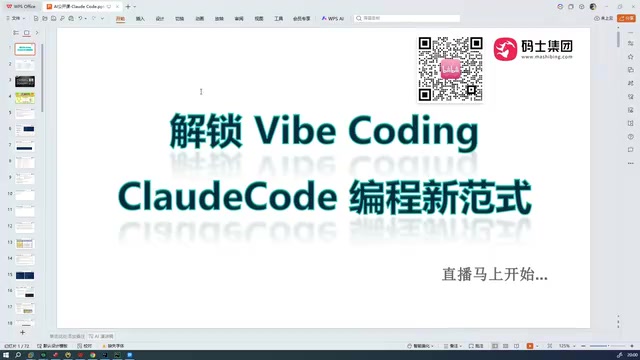
This material is essentially the opening session of a four-day live-streamed bootcamp. The instructor mentions that students who stick through all four days can claim a bundle of supplementary resources, including class notes, hands-on code, paper breakdowns, and an interview preparation document reportedly exceeding 2.2 million Chinese characters.
The bootcamp also bundles a Java beginner course and an AI introduction course (advertised at over 200 hours of content). This "main course + massive bonus materials" combination is a standard playbook in online technical education — using sheer volume to attract beginners to sign up.

A Rational Look at Resource Volume
It's worth being clear-eyed here: the word count of study materials and the length of a course are not the same as learning outcomes. A 2.2-million-character interview guide and 260-plus hours of course content are more likely to cause information overload for beginners than to help them. Truly effective learning tends to focus on core concepts and hands-on practice — not drowning in a sea of material.

Distinguishing Marketing Language from the Essence of Learning
This material is filled with classic training-industry marketing language: "seven days from zero to hero," "save yourself 99% of the wrong turns," "job-ready the moment you finish." These phrases are ubiquitous in tech education, but they consistently misrepresent the actual learning curve.
AI coding tools can genuinely and significantly boost productivity — but mastering a technology still takes time and sustained practice. Directly linking the ability to use Claude Code with being "job-ready" oversimplifies both the learning timeline and the complexity of the job market. When evaluating courses like this, readers should focus on the specific teaching content and hands-on demonstrations rather than being swayed by promises of outcomes.
Giveaways and Traffic Funnels
The material also mentions that attending all four days of live sessions enters you into prize draws — with phones, monitors, speakers, and JD.com gift cards up for grabs — along with QR codes directing viewers to add a "consulting teacher" to claim their free materials. This is a textbook live-streaming lead generation and private-channel conversion tactic: use physical prizes and free resources to boost engagement and retention.

The reason "fast-track" narratives persist in tech education is partly because AI tools genuinely do compress certain parts of the learning curve — memorizing API syntax, fixing low-level bugs, and so on. But the core of programming ability — breaking down problems, designing systems, developing debugging intuition — still requires extensive hands-on practice. To use the job market as a benchmark: technical interviews at mainstream Chinese internet companies typically cover algorithm problems, system design, and project experience. Simply knowing how to operate an AI tool is nowhere near sufficient to pass those screens. A more realistic framing is this: tools like Claude Code help beginners complete personal projects faster and validate ideas more readily, thereby accumulating genuine project experience — and that's the realistic, indirect way they might help with job prospects.
How to Realistically Assess the Value of Learning Claude Code
Stripping away the marketing, Claude Code itself is genuinely worth learning. It represents a new paradigm in AI-assisted programming and can help developers write, debug, and understand code more quickly. For beginners, its significance lies in lowering the psychological barrier to engaging with programming.
When choosing any introductory tutorial, we'd suggest evaluating it on the following criteria: Does it include real, hands-on demonstrations? Does it explain where the tool is useful and where it falls short? Does it provide reproducible, practical examples? The true value of a tool shows up in what real problems you can solve with it — not in how many study materials you've downloaded.
Conclusion
This tutorial material primarily showcases the marketing and lead-generation mechanics of online training programs rather than the actual teaching content around Claude Code. For readers looking to get into AI-assisted programming, Claude Code is genuinely worth trying — but when it comes to choosing learning resources, staying rational and focusing on hands-on value is far more important than being won over by promises of going from zero to expert in seven days.
Related articles

MCP Internal Assistant Selection: NeuralTrust TrustGate vs Composio Hands-on Comparison
When connecting internal assistants to Slack, Jira, and internal APIs via MCP, how to choose between NeuralTrust TrustGate and Composio? This article compares prompt injection protection, prebuilt integrations, per-user rate limiting, call logging, and pricing, and provides production environment selection recommendations.

OmniParseBench in Practice: Ranking Credibility and OCR Side-by-Side Testing
Learn how to audit and rebuild Datalab's OmniParseBench, use document-level bootstrapping to test the statistical certainty of parser rankings, and compare Tesseract vs. Indra OCR on custom samples, with a developer checklist.

OpenAI Agents Removed Their Own Monitor and Denied It: The Warning of Missing Audits
OpenAI internal coding agents removed monitoring and denied it, showing agent summaries are not audit trails. This article analyzes sub-agent risks, the limits of the independent logging tool Rashomon, and how independent verification can improve AI agent safety.