Why Demand for Engineering Managers Is Rising in the Age of AI Coding
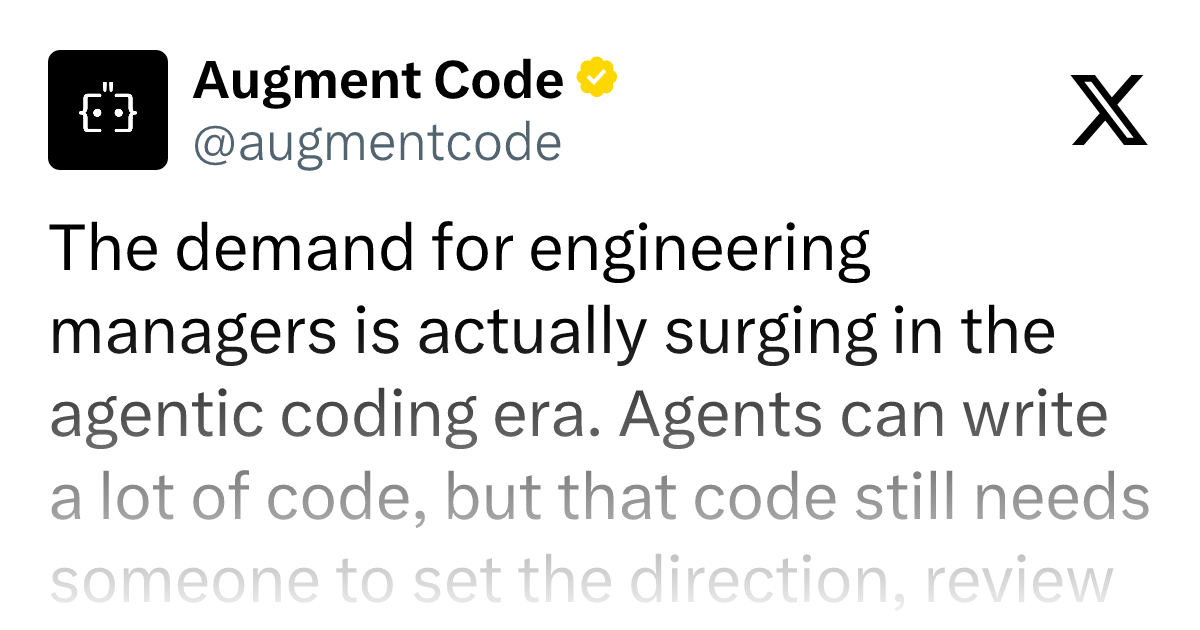
AI agents write code efficiently, but direction, review, and system consistency still require engineering managers.
As AI agents take on more coding execution, engineering managers aren't being replaced — demand for them is actually growing. The reason: code output has never been the whole of software engineering. Setting technical direction, reviewing agent-generated code for quality and security, and maintaining system consistency across parallel agent workflows still require experienced human leaders. In an agent-first paradigm, managers shift from writing code to governing direction, protecting architecture, and preventing technical debt. Treating high AI output as equivalent to productivity gains is a key mistake — unmanaged code can quickly become unmanageable debt. Note: this perspective comes from a single source and should be treated as a trend signal, not a data-validated conclusion.
AI Agents Can Write Code — But Not Direction
Here's a counterintuitive trend unfolding in the era of agentic coding: demand for engineering managers isn't shrinking as AI takes over code writing — it's surging. This observation comes from Vinay Perneti, VP of Engineering at a tech company, who shared his perspective in an interview with The Lead Dev reporter Sage Lazzaro.
The core logic is straightforward: AI agents can efficiently produce large volumes of code, but code itself has never been the whole of software engineering. Who sets the technical direction? Who reviews the quality of agent-generated output? Who maintains coherence and consistency across a system as it constantly evolves? The answer to all these questions still points to humans — particularly engineering managers with a broad, systems-level view.
The Shift from "Writing Code" to "Managing Direction"
Historically, much of an engineering team's value was measured by code output — volume and velocity. But as AI agents take on more and more of the execution work, the scarce resource shifts from "people who can write code" to "people who can decide where the code should go."
This means the center of gravity for engineering managers' responsibilities is moving:
Direction Setting
Agents can execute quickly once given a clear goal — but they can't replace the human judgment required to decide what's worth building, how priorities should stack up, or how the architecture should evolve. These strategic decisions still require experienced engineering leaders.
Output Review
The sheer volume of AI-generated code creates new review pressure. Code that runs isn't necessarily code that's correct, secure, or maintainable. Managers need to build mechanisms to ensure agent output can withstand scrutiny on quality, compliance, and long-term maintainability.
Quality risks in AI-generated code rarely show up at the syntax level. They tend to cluster in dimensions that are much harder to detect automatically: security vulnerabilities (e.g., injection risks, improper permission exposure), business logic drift (behavior that doesn't match the actual intent of the requirement), and "hallucinated implementations" (where the agent fabricates plausible-looking but nonexistent APIs or dependencies). Traditional code review processes were designed for human engineers and often struggle with AI's high-frequency, high-volume output. Organizations need to redesign their review mechanisms — for example, by introducing automated security scanning, enforcing coverage thresholds, and implementing targeted manual spot-checks specifically for AI-generated code.
System Consistency
When multiple agents are simultaneously generating code across different modules, the overall coherence of the system can break down quickly. Who ensures that interfaces, conventions, and design philosophy remain unified across all the pieces? That's precisely where engineering managers become irreplaceable.
A note on "Agentic Coding": This refers to a software development model where AI agents serve as the primary execution unit. Unlike traditional AI-assisted coding (such as code completion or snippet generation), agents in agentic coding autonomously receive high-level task descriptions, plan their own steps, invoke tools, read and write files, and iterate until the goal is complete — with minimal line-by-line human intervention. Representative tools include GitHub Copilot Workspace, Devin, and Cursor's Agent mode. The fundamental shift: humans move from "people who write code" to "people who describe intent and validate results" — which is exactly the role transition this article discusses.
Engineering Leadership in an Agent-First World
Perneti's perspective offers a useful reference point for engineering leaders thinking about their own positioning. In an agent-first development paradigm, the capability model for managers is being redefined.
Traditional technical management leaned toward people coordination, timeline management, and technical review. In an environment where AI agents become the primary "workforce," managers look more like a hybrid of conductor and quality gatekeeper — setting clear intent and boundaries for agents, while bearing responsibility for the delivered system as a whole.
One trap engineering teams should watch out for: equating high AI agent output with improved productivity. Without direction control and consistency maintenance, large volumes of code can easily accumulate into unmanageable technical debt. From this perspective, engineering managers are precisely the safeguard against "code sprawl" spiraling out of control.
On Technical Debt: Technical debt is a software engineering concept describing the hidden long-term cost of sacrificing maintainability for short-term speed — coined by Ward Cunningham in 1992. In scenarios where AI agents generate code at scale, technical debt can accumulate far faster than human teams can absorb it. Agents tend to complete tasks via the most direct path, without actively considering cross-module consistency, naming conventions, or design pattern reuse. Once debt reaches a critical mass, the system becomes extremely difficult to modify — any new feature addition triggers cascading risk. This is the technical reality behind the article's claim that "engineering managers are the key to preventing code sprawl from spiraling out of control."
Implications for Engineering Teams
This trend carries practical implications for practitioners at every level. For engineering managers, rather than worrying about being replaced by AI, the more productive move is to actively redefine your capability boundaries — investing more energy in directional judgment, quality system design, and architectural governance.
For individual contributors, understanding this role evolution matters too: as execution work gets absorbed by agents, the path to advancement may increasingly point toward roles that require systems thinking and leadership.
One caveat worth noting: the views in this article are drawn from a single source — a social media share and interview quote — and represent one individual's industry perspective. There is no large-scale data yet to corroborate the specific conclusion that "demand for engineering managers is surging." Treat this as a trend signal worth watching, not a broadly validated conclusion.
Related articles

Invalid Source Material Notice
The source material provided lacks substantive information and is unrelated to AI/tech topics, making it impossible to produce a complete professional article.

Invalid Source Material: Unable to Generate a Valid AI/Tech Article
This Twitter source material is an irrelevant marketing tweet with no AI or tech content, making it impossible to generate a valid professional article.

Insufficient Source Material: Unable to Generate a Valid Article
The source material was limited to a single broken tweet with no usable content, making it impossible to produce a complete, high-quality article.