Why Did Anthropic's "Mythos" Security Frenzy Fade Into Silence? A Retrospective on Project Glasswing

Anthropic's Mythos vulnerability-hunting hype hasn't aged well, and Project Glasswing raises data-access questions.
Anthropic boldly claimed its Mythos model was "too powerful to release" and launched Project Glasswing to offer closed-source code audits to select enterprises. Six months on, the predicted vulnerability explosion never materialized — disclosed findings were mostly in obscure features, and a few AI-assisted Linux LPE vulnerabilities weren't uniquely Mythos's work. The community raises two concerns: whether the actual security contributions match the hype, and whether Glasswing gave Anthropic a backdoor to scarce closed-source training data. The "too dangerous to release" framework, absent third-party verification, looks more like brand positioning than technical fact.
A Loud Warning, Followed by Silence
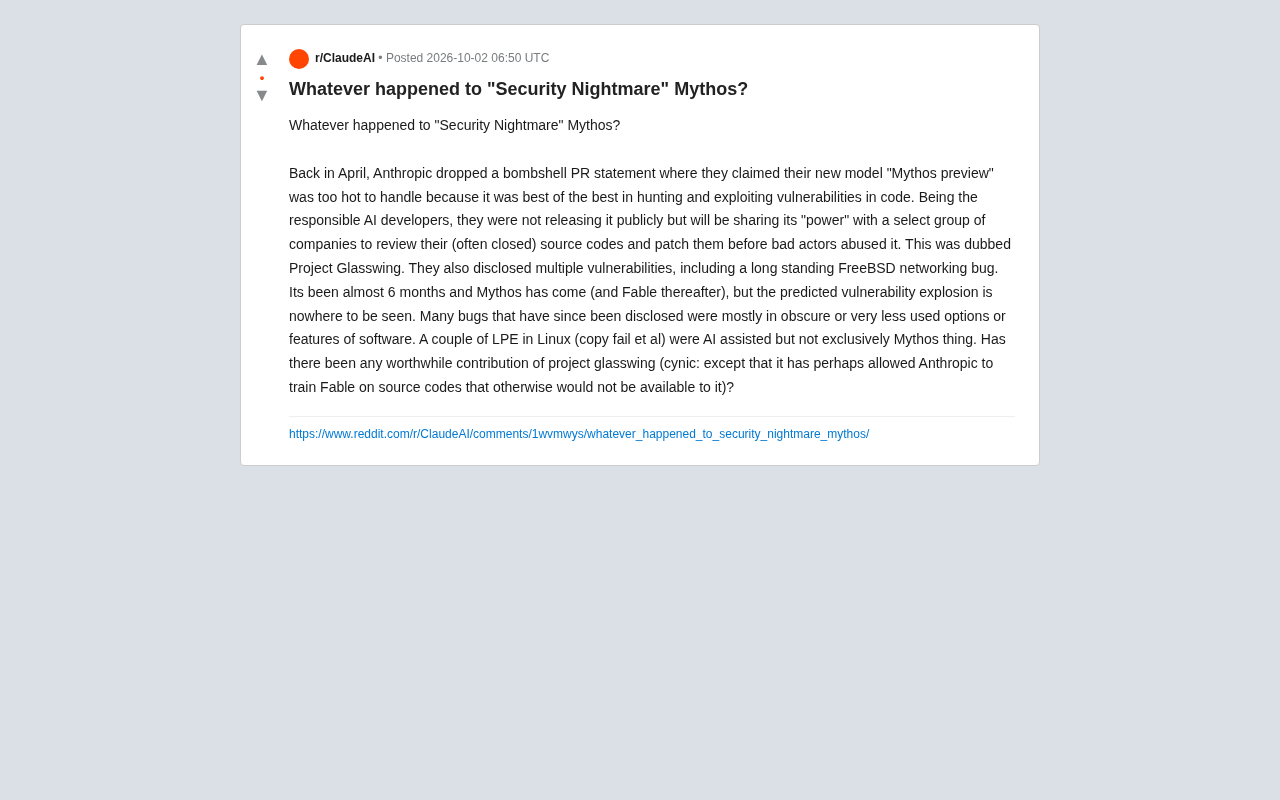
A few months ago, Anthropic dropped a headline-grabbing PR statement: their new model, "Mythos preview," was so powerful at finding and exploiting code vulnerabilities that it was "too hot to release publicly." True to their responsible-AI brand, Anthropic chose not to make this capability publicly available. Instead, they shared its "firepower" with a select group of companies, helping them audit (typically closed-source) codebases and patch vulnerabilities before malicious actors could exploit them. This initiative was named Project Glasswing.
As part of the announcement, Anthropic disclosed several vulnerabilities, including a long-standing flaw in the FreeBSD network stack. The narrative of a model "too powerful to release" sparked widespread debate at the time about whether AI-driven vulnerability discovery would fundamentally reshape the cybersecurity landscape.
The Predicted "Vulnerability Explosion" Never Came
A Reddit user recently raised a pointed question: nearly six months on, Mythos has been released (followed by a successor model called "Fable"), yet the predicted wave of vulnerability disclosures has never materialized.
Based on the poster's observations, the vulnerabilities disclosed during this period were largely concentrated in obscure or rarely-used options and features within software — not in core, widely-deployed components. A handful of Local Privilege Escalation (LPE) vulnerabilities in the Linux kernel — such as so-called "copy fail" issues — did involve some AI-assisted discovery, but these weren't uniquely attributable to Mythos, let alone its signature achievement.
This stands in stark contrast to the original billing of "the most powerful vulnerability hunter." If a model truly had overwhelming vulnerability-discovery capabilities, a six-month real-world window should have produced a far denser and more impactful trail of public disclosures.
Background: Local Privilege Escalation (LPE) refers to a class of vulnerabilities where an attacker who has already gained low-privilege access to a system exploits flaws in the kernel or system components to elevate their permissions to root or administrator level. LPE vulnerabilities have historically appeared at a high rate in the Linux kernel, given its massive, complex, and long-accumulated codebase. Memory copy paths in particular — such as "copy fail" issues involving edge-case error handling in functions like
copy_to_user/copy_from_user— are extremely granular and difficult to audit manually. AI-assisted code review does offer certain advantages in these "high code volume, low semantic complexity" pattern-matching scenarios. However, LPE discovery itself is nothing new; security researchers can produce a steady stream of them using traditional tools like fuzzing and static analysis. To credibly demonstrate "overwhelming" capability, a model would need to show breakthroughs in highly complex logical vulnerabilities or Remote Code Execution (RCE) — not just LPE counts.
The Real Value of Project Glasswing Is Questionable
Perhaps the most thought-provoking aspect of the discussion is a skeptical inference about what Project Glasswing actually delivered for the security community.
The poster floated a cynical reading: the project's greatest "achievement" may have been giving Anthropic access to closed-source codebases it could never have obtained otherwise — and using that code to train the successor model, Fable. In other words, a collaboration framed as "responsibly protecting corporate security" may have simultaneously opened a pipeline for the model provider to acquire high-value training data.
This perspective cuts to a subtle conflict of interest within current AI security narratives: when a single company is both the provider of vulnerability-discovery tooling and the model trainer that benefits from any exclusive data gathered in the process, where exactly is the line between "security collaboration" and "data acquisition"? And when enterprises hand AI systems their closed-source code for review, do they fully appreciate the potential data exposure risk?
Background: The "Data Flywheel" Problem is becoming an increasingly prominent concern at the intersection of AI and cybersecurity. The term refers to a mechanism by which model providers, through offering services to external users, feed high-value inputs — such as proprietary code and internal documents — back into the next generation of model training, thereby building a competitive moat. Closed-source code has historically been among the scarcest resources in training data: while public open-source code is abundant, it cannot capture the unique patterns and security boundaries of enterprise software. If participating companies submit internal codebases to AI review without explicit restrictions, they may inadvertently be contributing extremely valuable private training material to the model provider. This concern is not a specific accusation against Anthropic — it is a structural transparency problem that the entire "AI security services" business model must confront. The industry needs clearer norms around contractual terms and data governance.
From Marketing Narrative to Real-World Test
This episode offers a textbook example of how AI capability claims hold up under scrutiny over time. "The model is too powerful to release publicly" has become a common narrative framework for AI companies in recent years — it generates buzz while simultaneously projecting the image of a responsible developer. But what actually tests such claims is time and verifiable public outcomes.
Based on what we can observe, Mythos's real-world output in vulnerability discovery falls noticeably short of the fanfare that accompanied its debut. This doesn't necessarily mean the capability was fabricated — AI-assisted vulnerability discovery is a genuine and advancing technical direction — but it serves as a reminder to practitioners and observers alike: treat capability claims with a strong marketing flavor skeptically, and use actual disclosures and reproducible cases as your benchmark.
It should be noted that the content above originates from a single Reddit discussion thread, reflecting one community member's personal observations and inferences. The model names, project details, and vulnerability attributions mentioned have not been systematically verified by any authoritative third party. Readers should treat this as a starting point for asking questions, not as settled conclusions.
Background: The "Too Dangerous to Release" Framework in AI has a specific context, typically associated with concepts like capability gating or dual-use risk. Dual-use problems refer to situations where a technology can serve both defensive purposes (e.g., helping companies patch vulnerabilities) and offensive ones (e.g., automating exploit chain generation), making the question of public release a trade-off between benefits and risks. However, this framework is inherently difficult to verify externally — the party claiming "the capability is too dangerous" is simultaneously the one judging how dangerous it is, creating a natural information asymmetry. Academic institutions and security research organizations typically require independent red teaming and public evaluation benchmarks to substantiate such capability claims, rather than relying solely on the vendor's self-assessment. Capability claims that lack third-party verification are, objectively speaking, closer to brand positioning than technical fact.
Questions Worth Continuing to Ask
Around this class of "loudly announced, quietly delivered" AI security projects, several questions deserve ongoing scrutiny:
- Where are the verifiable results? How many publicly disclosed high-severity vulnerabilities can be clearly attributed to this model — as opposed to conventional research or the combined output of multiple AI tools?
- Is the data flow transparent? Was the closed-source code submitted by participating companies used in model training? Do the collaboration agreements contain explicit restrictions on this?
- How much of the capability claim is real, and how much is marketing? To what extent is the "too dangerous to release" framework a genuine technical judgment, versus a brand-building exercise?
In an era where AI capabilities are routinely amplified, calibrating hype against public, reproducible evidence is a discipline every serious technical observer needs to practice.
Related articles

A Single Prompt Triggers a Global PHP Security Storm: Is AI a Savior or a Hidden Risk?
A single AI prompt triggered a global PHP security crisis affecting Wikipedia and the Internet Archive. This article reviews the incident, analyzes the OpenAI-Amazon controversy, and explores the security paradox of lowered vulnerability discovery barriers in the AI era and developer response strategies.

When AI Is Taken Away: How Reliance on Shortcuts Undermines Your Problem-Solving Resilience
A study of 1,222 people found that after using AI to answer questions, once AI was removed, people gave up on more problems than a control group that never used AI. The article analyzes the impact of AI reliance on learning resilience and metacognition, and explores design implications for AI learning tools.

Carta and NewView Partner to Let Startup Employees Cash Out Equity Early
Carta and NewView Capital partner to simplify startup tender offers, helping employees sell equity early. Analysis of the mechanism, liquidity pain points, and impact.