Why Did OpenAI's $3B Windsurf Acquisition Fall Apart? Microsoft's Veto and Google's $2.4B Lightning Grab

Google's $2.4B acqui-hire of Windsurf outmaneuvered OpenAI after a Microsoft IP clause killed the original $3B deal.
OpenAI's planned $3B acquisition of AI coding company Windsurf fell apart because a Microsoft IP-sharing clause would have given Windsurf's technology to GitHub Copilot — Windsurf's direct competitor. Google quickly stepped in with a $2.4B "talent acquisition + technology licensing" deal, poaching the core team while sidestepping antitrust scrutiny. The episode exposes key industry trends: AI competition shifting from models to applications, quasi-acquisitions becoming the new normal, and shrinking survival space for AI startups.
OpenAI had plans to acquire AI coding upstart Windsurf for nearly $3 billion — only to have the deal collapse over a single clause in an agreement with Microsoft. Google then swooped in with a $2.4 billion "quasi-acquisition" to snap up the core team and technology. This dramatic M&A battle reveals how the competitive landscape among AI giants is undergoing a profound shift.
Microsoft's "Golden Handcuffs": How an IP-Sharing Clause Killed the Deal
The deal didn't fall apart over money — it got stuck on a critical agreement between OpenAI and its largest investor, Microsoft.
The OpenAI-Microsoft partnership dates back to 2019, when Microsoft made an initial $1 billion investment, eventually committing over $13 billion in total. In return, Microsoft secured exclusive cloud computing rights for OpenAI's technology (via Azure), profit-sharing rights, and a key intellectual property sharing clause. This deep entanglement is exceptionally rare in the AI industry — it's essentially a "technology-for-capital" strategic alliance. But as OpenAI's valuation soared past $300 billion and it accelerated its transition to a for-profit company, the two parties' interests began to diverge structurally.
Under their long-term partnership agreement, there is an IP-sharing clause stipulating that any technology or IP from companies OpenAI acquires is available for Microsoft to use. Under normal circumstances, this might not be a problem — but with Windsurf, it was a dealbreaker.
Windsurf's core business is AI-assisted coding, and its biggest competitor is none other than Microsoft's own GitHub Copilot. Launched in 2021, GitHub Copilot is an AI coding assistant built on OpenAI's Codex model, with over 1.5 million paying users and a dominant position in the AI-assisted coding market. It's deeply integrated into mainstream development environments like Visual Studio Code, creating a powerful ecosystem moat. Microsoft refused to budge on the IP-sharing clause precisely because AI coding tools are considered a cornerstone of its developer ecosystem strategy — not just a product, but a critical gateway to locking in tens of millions of developers worldwide.
Just imagine: how could the Windsurf team possibly accept having their core technology handed directly to their most powerful competitor? It would be tantamount to self-sabotage.

OpenAI recognized the problem and tried to negotiate an exemption with Microsoft — but Microsoft wouldn't agree. The very partnership that helped OpenAI take off had become a pair of "golden handcuffs." This metaphor is apt: it not only limits OpenAI's ability to expand at the application layer, but also exposes a structural constraint baked into OpenAI's corporate governance from the start. Microsoft wants to maximize its control over the AI ecosystem through contractual terms, while OpenAI increasingly wants to break free and independently develop application-layer businesses. The Windsurf episode brought this structural contradiction into full view.
Google's $2.4B Lightning Grab: The Elegance of the "Quasi-Acquisition" Model
After OpenAI's bid collapsed, Google moved in with remarkable speed — but through an unusual approach. Rather than acquiring Windsurf outright, Google used a "talent acquisition + technology licensing" combination.
Specifically, Google spent approximately $2.4 billion on a multi-year agreement that accomplished two things:
- Poached the core team: Windsurf's founders and key R&D personnel were brought on board at Google
- Secured a technology license: Google obtained a non-exclusive license to use Windsurf's core technology
This "acqui-hire" model isn't new to Silicon Valley, but it's becoming increasingly common in the AI space. In 2024, Microsoft used a similar approach to recruit Inflection AI co-founder Mustafa Suleyman and most of its core team, paying roughly $650 million in technology licensing fees. Amazon has similarly pursued AI capabilities through a $4 billion investment in Anthropic paired with a deep partnership agreement, rather than an outright acquisition. The rise of this model is closely tied to tightening antitrust scrutiny globally — the U.S. FTC and the European Commission have both signaled they will rigorously review large AI-sector acquisitions, making traditional full acquisitions increasingly risky and time-consuming from a regulatory standpoint.
The elegance of this approach lies in several considerations. First, it effectively sidesteps increasingly strict antitrust review — after all, it's not a traditional corporate acquisition in form. Second, in a fiercely competitive AI talent market, this method allows for more precise and rapid acquisition of the most valuable assets: top talent and core technology.
In other words, Google wanted the people and the technology, not the corporate shell. This efficient approach to resource acquisition may signal that future competition among AI giants will become more covert and more focused on the precise capture of core assets.
Why Windsurf Was Worth $3B: The "Vibe Coding" Revolution in AI Programming
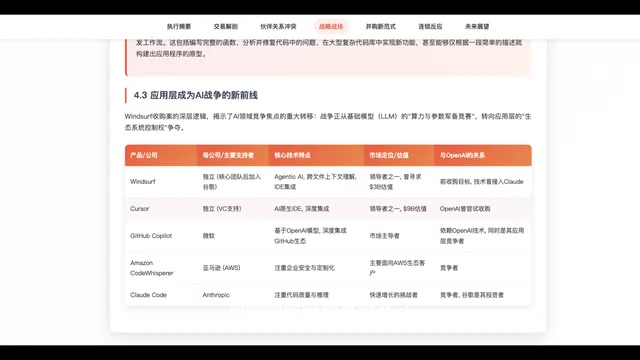
Windsurf (formerly Codium, and before that Exafunction) attracted both OpenAI and Google because of its star status in the AI-assisted coding space.
Its core competitive advantage is Agentic AI capability. Unlike traditional code completion tools, Windsurf's AI can more proactively and intelligently understand complex programming tasks. Agentic AI represents an important evolutionary direction for AI applications: traditional AI coding tools (like early Copilot) primarily offered "reactive" service — the user inputs code, and the AI predicts and completes the next line. Agentic AI, by contrast, has autonomous planning, multi-step reasoning, and environment interaction capabilities. It can understand a complete programming task, autonomously break it into sub-steps, navigate a codebase to find relevant context, write code, run tests, identify errors, and fix them — all with minimal human intervention. This capability relies on the maturity of underlying technologies including large language model reasoning, tool use mechanisms, and long-context memory.
Users simply describe what they need in natural language — like talking to a person — and the AI helps build out an application prototype.

This capability has given rise to a trend known as "Vibe Coding." The concept was introduced in early 2025 by Andrej Karpathy, former Tesla AI director and OpenAI co-founder. He described a new programming paradigm: developers no longer write code line by line, but instead describe their intent in natural language, fully "immersed in the vibe," letting AI handle the concrete code implementation. The developer's role shifts from "code writer" to "intent expresser and quality reviewer." Vibe coding means making the entire programming environment so intelligent that it proactively anticipates the developer's intent and offers assistance, making the coding process feel fluid and natural — as if the entire environment is collaborating with you.
This trend is profoundly reshaping the talent demands and workflows of the software development industry. Some startups report that with vibe coding tools, prototype development that once took weeks can now be completed in hours. But it has also sparked widespread debate about code quality, security, and the potential degradation of developer skills.
With these technical advantages and rapid commercial growth, Windsurf's valuation approached $3 billion before the acquisition, making it the hottest target in the AI coding space.
Winners and Losers: A Game With No Perfect Victor
The outcome of this M&A battle is a mixed bag for all parties involved:
OpenAI: Strategic Setback
A key step in its expansion toward the application layer was disrupted, and more critically, the latent structural tensions with Microsoft were publicly exposed. This may force OpenAI to reconsider the framework of its Microsoft partnership. In fact, OpenAI's recently accelerated push to become a for-profit company is, in part, an effort to gain greater autonomy in future strategic decisions and reduce similar constraints.
Google: Clear Winner
Google significantly strengthened its position in the AI coding space through a clever maneuver, while avoiding a lengthy antitrust review process. Windsurf's core team will inject new technical capabilities into Google's coding tools like Gemini Code Assist, helping Google close the gap with GitHub Copilot.
Microsoft: Short-Term Win, Long-Term Risk
Microsoft successfully blocked OpenAI's acquisition of Windsurf in the short term, protecting GitHub Copilot's competitive position. But in the long run, this move may have created a stronger Google competitor, while also making its relationship with OpenAI more delicate and tense. More notably, if OpenAI accelerates a "de-Microsoft" process as a result, Microsoft's central position in the AI ecosystem could be at risk.
Windsurf: Uncertain Future
The founding team and some investors achieved a liquidity event, but the company lost its core talent and technological leadership, leaving its future as an independent company deeply uncertain. This is the typical impact of the acqui-hire model on the acquired party — the corporate shell remains, but the soul has departed.
Deeper Implications: The AI Industry's Competitive Paradigm Is Shifting
This case clearly reflects several important trends in the AI industry:
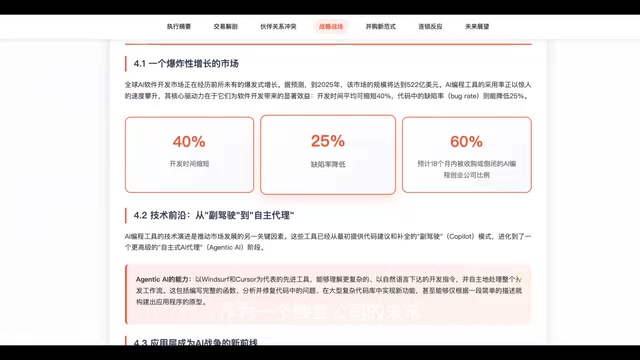
First, the competitive focus is shifting from the model layer to the application layer. The battle among AI giants is no longer limited to who has the most powerful foundation model — it's extending into application-layer control and ecosystem dominance. In 2023–2024, competition was primarily concentrated at the foundation model layer, with OpenAI's GPT series, Google's Gemini, Anthropic's Claude, and Meta's Llama all racing to demonstrate model capabilities. But as foundation model capabilities increasingly converge (a trend the industry calls "model commoditization"), the competitive focus is shifting upward to the application layer. Vertical application scenarios — coding tools, search engines, office collaboration, creative design — are becoming the new battlegrounds, because these scenarios directly connect to end users and commercial revenue. Whoever can build user stickiness and data flywheels at the application layer will hold the initiative in the next phase of AI competition. Coding tools are just a microcosm; similar battles will play out across many more vertical domains.
Second, "quasi-acquisitions" may become the new normal. Faced with increasingly strict antitrust regulation, Google's "talent acquisition + technology licensing" model may be adopted by more giants as a standard playbook for precisely acquiring talent and technology. It's worth noting that regulators have already begun scrutinizing this type of "de facto acquisition" — the U.S. FTC launched an investigation in 2024 into Microsoft's recruitment of Inflection AI talent, and the regulatory battle over this gray area will continue to intensify.
Third, the survival space for AI startups is narrowing further. When core value — top talent and key technology — can be surgically extracted by a competitor, startups find themselves in an increasingly awkward position on the giants' chessboard. How to grow, how to price, and even how to "sell" have all become unprecedentedly complex. For AI entrepreneurs, this means that having excellent technology alone is no longer enough. They also need to build moats in business models, user ecosystems, and data barriers that giants cannot easily replicate through acqui-hires.
The battle over Windsurf may have reached a temporary conclusion, but the deep industry logic it has revealed — the ecosystem power plays among giants, the white-hot competition for talent, and the existential choices facing startups — will continue to shape the direction of the AI industry for a long time to come.
Related articles
 Tech Frontiers
A Rare Quiet Day in AI: Recursive Self-Improvement Stirs Beneath the Surface
A rare quiet day in AI sees multiple sources go silent simultaneously. Behind the calm, Recursive Self-Improvement (RSI) research continues. What this means for the industry.
 Tech Frontiers
Reve 2 vs. Ideogram 4: A Deep Dive into Layout Control in AI Image Generation
A deep comparison of Reve 2 and Ideogram 4's layout control capabilities, covering technical approaches, real-world use cases, and industry trends for designers and creators.
 Tech Frontiers
In the Weights: Check Your Influence Score in the AI World
In the Weights is an AI influence search engine that quantifies your presence in the AI world with a score. Explore how it evaluates practitioners and what it means for digital identity.