Why Do AI-Generated Women All Look the Same? Understanding the Convergence Phenomenon in Image Generation

Exploring why AI image generators produce nearly identical women and what drives this convergence.
A Reddit experiment revealed that ChatGPT generates strikingly similar images of women from the same minimal prompt. This article explains the convergence phenomenon through vector space statistics, prompt expansion mechanisms, diffusion model behavior, and training data bias, while offering practical prompt engineering tips to achieve more diverse outputs.
A Simple Experiment Reveals a Pattern
Recently, a Reddit user shared a remarkably revealing experiment. Out of curiosity, they repeatedly entered the same minimal prompt into ChatGPT — "Generate an image of a woman" — deliberately starting each attempt in a completely independent, context-free new conversation.
The results were striking: across nearly 20 generation attempts, they got highly consistent image patterns. The female figures in these images converged noticeably in facial features, composition style, and color palette.
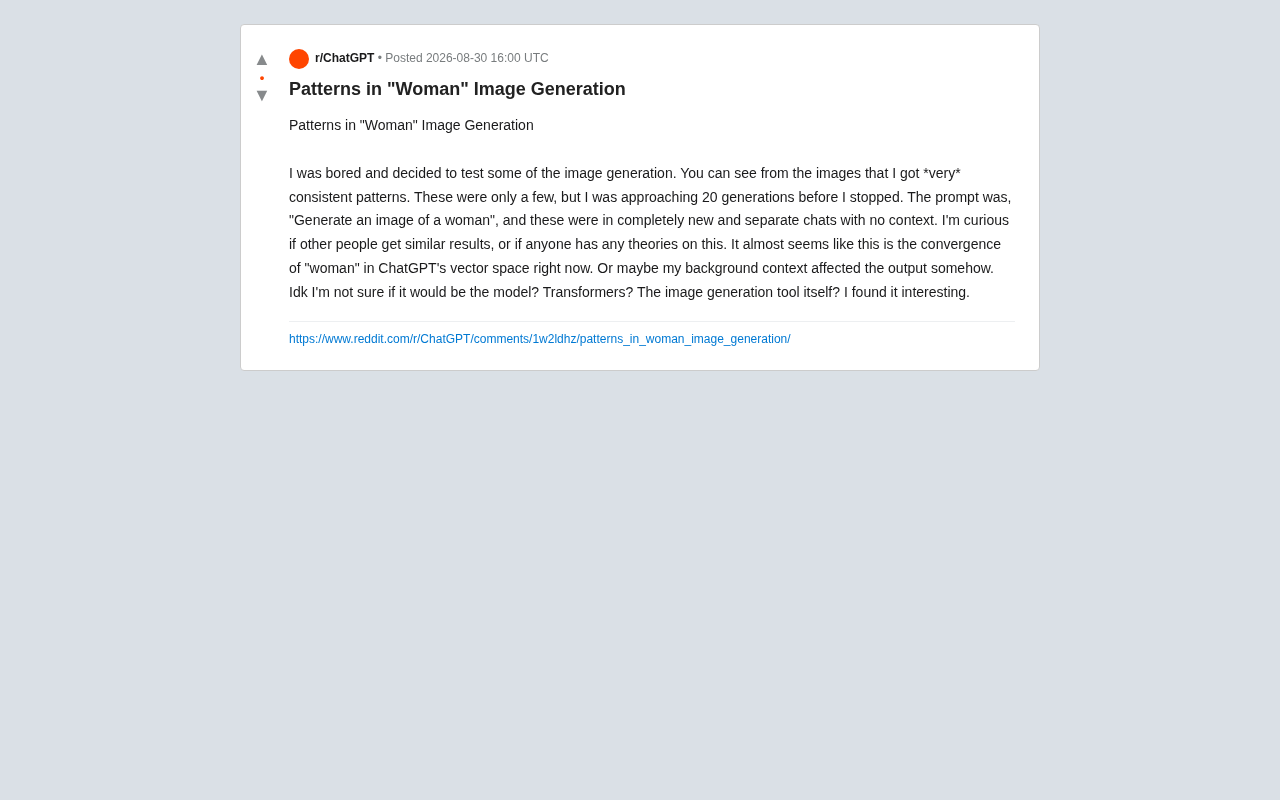
The user then posed a series of thought-provoking questions: Does this mean we're seeing the convergence point of the concept "woman" in ChatGPT's vector space? Does this consistency stem from the model itself, the Transformer architecture, or the image generation tool? They admitted, "Not sure, but I find it fascinating."
Why AI-Generated Images All Look the Same
To understand this phenomenon, we need to start with how generative models work.
The "Statistical Average" in Vector Space
When we feed a model an extremely abstract, unconstrained prompt like "woman," the model receives no specific information about age, ethnicity, profession, or setting. In this "information vacuum," the model tends to output what it considers the most representative, highest-probability result.
This is essentially searching for the "centroid" or "mode" of the concept "woman" in vector space. Vector space is the core mathematical structure through which deep learning models represent concepts — in large language models and multimodal models, every word, phrase, and abstract concept is mapped to a vector in high-dimensional space (typically hundreds to thousands of dimensions). Semantically similar concepts cluster near each other in this space, and the "centroid" is the weighted average position of all training sample vectors within a given concept category. When a user inputs a broad concept without any modifiers, the model is essentially sampling from the nearest high-density region in this high-dimensional space.
In other words, the model doesn't output some random female figure — it outputs the statistical average of the training data distribution. The vaguer the prompt, the more the output collapses toward this high-probability region, and the stronger the consistency becomes.
From Text to Image: Convergence Through Multi-Module Collaboration
It's worth noting that ChatGPT's image generation involves multiple modules working together, and the convergence phenomenon is actually the combined result of several stages. First, the Transformer architecture interprets and expands the user's text prompt — even if the user writes only a few words, the model internally "completes" it into a more detailed image description. This process is known as Prompt Expansion. In other words, even if the user enters just six words, what actually gets fed into the image generation model may be a lengthy text containing detailed scene descriptions, lighting styles, and composition instructions. This expansion process itself is influenced by the language model's training data and alignment strategies, naturally filling in the "most reasonable" default details.
Then, this expanded description is passed to a diffusion model (such as DALL·E 3). Diffusion models work by learning to reverse the process of adding noise to images during training; at inference time, they start from random noise and gradually "sculpt" a clear image under the guidance of text conditions. As a result, the Transformer tends to expand vague prompts into similar detailed descriptions, and the diffusion model naturally produces similar outputs given similar conditional inputs — the compounding effect of these two stages makes the final results highly convergent. This also explains the original poster's confusion: the convergence doesn't come purely from the language model or purely from the image generator, but is a collaborative result of the entire pipeline.
Training Data Determines AI's "Aesthetic"
This convergence phenomenon is fundamentally a direct reflection of training data distribution. If a particular type of female image (e.g., a specific age range, specific physical features, specific aesthetic style) dominates the model's training data, the model will naturally reproduce this type of image with high probability in its "default state."
Large-scale image-text datasets (such as LAION-5B, Common Crawl-derived data, etc.) are primarily collected from publicly available internet resources. Because internet content itself has significant distributional imbalances — English content dominates, Western beauty standards are overrepresented in stock photo sites, and models of certain age ranges and body types are overrepresented in commercial image libraries — these skews are directly transmitted into the training data. Multiple studies have shown that mainstream image generation models, under unconstrained conditions, produce human figures whose distributions of skin color, age, and body type significantly deviate from actual global demographic data.
AI doesn't create aesthetics out of thin air — it simply amplifies and solidifies the visual preferences that human society has left on the internet. This also explains why different users, under context-free conditions, often get strikingly similar results.
Algorithmic Bias Hidden in Default Settings
This seemingly fun little experiment actually touches on a core issue in AI ethics — Algorithmic Bias.
Research on algorithmic bias can be traced back to ProPublica's 2016 investigation of the COMPAS algorithm in the U.S. criminal justice system, and has since rapidly expanded into facial recognition, hiring screening, credit approval, and other domains. In the era of generative AI, the manifestation of bias has shifted from "decision-making discrimination" to "representational bias" — whether a model's default visual or linguistic portrayal of specific groups is fair. Since 2023, multiple academic studies (such as joint research from the University of Washington and MIT) have systematically evaluated bias levels in mainstream text-to-image models, finding significant stereotype reproduction across dimensions of occupation, gender, and race. This has prompted the industry to start incorporating fairness metrics into model evaluation standards.
When the word "woman" defaults to converging on a specific type of image in the model, groups that don't match this "default setting" are invisibly marginalized. Diverse ages, body types, ethnicities, and temperaments are systematically compressed under the mechanism that pursues the "highest-probability output."
This bias isn't intentionally engineered — it's the combined result of data and optimization objectives. It reminds us that AI's output always carries the imprint of the world it learned from. When we rely on these tools to generate content, we're also unconsciously propagating and reinforcing certain established stereotypes. Companies like OpenAI and Google have acknowledged this issue in their technical reports and are attempting to mitigate it through data rebalancing and post-processing strategies, but the current state is still far from ideal.
The Influence of Context and Personalization
Interestingly, the original poster also wondered whether "background context influenced the output." In modern AI products, a user's conversation history, geographic location, account preferences, and other information can sometimes be used to personalize outputs. However, since the author emphasized using "completely independent new conversations," this factor should have minimal impact, and the convergence phenomenon more likely stems from the model's inherent statistical tendencies.
How to Break AI's Convergence Habits with Better Prompts
Once you understand this mechanism, everyday users can obtain more diverse image generation results through more refined prompt engineering:
- Add specific constraints: Explicitly specify dimensions like age, ethnicity, profession, clothing, setting, and lighting to guide the model away from the "high-probability centroid" toward more specific regions of the space. Because of the prompt expansion mechanism, the more details you provide, the less room the model has to "fill in" default settings on its own, making the output more faithful to your intent.
- Introduce diversity keywords: Proactively include words like "diverse," "elderly," "athletic," and similar terms to counteract default biases.
- Adjust randomness parameters: In tools that support it, increase the temperature or change the seed value to increase output variance. Temperature is a key hyperparameter that controls the randomness of model output — lower temperature values make the model favor the highest-probability outputs, producing more deterministic, "conservative" results; higher temperature values give lower-probability options a greater chance of being selected, increasing output diversity and creativity. The seed value is the initial state of the random number generator; in diffusion models, it determines the initial noise pattern, which directly affects the final image's overall composition and details. The same seed under the same conditions will produce identical output, so changing the seed lets you explore different generation results while keeping other conditions constant.
The more specific your prompt, the more the model's creative freedom is constrained by your intent rather than its statistical inertia.
AI Is a Mirror Reflecting Data Bias
This Reddit user's casual experiment revealed a deep-seated trait of generative AI: it's a mirror that reflects the distribution of training data, not the diversity of the real world.
The convergence of "woman" in ChatGPT's vector space is both a technical phenomenon and a social issue. It shows us that when we hand an open-ended task like "generate an image of a woman" to AI, we often don't get infinite possibilities — we get a "standard answer" quietly framed by data and algorithms.
For AI practitioners, how to improve output diversity and reduce systematic bias at the model level remains an urgent challenge. And for every user, maintaining awareness of these "default settings" may be the most important clarity we need when coexisting with AI.
Key Takeaways
Related articles

Why Does the Tesla Roadster Need to Fly? A Deep Dive into Musk's Wild Demo
Tesla's Roadster launch showed wall-climbing, upside-down driving, and flying stunts—but The Vergecast notes the demo car may lack a battery, the Rocket version is invite-only and not street-legal, and the website terms don't guarantee delivery. After nine years of delays, why does this car still need to exist?

AI Is Not a Replacement: Human-AI Collaboration Through the Lens of Factory Root Cause Analysis
Starting from factory root cause analysis, this article explains how AI accelerates evidence chain construction rather than replacing human experts, exploring the pragmatic implementation logic and business value of 'AI supporting people rather than replacing them.'

AI Agent Decision Auditing: Building an Evidence Chain in Regulated Workflows
Starting from a Reddit discussion, this article analyzes three core issues in AI agent decision auditing within regulated workflows: what fields audit records should contain, how to handle feedback latency for erroneous decisions, and how to continuously calibrate LLM judge consistency with human judgment.