Why Do Companies Still Cling to DOS Machines? The Legacy System Trap of Business Dependency

A viral Hacker News thread reveals how many businesses are still held hostage by DOS-era hardware and software.
A Hacker News post asking "who still maintains a DOS machine?" went viral, exposing just how widespread legacy system lock-in really is. The article identifies three core scenarios: business systems built with RAD tools like dBase and Clipper, industrial instruments such as CNC machines and spectrometers controlled by ISA bus expansion cards, and software irreversibly tied to parallel port dongles. The fundamental reason these systems resist retirement is that business value is rigidly coupled to obsolete hardware — original developers are gone, documentation is missing, and downtime costs are prohibitive. Modernization options include DOSBox emulation, FPGA-based interface bridging, and dongle virtualization, each with its own technical and legal limitations. Keeping legacy systems alive is a niche but very real market.
A Question That Went Viral on Hacker News
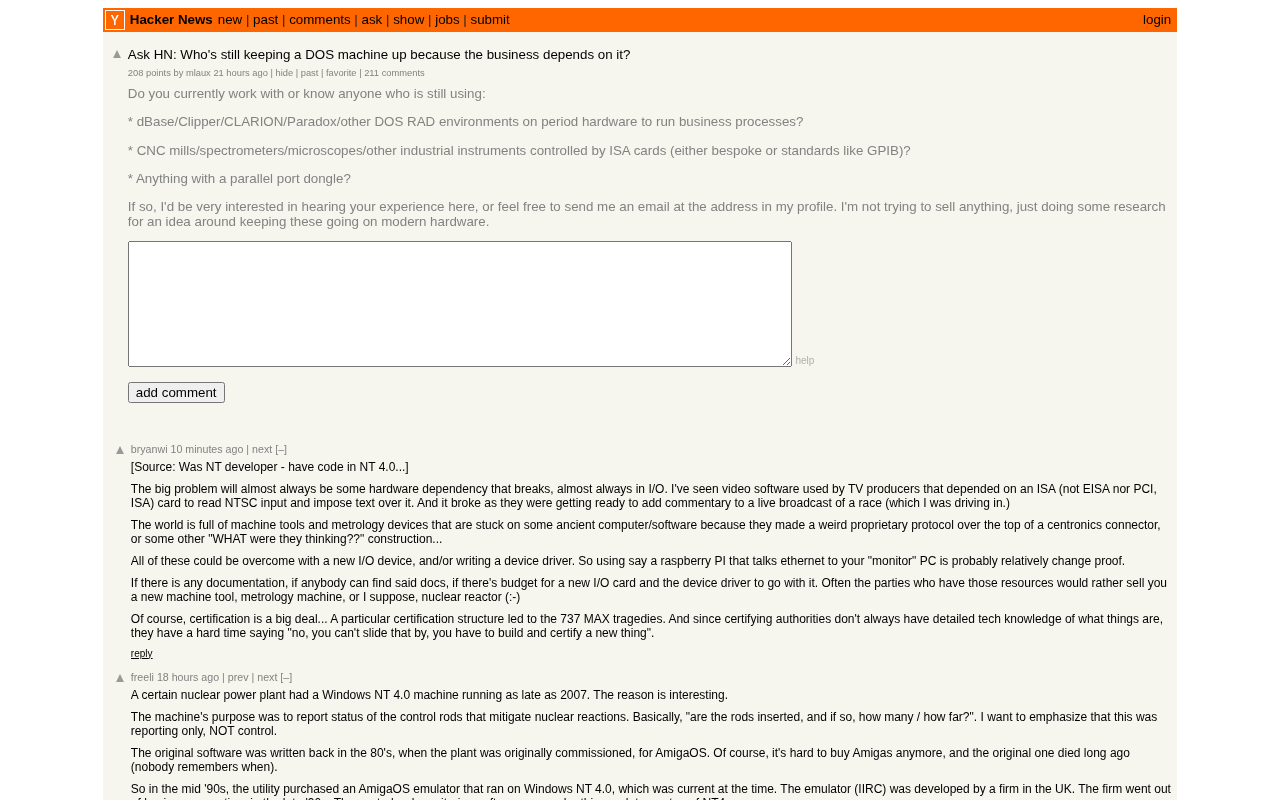
Recently, a seemingly nostalgic post on Hacker News sparked a lively debate (203 upvotes, 207 comments): "Who still maintains a DOS machine because their business can't function without it?"
The poster wasn't waxing nostalgic — they were researching an idea: how to keep these legacy systems running on modern hardware. They outlined three classic scenarios that neatly capture the three biggest "problem zones" in legacy tech assets.
Three Business Scenarios Held Hostage by DOS
RAD Database Environments: Living Fossils of Business Logic
The post first called out a cohort of DOS-era rapid application development (RAD) tools: dBase, Clipper, CLARION, and Paradox. These environments were the go-to platforms for small and medium-sized businesses building internal systems in the 1980s and '90s, and many custom inventory management, accounting, and order-processing applications built with them are still quietly running in factory corners and distributor back offices today.
What makes them so stubborn is this: the systems themselves are highly stable, their business logic has been refined over decades, and rewriting them carries enormous risk with no obvious payoff. For business owners, "if it ain't broke, don't fix it" is the most rational economic choice. And as the original developers retire or pass away, with source code and documentation gone, these systems become black boxes that nobody dares touch.
dBase was the best-selling microcomputer database software of the 1980s, and its derivative .DBF file format became a de facto industry standard. Clipper was a compiled language built on top of dBase that could generate standalone DOS executables; its strong performance made it widely deployed in SME accounting and inventory systems. CLARION was an integrated RAD framework combining a database engine with UI construction tools, while Paradox was known for its powerful query wizards. Applications built with these tools typically compiled the database engine, business logic, and user interface into a single tightly coupled executable — with no clear layered architecture and no standard data export interfaces. For modern developers attempting a migration, the process usually requires reverse-engineering the original business rules before reimplementing them in a modern language, often more work than building a new system from scratch. This is the technical root cause of why "rewriting carries enormous risk."
Industrial Instrument Control: Hardware Locked Down by ISA Slots
The second scenario is even thornier — CNC milling machines, spectrometers, microscopes, and other industrial instruments controlled by ISA expansion cards, whether vendor-proprietary cards or standard interfaces like GPIB.
The core tension here is this: a CNC machine or precision instrument may have a physical lifespan of 20 to 30 years, while the control computers and interface buses that go with them cycle out far faster. When ISA slots disappeared from motherboards long ago, companies are left with an awkward reality: the instrument still has decades of usable life, but no modern computer can accommodate the card that drives it. Replacing the entire setup can cost hundreds of thousands of dollars — far more than maintaining an aging PC.
The ISA (Industry Standard Architecture) bus was introduced with the IBM PC in 1981 and was the primary expansion interface for sound cards, network cards, and industrial data acquisition cards throughout the PC era. GPIB (General Purpose Interface Bus, IEEE-488 standard) was a bus protocol designed by HP in 1965 specifically for instrument interconnection, widely used for automated control of oscilloscopes, spectrum analyzers, signal generators, and other lab and industrial equipment. ISA was fully replaced by PCI as ATX motherboard specifications evolved in the early 2000s, with mainstream motherboards dropping ISA slots around 2005. Yet many scientific instruments and CNC machines that rely on ISA acquisition cards or GPIB controller cards were purchased in the 1990s — their physical performance remains intact and their precision still meets spec. The vast gap between residual equipment value and replacement cost leads companies to stockpile spare parts for aging PCs rather than replace entire instrument setups. This "bus lock-in" phenomenon is especially concentrated in semiconductor testing, chemical analysis, and precision manufacturing.
Parallel Port Dongles: The Historical Baggage of Software Licensing
The third scenario involves hardware security dongles plugged into parallel ports — an early software copy-protection scheme. Modern motherboards dropped the parallel port long ago, yet the software that depends on these dongles may still be irreplaceable in a company's production workflow. If a dongle fails and the vendor has gone out of business, the entire software package may be permanently dead.
Why Legacy Systems Are So Hard to Leave Behind
All three scenarios share the same underlying logic: business value and technical infrastructure are rigidly coupled together.
Companies don't fail to upgrade out of ignorance or laziness — it's because the cost and risk of migration far outweigh the cost of maintaining the status quo. What makes this form of technical debt particularly insidious is:
- Dependence on vanished hardware form factors: ISA buses, parallel ports, and specific BIOS implementations have all exited the mainstream market;
- Knowledge lost with the people: original developers are gone, source code and documentation are incomplete, and reverse-engineering is prohibitively expensive;
- High cost of downtime: many of these systems are directly connected to production lines, where any trial-and-error can mean costly stoppages.
So a dust-covered DOS machine becomes the most fragile and most critical link in the entire business chain. When it fails, there are no spare parts to find and no one who knows how to fix it — operations can grind to a halt in an instant.
Paths Toward Modernization
The poster's interest in "keeping these systems running on modern hardware" points toward several technical approaches already being explored in the real world:
Virtualization and emulation: Tools like DOSBox, 86Box, and PCem — or running a full DOS environment inside a virtual machine — can free old software from its original hardware. The challenge is that industrial control scenarios with demanding hardware I/O and real-time requirements are often difficult to emulate with sufficient timing precision.
Interface bridging: USB-to-GPIB adapters, PCIe-to-ISA bridge cards, or FPGA reimplementations of legacy interface protocols can connect old instruments to new computers. These solutions can extend instrument lifespans, but require deep hardware engineering expertise.
Dongle virtualization: Analyzing the parallel port dongle protocol and emulating it in software carries both legal and technical risks.
It's worth noting that this discussion itself signals a market opportunity: "life support" services for legacy systems may represent a niche business that mainstream tech largely ignores, yet genuinely exists. The long service lives of industrial equipment mean this demand is not going away anytime soon.
FPGAs (Field-Programmable Gate Arrays) are playing an increasingly important role in legacy interface recreation. Unlike fixed-function bridge chips, FPGAs can precisely replicate the timing characteristics of the ISA bus at the logic level using hardware description languages (such as VHDL or Verilog) — including read/write wait cycles accurate to the nanosecond — which is critical for industrial control applications with strict real-time requirements. Vendors have already released PCIe-to-ISA adapter cards based on FPGAs, enabling legacy ISA industrial cards to run in modern server motherboards. Compared to pure software emulation, FPGA solutions offer timing fidelity much closer to original hardware behavior, though the development barrier is higher and requires engineers with digital circuit design expertise for customized integration.
Final Thoughts
The fact that this Hacker News thread attracted hundreds of responses speaks to just how widespread the legacy system dilemma truly is. In an era of chasing AI, cloud-native architectures, and the latest tech trends, enormous amounts of real business still run on code and hardware from decades ago.
These systems remind us: the value of technology lies not in how new it is, but in whether it continues to deliver business value. How to gracefully keep these "living fossils" running — or help them transition smoothly to modern platforms — is an engineering challenge that is vastly underestimated, yet profoundly relevant to the real world.
Related articles

OpenAI Partners with Shield: How the Astra Agent Revolutionizes IT Troubleshooting
OpenAI and Shield launch the Astra agent, which autonomously logs into computers and legacy systems to fix IT issues in real time, 35-40% faster than traditional models, with humans involved only when judgment is needed.

iPhone Duo Battery Life Tested: One Charge a Day Is Unavoidable, and the Large Screen Is the Culprit
iPhone Duo battery test: heavy use needs at least one charge a day, and about 30% remains after 6.5 hours of screen-on time. How often the large screen is unfolded is key; a MagSafe battery pack helps, and long-term degradation is also worth watching.

Kimi K3.1 Pro Open-Sourced: 2.8 Trillion Parameters Close In on Opus
Moonshot releases the open-source MoE model Kimi K3.1 Pro, with 2.8T total parameters and 104B activated, trailing Opus 5.5 by under 1 point on Terminal Bench 4.0.