Why Does Docker Feel Weird? A Deep Dive into a Hacker News Discussion

A Hacker News post "Docker is weird" struck a chord, exploring Docker's abstraction tax and predictability pain points.
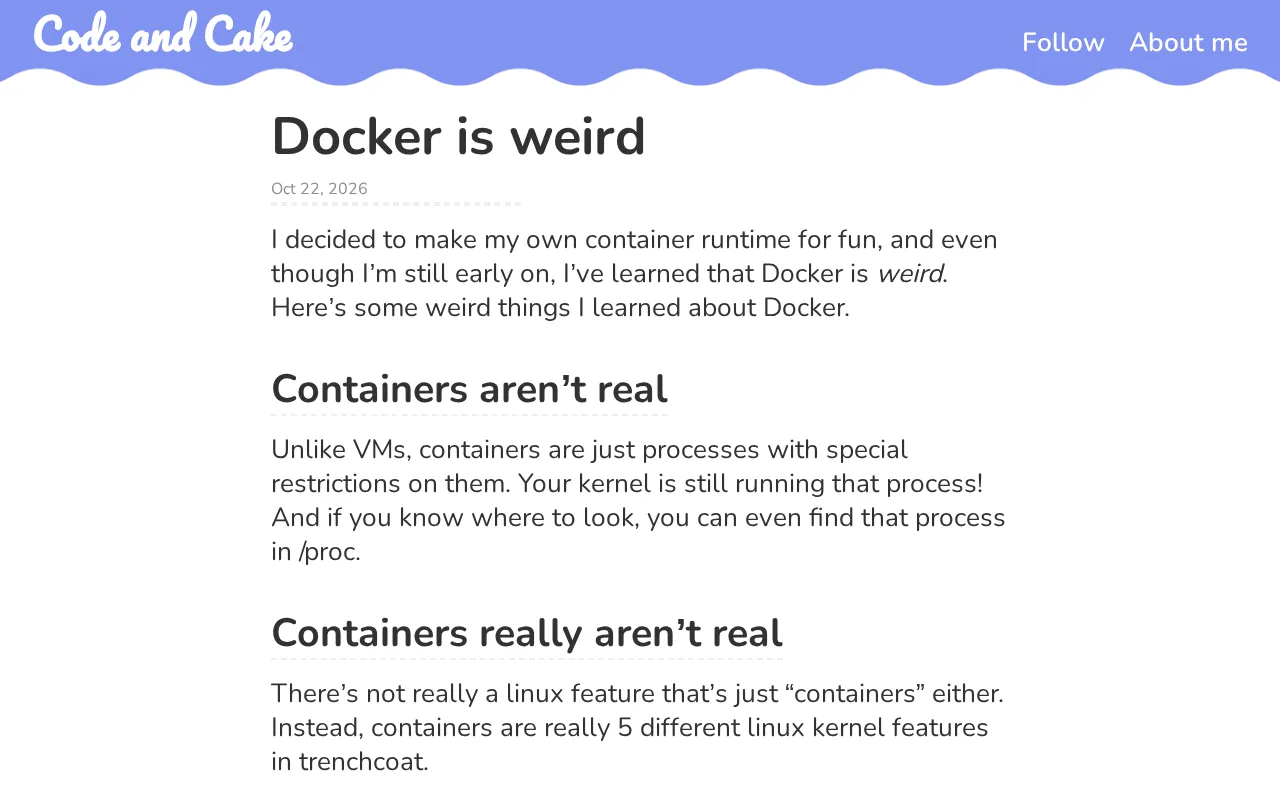
A post titled "Docker is weird" on Hacker News received 366 points and 180 comments. The author starts from aspects of daily developer use that aren't exactly wrong but always feel a bit off. The article analyzes that this weirdness stems from the management layer Docker stacks on top of Linux namespaces, cgroups, and union filesystems, leading to unpredictable build caches, historical baggage in default configs, and an underestimated learning curve. Comments show developers care more about predictability than simplicity, explaining why wrapper tools keep emerging. It emphasizes weird doesn't mean bad and offers pragmatic advice.
A Title That Sparked 180 Comments
A post with a rather plain title but 366 points and 180 comments appeared on Hacker News: "Docker is weird". The original article comes from codeandcake.dev. Rather than using clickbait headings like "Top 10 Docker Pitfalls", the author starts from those aspects of daily developer use that aren't exactly wrong but always feel a bit off. This perspective struck a chord with many—Docker has become the infrastructure of modern software delivery, yet its design logic still leaves plenty of engineers feeling that "something isn't quite right."
Where Does the Weirdness Come From
The discussion around this post quickly split into several camps: some complained that image layering and build cache behavior are hard to predict, others felt that container networking and port mapping involve too many layers of abstraction, and still others pointed out that Dockerfile's instruction set looks simple but produces counterintuitive results when combined. What these responses share is that problems rarely occur on first use—they occur after you're already familiar with it, when you think you understand the rules and it throws you an exception.
Docker's "Weirdness" Is Really an Abstraction Tax
The Cost of Stacking Two Layers of Abstraction
Docker's core value is packaging an application together with its runtime environment, but it doesn't directly operate kernel capabilities—it layers a management layer on top of Linux namespaces, cgroups, and union filesystems. Every docker run a user sees involves a series of actions: pulling images, creating containers, configuring networks, mounting storage. The abstraction layer lowers the barrier to entry, but it also means that when behavior deviates from expectations, the troubleshooting path gets longer.
A frequently mentioned example in the community is build cache: a minor adjustment to instruction order in a Dockerfile can invalidate the entire cache, while some seemingly unrelated instructions unexpectedly hit old cache. This isn't a bug—it's determined by how layered filesystems work—but it doesn't match most developers' intuition about "building."
Namespaces, cgroups, and union filesystems are key background for understanding Docker's abstraction layer. Namespaces handle view isolation, so processes inside a container can only see their own PIDs, networks, mount points, and other resources; cgroups handle resource limits and accounting, controlling CPU, memory, and IO allocation; union filesystems (such as overlay2) overlay read-only image layers and writable container layers into a unified view. Docker itself doesn't implement these kernel mechanisms—it calls them through components like containerd and runc. Precisely because of this, when container behavior goes wrong, the problem may lie in Docker's orchestration logic, containerd's state management, or kernel parameters or storage drivers—troubleshooting spans multiple layers.
Historical Baggage in Default Value Design
Another repeatedly discussed point is default configuration. Many of Docker's default behaviors were reasonable trade-offs in early versions, but as use cases expanded to production environments, these defaults became conservative or even dangerous. Containers don't limit resources by default, logs may grow indefinitely by default, and the default bridge network mode causes confusion in complex topologies. These designs aren't mistakes, but they require users to actively understand and override defaults—knowledge that often falls outside the scope of introductory tutorials.
Bridge network is Docker's default network mode, where containers obtain independent IPs through a virtual bridge and NAT and port mapping are implemented through iptables rules. This mode works out of the box in simple single-host scenarios, but when integrating with multi-host, multi-network, or existing network topologies, it introduces additional address translation and routing complexity. The -p 8080:80 users see behind the scenes is a whole set of iptables chains and bridge configurations—once port conflicts or cross-container communication issues arise, understanding these hidden rules becomes a prerequisite for troubleshooting. This is also one of the reasons commenters felt there are too many layers of network abstraction.
What Developers Really Care About, According to the Comments
Predictability Over Simplicity
Among the 180 comments, a high-frequency theme is "predictability." Developers can accept complexity but struggle to accept the same input producing different results. Behavioral differences in container builds across different machines and Docker versions were a frequently mentioned pain point in the discussion. This also explains why alternatives and wrapper tools around Docker keep emerging—most aren't trying to replace Docker but to converge the unpredictable parts.
Multi-stage builds are a mechanism Docker provides to alleviate build complexity and image bloat: define multiple FROM stages in one Dockerfile, use earlier stages for compilation and testing, and copy only the artifacts into a slim runtime stage. It separates the build environment from the runtime environment and significantly reduces image size, but it also increases Dockerfile structural complexity. The build unpredictability mentioned in comments also exists in multi-stage builds—inter-stage cache dependencies and instruction order still affect the final result, and explicit design is needed for stable reproducibility.
The Learning Curve Is Underestimated
Many commenters mentioned that Docker's introductory demo is extremely simple—a hello-world image gets you running—but truly mastering build optimization, multi-stage builds, network debugging, storage driver selection, and more requires far more knowledge than expected. This "easy to start, hard to master" curve leads many teams to catch up mid-project, by which point architectural decisions have already been made.
Weird Doesn't Mean Bad
Complexity Is a Map of the Problem Domain
One more point: "weird" in the post's title is more a description of experience than a negative judgment. The problems containerization itself aims to solve—environment consistency, dependency isolation, reproducible builds—are inherently complex. Docker has encapsulated this complexity into a relatively unified interface, greatly reducing the difficulty of directly operating underlying mechanisms. Most of the comment discussion also stays at "we wish it were easier to use" rather than "it should be replaced."
Practical Takeaways for Users
Several pragmatic suggestions can be drawn from this discussion: treat Dockerfiles as code that needs review rather than configuration files; pin base image versions in CI to reduce drift; explicitly design cache strategies for critical build steps; and build a container-related troubleshooting knowledge base for your team. These practices can't eliminate the "weirdness," but they can keep its impact manageable.
Conclusion
"Docker is weird" resonated widely because it articulated a shared experience among many engineers: a tool you use every day but have never fully tamed. This kind of candid discussion is more valuable than one-sided praise or criticism—it reminds us that the maturity of infrastructure tools is reflected not only in features but also in users' clear understanding of their behavioral boundaries.
One-line Summary
A Hacker News post "Docker is weird" struck a chord, exploring Docker's abstraction tax and predictability pain points.
Paragraph Summary
A post titled "Docker is weird" on Hacker News received 366 points and 180 comments. The author starts from aspects of daily developer use that aren't exactly wrong but always feel a bit off, striking a wide chord. The article analyzes that this weirdness stems from the management layer Docker stacks on top of Linux namespaces, cgroups, and union filesystems, leading to unpredictable build caches, historical baggage in default configurations, and an underestimated learning curve. Comments show developers care more about predictability than simplicity, which explains why wrapper tools around Docker keep emerging. The article emphasizes that weird doesn't mean bad, complexity is a map of the problem domain, and offers pragmatic advice such as treating Dockerfiles as code, pinning base image versions, and explicitly designing cache strategies.
Related articles
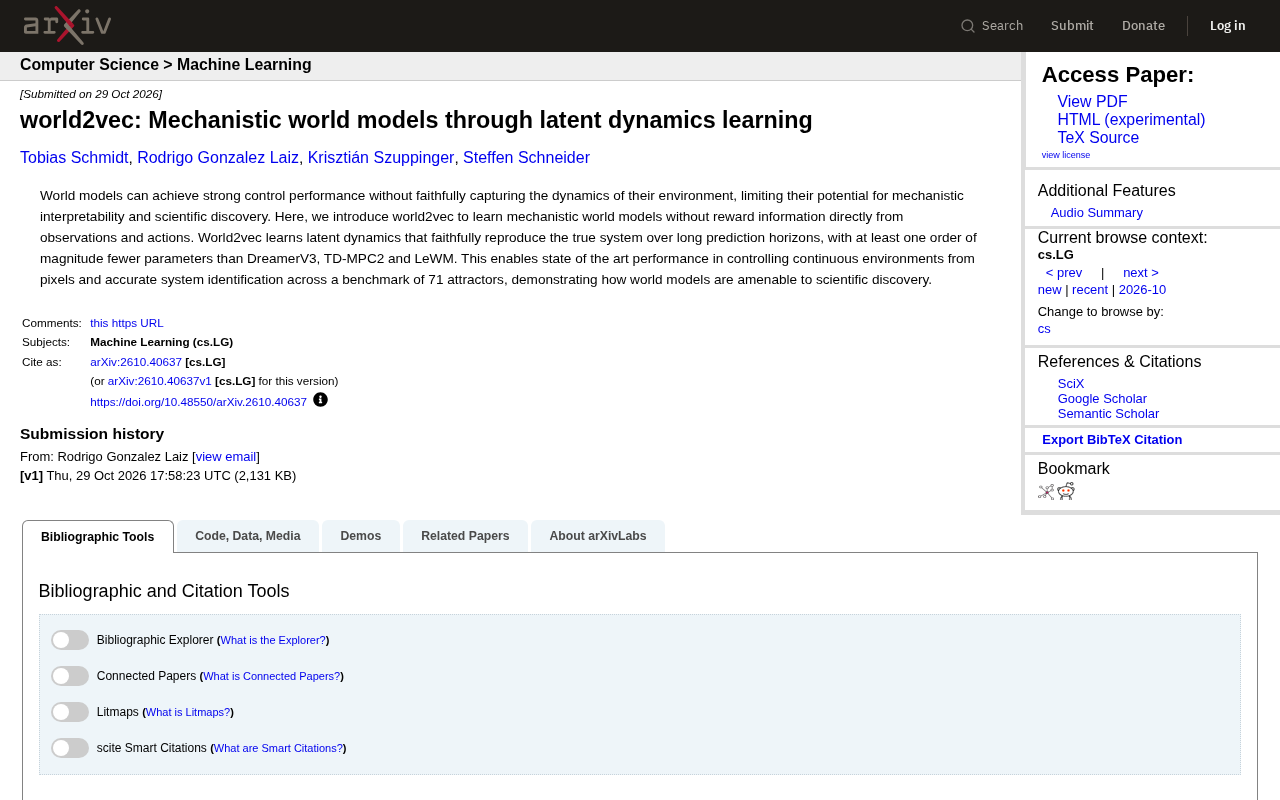
world2vec: Building Mechanistic World Models with Latent Dynamics Learning
world2vec proposes a reward-free method for learning mechanistic world models via latent dynamics, faithfully reproducing systems over long horizons with at least an order of magnitude fewer parameters than DreamerV3, TD-MPC2, and LeWM, and achieving accurate system identification on 71 attractor benchmarks.

A New KL-DRO Paradigm: Adaptive Scenario Generation Around a Learned Density Model
KL-DRO research proposes centering the KL ball on a learned density model instead of the empirical distribution, with adaptive scenario generation guiding sampling toward the worst case. Experiments show lower cost under distribution shift when records are scarce and the model can extrapolate, with comparable in-distribution cost.

ODE Samplers for Discrete Diffusion Models: Exponential Residual Flows Accelerate Generation
Discrete diffusion models lack deterministic ODE sampling? This article introduces Exponential Residual Flows (ERFs), which introduce continuous residual variables per token to construct piecewise ODEs for deterministic sampling and support consistency distillation acceleration. Superior to prior methods on code and text generation tasks.