Why Does GTA VI's Florida Feel So Real? Unpacking the Immersion of Its Game World
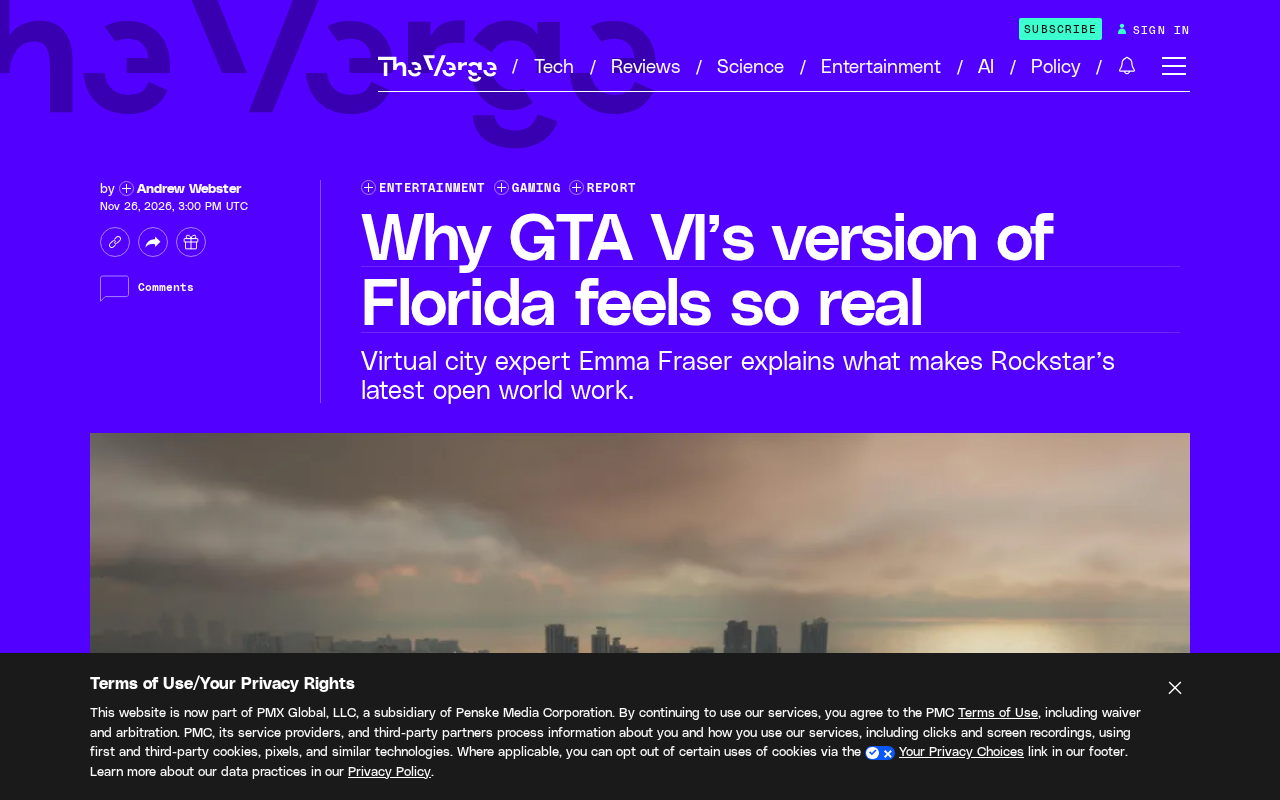
GTA VI uses sense of place as its core, reshaping virtual Florida with detail density and cultural symbols.
This article analyzes how *Grand Theft Auto VI* makes the fictional state of Leonida (modeled on Florida) feel authentic, from three angles: scene construction, cultural symbols, and detail density. It argues that the GTA series' core competitiveness isn't map size but recognizable regional character — "sense of place." GTA VI captures Florida's distinctive sense of contradiction (vacation paradise coexisting with a criminal underbelly), selectively exaggerates cultural symbols, and builds a credible social ecology (NPC schedules, regional demographics, etc.), making players feel a world that operates even without them. Humor, satire, and musical atmosphere further reinforce local identity. The article concludes that open-world competitiveness should return to shaping the soul of a place, rather than racing for map scale.
Introduction: More Than Just Waiting — It's About Anticipating a "Sense of Place"
It's been a while since the first trailer for Grand Theft Auto VI (GTA VI) dropped, yet the player community's enthusiasm has never faded. People discuss its interactive dual protagonists, its romantic narrative threads, and its astonishing density of detail. However, there's one dimension that's often mentioned but rarely analyzed in depth: Sense of Place. The GTA series has always been unmatched in reconstructing bustling real-world environments, and this time, the state of Leonida — a fictional state modeled on Florida — seems poised to push that realism to new heights.
This article will analyze how GTA VI brings a fictional Florida to life from three angles — scene construction, cultural symbols, and detail density — and what this means for open-world game design.
1. Sense of Place: GTA's Invisible Ace
Why "Feeling Real" Matters More Than "Big and Comprehensive"
Many open-world games chase map size, but the GTA series' core competitiveness lies in recognizable regional character. From Los Santos (Los Angeles) to Liberty City (New York), players can always instantly recognize the soul of these places — not just landmark buildings, but the street atmosphere, passerby dialogue, jokes on billboards, and even the "smell" in the air.
According to the original author's observations, GTA VI's Florida version feels real because it captures the region's distinctive sense of contradiction: sun-drenched vacation paradise coexisting with a seedy criminal underbelly, retirement communities adjacent to party culture. This complexity isn't achieved by piling on assets, but through carefully selected cultural symbols and environmental storytelling.
Sense of Place is a concept originating from humanistic geography, first proposed by scholar Yi-Fu Tuan in the 1970s, referring to the emotional connection and meaningful identification people develop with a specific location. In game design, it's extended to mean whether a virtual world can give players the intuitive judgment that "this is a place that really exists." This judgment doesn't depend on map size or quest count, but on whether the environment has recognizable personality, coherent cultural logic, and a symbol system that players can interpret. The reason the GTA series stands apart in the open-world field is precisely because it has long placed sense of place at the core of its design, rather than simply pursuing content volume.
Florida: A Backdrop with Built-In Drama
Florida has always been a unique presence in American culture — it's both synonymous with spring break revelry and a frequent source of bizarre news stories. GTA VI clearly understands this well. The wetlands, neon-decorated motels, alligator-infested swamps, and Latin-flavored neighborhoods shown in the trailer all reinforce the intuitive judgment that "this is Florida."
This realism doesn't come from 1:1 recreation, but from selective exaggeration: extracting the most recognizable elements from reality, then amplifying them with GTA's signature satirical touch. The "realness" players feel is actually an artistically refined "hyperreality."
2. How Detail Density Serves Immersion
From Environmental Storytelling to Social Ecology
GTA VI's trailer showcases numerous seemingly trivial details: people sunbathing on the beach, product displays in convenience stores, arguments between passersby. These details aren't remarkable in isolation, but combined they constitute a credible social ecology.
The original article points out that the GTA series is unmatched in recreating "bustling real-world environments." "Bustling" here doesn't just mean lots of people, but the interaction between systems: NPCs have their own schedules, weather affects behavior, different areas have different demographic compositions. When players realize this world operates even without them, immersion naturally arises.
Technical Foundation: Making Details More Than Fleeting Decoration
Although the original article doesn't delve into technical details, it can be inferred that GTA VI's realism is inseparable from underlying system support. More refined animations, smarter AI behavior trees, and more dynamic lighting systems are all key to transforming scenes from "static sets" into "living spaces." The "realism" players perceive is often the result of numerous invisible systems working in concert.
Behavior Tree is a decision-making architecture commonly used in game AI, organizing NPC behavior logic in a tree structure that allows characters to flexibly switch actions based on environmental states and priorities. Compared to traditional finite state machines, behavior trees are easier to extend and debug, making them particularly suitable for handling the complex schedules and interactions of numerous NPCs in open worlds. In games like GTA VI that emphasize social ecology, behavior trees make passersby more than background props looping animations — they can respond differently to weather, time, and player behavior, thereby supporting the immersion of "a world that operates even without the player."
3. The Precise Invocation of Cultural Symbols
Humor and Satire: GTA's Secret Seasoning
The GTA series has never lacked mockery of real society. Against a Florida backdrop, this satire has an even richer material library: from the absurd headlines of local news to influencer culture on social media, the game can weave these elements into the world through fictional brands, radio stations, and billboards.
This humor not only adds entertainment value but also reinforces sense of place — because only with sufficient familiarity with local culture can you create memes that make players smile knowingly. Realism and entertainment are not contradictory here; they actually reinforce each other.
Hyperreality is a concept proposed by French philosopher Jean Baudrillard, referring to when simulacra (simulations) become more convincing than reality itself, causing the boundary between real and fictional to dissolve. GTA VI's portrayal of Florida is a quintessential example of hyperreality: it doesn't replicate reality 1:1, but extracts the most recognizable cultural symbols from reality and reassembles them with satire and exaggeration, giving players the experience that "this is more Florida than the real thing." This strategy explains why the game's fictional brands and absurd advertisements actually strengthen sense of place — they activate players' existing perceptions of real Florida while amplifying them in an entertaining way.
Music and Atmosphere: Auditory Memory Anchors
The music choices in the trailer are also worth pondering. Florida's association with specific music styles (such as Latin rhythms and Southern rap) adds an auditory dimension to the scenes. When players drive through neon-lit streets with just the right radio music playing, sense of place extends from the visual to the auditory.
4. Implications for Open-World Design
GTA VI's reimagining of Florida offers the industry an important insight: an open world's competitiveness lies not in map size, but in whether the sense of place is strong enough. What players remember is often not how many kilometers they traveled, but an unexpected event at a street corner, a joke on the radio, or the view at a certain sunset.
For other developers, this means that when building a world, they need to first answer a question: What is the soul of this place? Then organize details around that soul, rather than using details to fill a map in reverse.
Conclusion: Realism Is a Carefully Designed Illusion
GTA VI's Florida feels real because Rockstar has reassembled the most recognizable cultural fragments, social contradictions, and visual symbols from reality in a highly coordinated way. It's not a copy of reality, but a refined and exaggerated mirror image — and that's precisely why it feels "more real than real."
When players finally step into the state of Leonida in 2026, what they'll experience won't just be a game map, but a place with breath, personality, and flaws. This may be the ultimate secret behind the GTA series' enduring success.
Related articles
Read Replicas in Lakehouse Architecture: Rethinking Scaling Strategies
Reexamining read replica design in lakebase architecture: why traditional primary-replica thinking no longer applies, how cache consistency and cold start costs become new bottlenecks, and feasible directions like layering by query characteristics and compute-side elasticity.

72-Hour Fasting Resets the Immune System: USC Study Reveals Mechanism
USC research suggests 72-hour fasting may reset the immune system by breaking down old immune cells and triggering hematopoietic stem cell regeneration. This article reviews the study mechanism, consensus and divergence in Hacker News community discussions, and the limitations and practical implications of the findings.
Testers Say Claude Opus 5.6 Appears Under the "5.5 Extra" Label
Hacker News discussion claims some testers believe the Claude Opus 5.5 Extra they use is actually Opus 5.6. This article analyzes the rumor's sources, vendors' blurry version-naming strategy, and its practical impact on developers and users.