Why Engineers Should Walk into Capitol Hill: A Frontline Technologist's Practical Guide to Policy Advocacy

Engineers walk into Congress and influence technology policy with clear requests, organizational endorsement, technical expertise, and genuine concern.
Using software engineer Nikhil Jathar's two IEEE-USA Congressional Visit Day experiences, the article explains how engineers can participate in policy advocacy effectively. Key points: engineers offer a technical perspective lobbyists cannot replace; organized visits require unified talking points, and organizational endorsement raises meeting priority with congressional staff; meetings last only 15 minutes to 1 hour, so asks must be concise and jargon-free; understanding committee jurisdiction and the legislative cycle is essential. Technical expertise and genuine emotional connection build lasting trust better than scripted talking points.
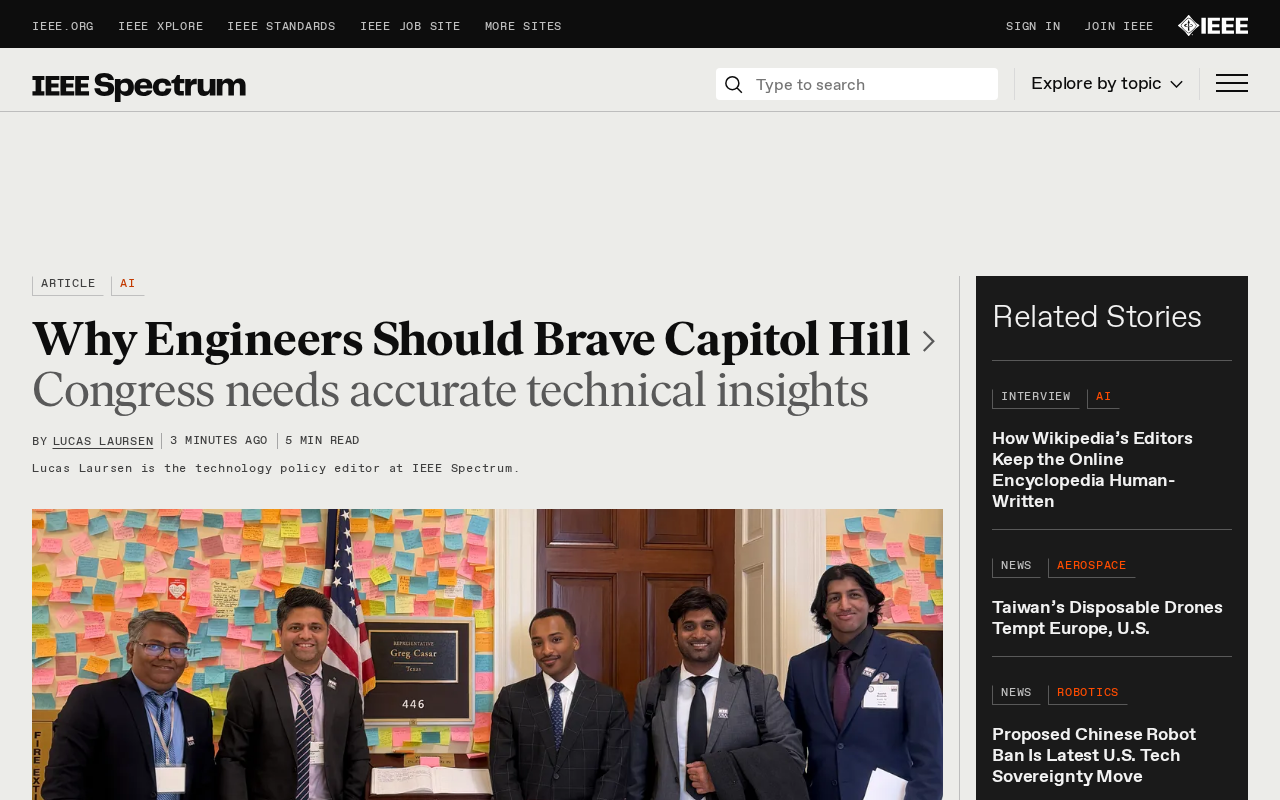
When Nikhil Jathar, a software engineer from San Antonio, first walked into Washington, D.C. to speak up for technology education and research funding, his reaction was that he felt "overwhelmed with honor." He had recently moved to the United States from India and received an invitation to IEEE-USA's annual "Congressional Visit Day." His initial reaction was straightforward: "Wow, I can go to Congress." Jathar is the co-founder and CTO of AvanSaber, a commercial software company. At the time, he had no specific position to lobby for on behalf of his company, but after reading some material about congressional visits, he decided he "had to give it a try and see where it would lead."
Political participation by engineers is not just "the lobbyist's job"
Congressional staff have a simple expectation of advocates: say clearly what you want. A staff member of the House Committee on Science, Space, and Technology (who requested anonymity due to the office's media policy) said that new policy ideas come from multiple channels—the member themselves, the staff level, constituent demands, or industry needs. "For example, if you leave this to professional lobbyists, they will naturally do what serves their clients' interests." This points to the core value of engineers walking into Congress: only when technologists are present can public policy avoid being defined unilaterally by commercial interests.
For U.S. engineers, talking with elected representatives is an effective way to influence key policies, but it requires preparation and the right approach—something Jathar experienced deeply over his two visits.
Distinguish "advocacy" from "lobbying"
Congress has its own rules. Broad advocacy aimed at constituents and professional lobbying are two different things; the latter involves paid professionals and is governed by the Lobbying Disclosure Act. Many professional groups, including IEEE, organize congressional visits for their members, and such visits may be subject to lobbying rules. The organizers told Jathar explicitly: "You represent the organization, not your personal views." He needed to follow the unified talking points prepared by IEEE-USA for all participants.
On his first visit, these points included funding smart grids, authorizing Department of Energy research, and investing in STEM education. This reflects a trade-off in Washington access: organizational priorities may not directly overlap with one's own work, but they broadly empower the technological enterprise. Jathar said: "STEM education funding is close to my heart."
The Lobbying Disclosure Act (LDA) is a U.S. federal law enacted in 1995. It requires professional lobbyists who are paid to influence federal legislation or administrative decisions on behalf of specific clients to register with Congress and periodically disclose their activities, clients, and expenditures. The law defines "lobbying contact" as oral or written communication with federal legislative or executive branch officials regarding specific policies, and sets registration thresholds (such as reaching a certain amount of quarterly lobbying expenditure). For engineers, understanding this distinction is crucial: expressing policy views to one's own district representative as a citizen is a right to petition protected by the First Amendment and does not require registration; but if employed by an organization and systematically pushing specific legislation in a professional capacity, disclosure obligations may be triggered. Many professional groups organize congressional visits and require participants to follow unified talking points precisely to define these activities as "broad advocacy" rather than "paid lobbying for specific clients," thereby providing members with a channel for participation within a compliant framework.
Why organizational endorsement matters
Jathar points out that anyone can bring a personal issue to a representative, but congressional staff time is extremely tight, and they are more likely to prioritize meetings that represent the views of as many constituents as possible. "I could bypass IEEE's structure," he said, but "if you belong to a larger organization, they are more willing to listen."
On his first visit, the organizers arranged for him to visit the offices of several members of both parties based on his place of residence. He mentioned that meeting with staff or senior office members worked well: "They can relate to these issues better than the members themselves, because members have ten high-level things to worry about, while staff can focus more on policy details."
Congressional staff allocate time according to a "constituent representativeness" logic: each member's office receives a large number of meeting requests every day, and staff usually prioritize meetings that reflect the broad interests of the district and have organizational endorsement, because such meetings mean there is a quantifiable constituent group behind the issue. The reason endorsement by professional groups (such as IEEE-USA) is effective is that it simultaneously sends three signals: the issue has been screened through the organization's internal policy process, the participants are constituents with professional qualifications, and the meeting request is consistent with the organization's long-term legislative agenda. By contrast, personal issues, even if highly technical, are often placed at lower priority due to a lack of verifiable constituent representativeness. This is also why organizers often arrange visits to members of both parties based on participants' places of residence—bipartisan coverage strengthens the signal that "this is not a single-party demand" and increases staff willingness to schedule meetings.
A meeting lasts only 15 minutes—how to make your case
A typical congressional visit lasts from 15 minutes to 1 hour. Jathar's principle is to be brief: "The window you get is very small, so make sure everything is prepared in bullet points, and don't pile on jargon. If they follow up, then expand." A one-page visual aid helps convey numbers or technical information.
House Science Committee staff agree: "I prefer meetings where people know what they want and also know what Congress is doing." In addition to clear requests, engineers should track the congressional cycle: Is it appropriations season now? When will the next budget be determined? What stage is a certain bill at, and what is realistic to change at this point?
During a visit in 2025, Jathar learned firsthand the importance of preparation. When visiting one of three members, staff politely pointed out that this member was not on the committee with jurisdiction over the relevant issue. "They explained that the member could only do specific things on this issue, and that to achieve more, we would need to talk to other people."
The congressional legislative cycle consists of several key nodes that directly affect advocacy timing: appropriations season (usually spring to summer, when appropriations subcommittees consider annual spending bills), budget resolutions (setting overall spending caps), authorization bill consideration (setting legal authority for programs), and the fiscal year deadline (September 30, often accompanied by continuing resolutions). In addition, the jurisdiction of the committee a member sits on determines their actual influence on a specific issue—for example, AI research funding may involve both the Committee on Science, Space, and Technology (authorization) and the Appropriations Committee (appropriations), while tax or trade issues fall under the Finance Committee and the Ways and Means Committee. Before scheduling meetings, engineers can use Congress.gov to check members' committee assignments and bill progress, determine which node is current, and assess what is realistic to push at this time. If an issue is not within the other party's jurisdiction, staff usually suggest contacting the office of a member on the relevant committee instead—precisely the typical situation Jathar encountered during his 2025 visit.
Technical expertise is the strongest credential
Earlier this year, Jathar walked into Capitol Hill again with new knowledge, still within the framework of an IEEE-USA visit. This time he could offer what legislative staff really want: authoritative technical knowledge.
"When I introduced myself to a staff member as a software developer, his first question was: 'Do you think AI will replace programmers?'" Jathar said. The conversation went back and forth, and staff asked Jathar and his fellow engineers question after question. Jathar explained that his company developed open-source business management software ERPClaw, designed to work with AI agents such as OpenClawAd. The topic naturally extended to the role of open source in AI—one of IEEE-USA's proposals to democratize AI. This time, he aligned organizational advocacy, personal expertise, and staff interest.
The legislative impact is still hard to judge, but the words of the House Science Committee staff point the way: "People who build trust carry more weight with congressional staff, because what they propose has been reasonably thought through." Conversely, staff are also more willing to speak up internally for policies brought by people they trust.
Emotional connection matters more than talking points
This staff member had visited Congress as an advocate before becoming a congressional staffer. During that visit, the organizers also gave a script. "I was selling a script someone gave me, and I didn't personally identify with it much." His advice is: "You should have an emotional connection to the issue you are advocating for."
Jathar's support for the open-source movement is exactly that. Open source provides small companies with a foundation they can modify and build on, and allows other developers to extend the work. "We can progress much faster," Jathar said. "I do this not only because it benefits my business, but because I think it benefits any technological progress."
For technologists, Capitol Hill is not unfamiliar territory. Clear requests, organizational endorsement, technical expertise, and genuine concern—the combination of these four things will make policymakers remember you more than any carefully packaged lobbying script.
One-line Summary
Engineers walk into Congress and influence technology policy with clear requests, organizational endorsement, technical expertise, and genuine concern.
Paragraph Summary
Using software engineer Nikhil Jathar's two experiences at IEEE-USA Congressional Visit Day as a thread, the article explains the value and methods of engineer participation in public policy advocacy. Core arguments include: the presence of engineers provides a technical perspective that lobbyists cannot replace, preventing policy from being defined by a single commercial interest; participation in organized visits requires following unified talking points, and organizational endorsement can significantly increase the priority congressional staff give to meetings; meetings usually last only 15 minutes to 1 hour, so requests must be expressed in bullet points and avoid jargon; understanding members' committee jurisdiction and the legislative cycle is a basic skill. The article also emphasizes that technical expertise and genuine emotional connection build long-term trust with congressional staff better than reciting talking points, and Jathar demonstrates the effect of this alignment using open source and AI democratization issues as examples.
Related articles

Gemini 4 Argon Hands-On: AI Builds Board Games, Constructs Temples, and Trains Robots Autonomously
Gemini 4 Argon hands-on roundup: AI autonomously builds a desk racetrack and temple in Blender, writes a ray tracing engine, trains a humanoid robot to sink 7 shots, plus API pricing and developer access.

The Magic Octagonal Coin: Why Only 9% of People Can Predict Its Flip?
Only 9% of people can correctly predict the Magic Octagon coin flip. This article explains its spatial rotation mechanism, common cognitive pitfalls, and a new hypothesis based on Relevance Theory, exploring the limits of human spatial reasoning.

Sam Altman: AI Is Entering the Era of Scientific Discovery — Math Breakthroughs Will Replicate in Biology and Energy
Sam Altman says AI is entering the era of scientific discovery — math breakthroughs will replicate in biology, materials science, and energy to help develop new drugs and energy sources.