Why Google Scholar Citation Counts Always Lag Behind: What Every Researcher Should Know

Google Scholar citation delays of several months are normal — here's why, and how researchers should respond.
This article explains why citations visible on arXiv often don't appear in Google Scholar counts for months. Google Scholar uses periodic crawlers rather than real-time updates, and citation parsing involves metadata matching, PDF extraction, and version merging — each a potential source of delay. Conference papers transitioning from arXiv preprints to official proceedings can temporarily fragment citation counts across multiple records. Based on community experience, a three-to-six month lag is normal. The article recommends cross-referencing platforms like Semantic Scholar and Scopus, actively maintaining your scholar profile, and focusing on producing research rather than monitoring citation numbers.
A Common Frustration Among Early-Career Researchers
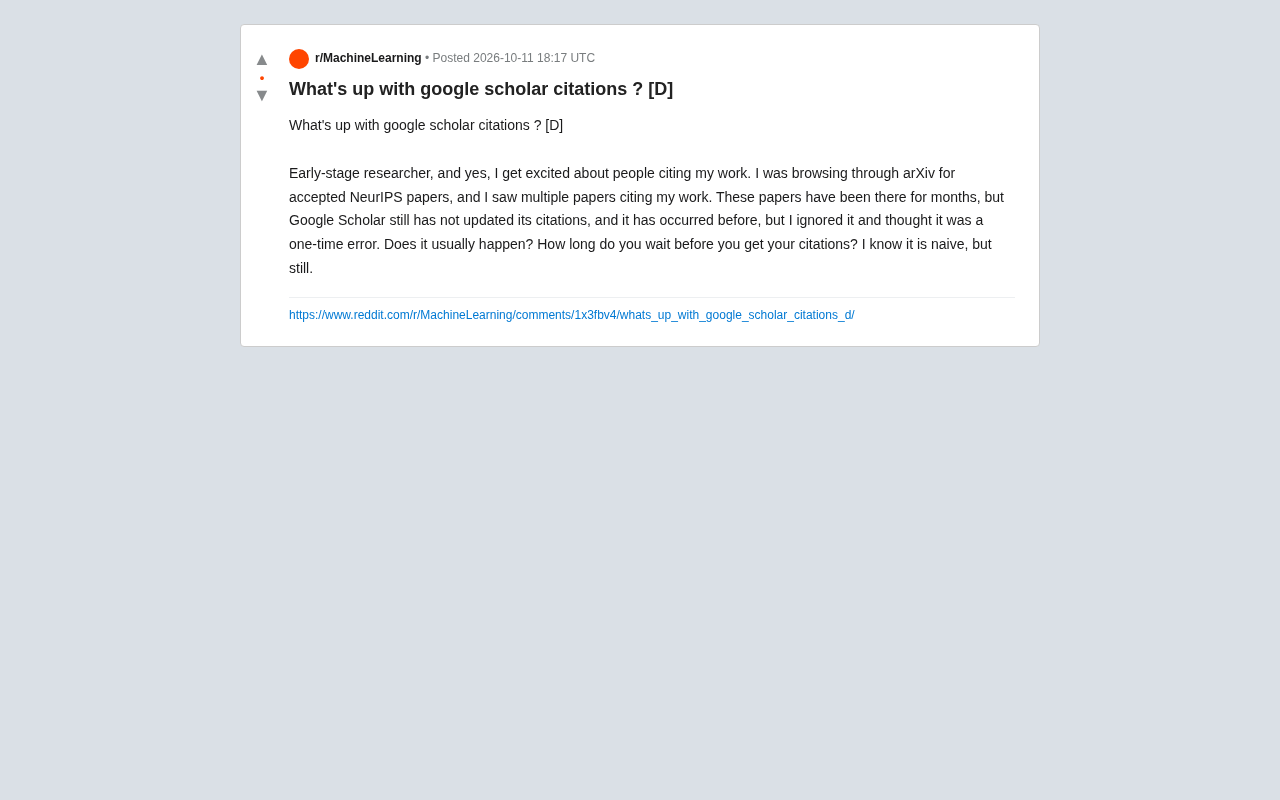
For researchers new to academia, seeing their work cited is an exciting milestone. Yet a question that sparked discussion in a Reddit machine learning community captures a frustration many share: several papers already accepted to NeurIPS — visible on arXiv for months — clearly cite your work, but Google Scholar's citation count hasn't budged.
The researcher admitted this had happened before, and they'd brushed it off as a one-time glitch. But when the pattern kept repeating, they started wondering whether this was simply how Google Scholar operates. The question may seem trivial, but it reflects something deeper about how academic metrics tools actually work — and it's worth unpacking.
How Google Scholar's Indexing Works — and Why It Lags
Google Scholar is not a real-time database. It relies on web crawlers that periodically scrape academic websites, publisher pages, institutional repositories, and preprint platforms like arXiv. An algorithm then parses reference lists and matches citation relationships. This pipeline means citation counts are inherently delayed.
Why Can You See a Citation on arXiv But Not in Scholar?
Even when a paper is publicly visible on arXiv, there's a time gap before Google Scholar parses its citations. The crawler first needs to fetch the citing paper, then accurately identify entries in its reference list, and finally link them to the correct record for the cited work. This process isn't always immediate — especially when a paper's metadata is inconsistently formatted, PDF parsing fails, or multiple versions exist. Citations can be delayed or missed entirely.
The Mess Created by Version Transitions
Conference papers from venues like NeurIPS typically go through a transition from an arXiv preprint to an official proceedings version. When multiple versions of the same paper exist, Google Scholar may split citations across different records, making the main entry's citation count appear artificially low. Only after the system completes version merging does the count "suddenly" jump.
DOIs (Digital Object Identifiers) are a key mechanism for resolving version confusion. Formally published conference and journal papers are assigned a unique DOI, allowing different databases to precisely identify and link versions of the same work. ArXiv preprints, however, use their own arXiv ID system, which isn't automatically linked to a formal publication's DOI. Google Scholar relies on heuristics — title similarity, author names, abstracts — to merge versions, with limited accuracy. If a paper's title changed during revision, or an author's name is spelled differently across versions, the system may fail to recognize them as the same work, permanently fragmenting the citation count across multiple records. This is precisely why researchers are advised to actively maintain their personal profile pages and manually merge duplicate entries.
How Long Does a Citation Update Typically Take?
Based on widespread community experience, Google Scholar's citation update cycle varies considerably — anywhere from a few weeks to several months. Some researchers report that after a conference paper is officially published, a concentrated update to citation counts may lag by three to six months. Factors that affect update speed include:
- Where the citing paper is hosted: Official publisher pages are typically indexed faster than preprints
- Metadata quality: The more standardized the title, authors, and DOI, the more accurate the matching
- Crawler crawl frequency: High-profile journals and conferences may receive higher crawl priority
- Citation format consistency: Non-standard citation styles are more likely to be missed
Seeing a citation on arXiv that hasn't shown up in Scholar counts is completely normal within a window of several months — there's no need to panic.
How Researchers Should Rationally Approach Citation Data
Don't Rely on a Single Metrics Tool
Google Scholar has broad coverage but limited precision. Platforms like Scopus, Web of Science, and Semantic Scholar each have different strengths. Cross-referencing multiple sources gives you a more complete picture of a paper's real-world impact. Semantic Scholar in particular tends to be more agile at tracking arXiv preprint citations in computer science, making it a useful supplement.
Semantic Scholar, developed by the Allen Institute for AI, is deeply optimized for fields like computer science and biomedicine. Beyond tracking citations, it offers a "Highly Influential Citations" feature that distinguishes whether a paper is cited as a core methodological contribution or merely as background context — a richer signal than raw citation counts alone. Scopus and Web of Science focus primarily on formally published journal articles, offering more limited coverage of conference preprints, but their data curation is stricter and they're commonly used for institutional evaluation and grant-related citation audits. Understanding each tool's data sources and priorities helps researchers choose the right reference for each use case.
Actively Maintain Your Academic Profile
Claiming and keeping your Google Scholar profile up to date — ensuring papers are correctly listed and versions properly merged — helps the system attribute citations more accurately. Regularly check for duplicate entries or misattributed records, and manually merge them when needed.
Redirect Your Attention Back to the Research
Citation count growth is inherently delayed relative to actual scholarly contribution. Rather than obsessively refreshing numbers, invest that energy in follow-up research and engaging with peers. Being cited by a NeurIPS paper already signals that your work has earned recognition in the field — and that matters far more than a number that hasn't updated yet.
Conclusion
Google Scholar citation lag is an inherent feature of how the system works, not a malfunction. For early-career researchers, understanding this can ease unnecessary anxiety. The citations will catch up eventually. What truly matters is continuing to produce valuable research. Building academic impact is a long game — not a race to watch real-time numbers tick up.
Related articles

Should U.S. College Fraternities Be Banned? A Researcher's Incisive Observations
Why not just ban U.S. college fraternities? A researcher finds the key resistance comes from decision-makers' own fraternity identities and schools' "willful ignorance."

Microsoft Discovery: Accelerating Scientific Discovery with AI Agents
Microsoft's Discovery platform runs specialized AI agents to help researchers screen and prioritize the most promising compounds and experimental paths, reducing experiments and accelerating scientific discovery.

Cambridge Heavy Industries Secretly Develops Desktop-Scale Nuclear Fusion Device
Cambridge Heavy Industries is secretly developing a desktop-scale laser-driven nuclear fusion device, targeting the equipment supply market for fusion power plants. This article analyzes its miniaturization technology path, commercialization logic, and unique positioning in the fusion startup wave.