Why Is Apple Making Smart Home Hardware Itself? A Deep Dive into Home Collection

Apple launches Apple Home Collection, its own-brand smart home line, shifting from platform provider to brand owner.
Apple has officially launched Apple Home Collection, its first fully Apple-led smart home hardware line covering cameras, thermostats, sensors, smart locks, and video doorbells, co-developed with LG Electronics and Schneider Electric. This marks Apple's strategic shift from HomeKit platform provider to own-brand hardware maker. HomeView, launched alongside, is expected to become a unified home management interface. Key drivers include Matter protocol maturity, services revenue pressure, and user demand for integrated experiences—but Apple still faces challenges in pricing, installation/after-sales, and ecosystem closedness.
From "Let Others Do It" to "Doing It Ourselves"
For over a decade, Apple's strategy in the smart home space has been clear: build the HomeKit platform, invite third-party manufacturers to join, and position itself solely as the rule-maker and ecosystem connector. This approach shielded Apple from the risks of expanding into hardware categories, but it also created an awkward reality—HomeKit devices delivered wildly inconsistent experiences, with users frequently complaining about cumbersome pairing processes, delayed feature updates, and less-than-smooth cross-brand interoperability.
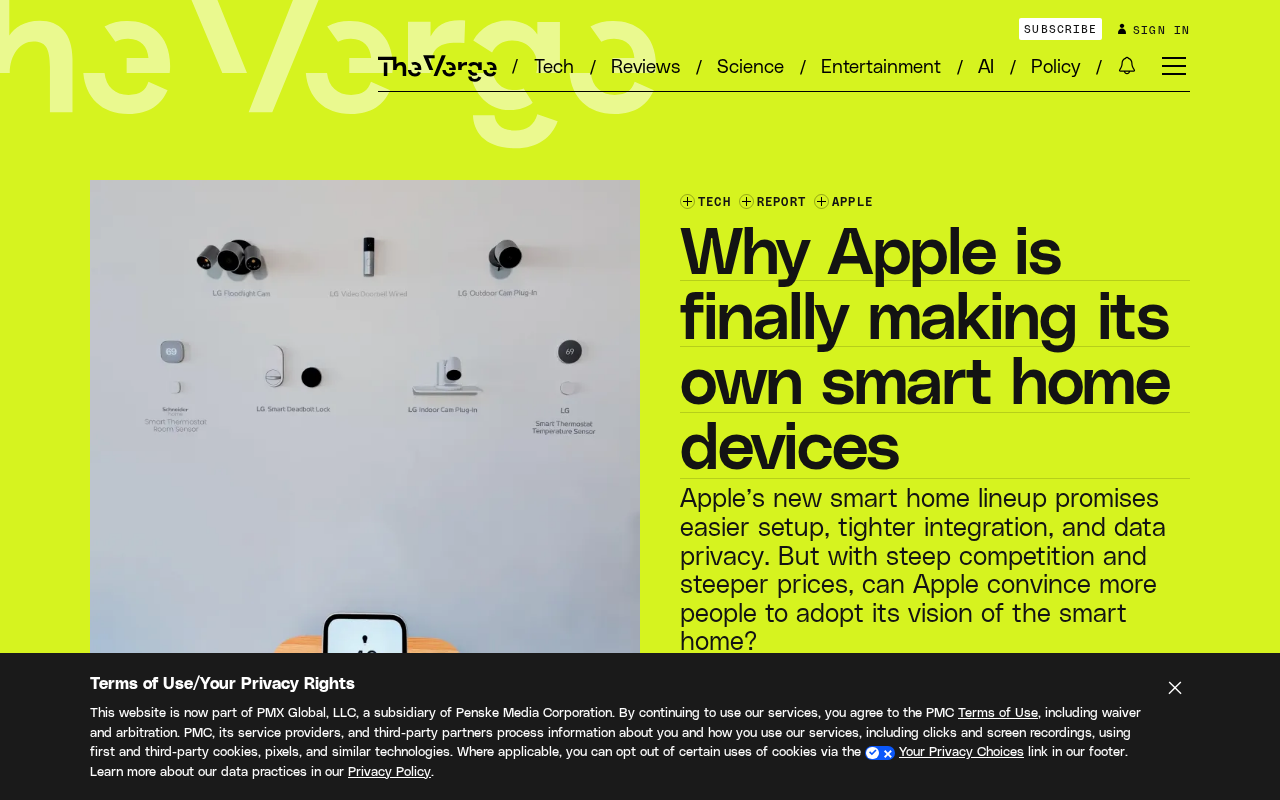
This week, Apple made a landmark shift. According to RSS sources, Apple has officially launched Apple Home Collection, a smart home product line fully led by Apple, covering cameras, thermostats, sensors, smart locks, and video doorbells. Unlike before, these products weren't developed by Apple alone—they were co-developed with LG Electronics and Schneider Electric respectively.
This means Apple is no longer content to be the "landlord" of a platform. It's stepping into the kitchen itself.
HomeKit is the smart home platform framework Apple released in 2014. It is not a hardware product itself, but rather a set of protocols and a certification system that allows third-party devices to be controlled uniformly through iPhone, iPad, and HomePod. Manufacturers must pass Apple's MFi certification to integrate, and device data is encrypted locally before being managed through the "Home" app. HomeKit's core selling point has always been privacy and security—for example, on-device processing to avoid uploading video footage to the cloud. But its weaknesses are equally obvious: high certification barriers have led to device variety and update speeds lagging behind Amazon Alexa and Google Home, and cross-brand automation capabilities have long been limited. Understanding this context is essential to grasp that Apple's shift from platform provider to brand owner is essentially a self-correction after years of HomeKit's ecosystem being "praised but not widely adopted."
What's Actually in Home Collection
Based on the announced product lineup, Apple Home Collection covers the most essential smart home categories:
Security & Monitoring: Cameras and video doorbells form the foundational layer of home security. Apple's accumulated expertise in privacy protection (such as on-device processing and end-to-end encryption) could become a key differentiator.
Environmental Control: The combination of thermostats and sensors points toward automation scenarios—collecting and linking temperature, humidity, and light data for coordinated adjustments.
Entry Management: Smart locks are the first line of physical home security and one of the devices where users demand the highest reliability.
A detail worth noting: the choice of partners. LG Electronics has deep manufacturing experience in consumer electronics and home appliances, while Schneider Electric is a giant in energy management and industrial automation. Apple's decision to partner with these two rather than traditional smart home startups shows it values supply chain maturity and quality control capabilities, not just IoT technology stacks.
HomeView: Software-Layer Integration Ambitions
Beyond the product line, Apple simultaneously launched HomeView. While public information is currently limited, based on naming logic and Apple's consistent product philosophy, HomeView is likely a unified home status viewing and management interface that integrates camera feeds, sensor data, and device status into a single view.
This is precisely where Apple has been weakest in the smart home space. HomeKit's "Home" app has long been criticized for its bare-bones functionality and scattered information. If HomeView can deliver a "home dashboard"-like experience, it will become the software hub connecting all Home Collection hardware.
Why Now?
Apple's decision to enter the smart home hardware market at this moment is likely driven by several factors:
Maturity of the Matter protocol. As one of the core proponents of the Matter standard, Apple has already paved the way for cross-platform interoperability. Now that fragmentation at the protocol layer has been largely mitigated, the experience differences between hardware itself become more important—and that's exactly where Apple excels.
Pressure on services revenue. With hardware growth slowing, Apple needs new revenue engines. Smart home hardware can drive iCloud storage, Apple Care, and potentially home security subscription services.
Integration experience users have long awaited. Third-party manufacturers have never been able to achieve Apple-level software-hardware synergy. When users buy a pile of HomeKit devices but don't get an "It just works" experience, brand trust actually suffers. Apple entering the fray directly is about repairing that trust gap.
Matter protocol is a smart home interoperability standard jointly launched by Apple, Google, Amazon, and the Zigbee Alliance (now the Connectivity Standards Alliance, CSA) in 2022, aiming to enable seamless cross-ecosystem collaboration between devices from different brands. It runs on IP networks and supports Wi-Fi, Thread, and Ethernet. In theory, users no longer need to worry about whether "this device supports my platform." Apple is one of Matter's core proponents, and both iOS and HomeKit natively support it. Matter's significance lies in standardizing the underlying question of "can it connect" so that competition shifts to "how good is the experience after connecting"—which happens to be Apple's strength zone with its integrated hardware and software capabilities. It's fair to say that without Matter's maturity, Apple's cost-effectiveness in making hardware itself would be much lower.
Challenges Are Equally Obvious
Smart home hardware is a notoriously difficult market. Google's Nest has undergone multiple restructurings, and while Amazon's Ring and Echo ecosystems are massive, profit margins have consistently been thin. The issues Apple must face include:
- Pricing positioning: Apple's hardware pricing has consistently been on the high end, while smart home users tend to be more price-sensitive
- Installation and after-sales service: Devices like thermostats and locks require professional installation, and Apple needs to build a service system different from its retail stores
- Ecosystem lock-in controversy: Apple emphasizes privacy and a closed ecosystem, but in smart homes, users often want devices to work across platforms
Whether the partnerships with LG and Schneider can solve manufacturing and channel challenges, and whether HomeView can truly unify the user experience—these questions can only be answered after the products officially hit the market.
But the direction is clear: Apple is no longer just the "platform provider" for smart homes. It wants to be a "brand" in this market. The impact on the industry landscape as a whole may be more noteworthy than the products themselves.
Ecosystem Lock-in refers to users being bound to a particular vendor's system due to interoperability limitations on devices, data, and services, resulting in high switching costs. Apple's closed ecosystem is viewed as an experiential advantage on iPhone, but in smart home scenarios it easily sparks controversy: devices in a home are often purchased by different family members with different brands, and users generally expect locks, bulbs, and thermostats to work together across platforms. If Home Collection can only deliver full functionality within Apple's ecosystem, it could limit its market penetration. Additionally, regulators are paying attention to ecosystem lock-in among tech giants. Regulations such as the EU's Digital Markets Act already require certain platforms to open up interoperability, adding a compliance variable to Apple's smart home hardware strategy.
One-line Summary
Apple launches its own-brand smart home product line Apple Home Collection, transitioning from platform provider to brand owner.
Paragraph Summary
Apple has officially launched Apple Home Collection, its first fully Apple-led smart home hardware product line, covering cameras, thermostats, sensors, smart locks, and video doorbells, co-developed with LG Electronics and Schneider Electric respectively. This marks Apple's strategic shift from HomeKit platform provider to own-brand hardware maker. The simultaneously launched HomeView is expected to become a unified home management interface, addressing HomeKit's software experience shortcomings. The article analyzes that Matter protocol maturity, services revenue pressure, and user expectations for an integrated experience are the main drivers, but Apple still faces challenges around pricing positioning, installation and after-sales service, and ecosystem closedness.
Related articles

AgentCore in Practice: Connecting Custom Tools and MCP Servers to Agents
DebuggerCafe tutorial shows how to connect custom tools and MCP servers to Amazon Bedrock AgentCore agents, covering tool contract design, MCP reuse, and production concerns.

816B Parameters Scores Only 39? The Real Cost-Effectiveness of the Open-Source LLM Parameter Race
Meta's 816B Muse Spark Open scores just 39 on Artificial Analysis, while 180B Qwen3.8-Flash-Next scores 40. This article analyzes 11 open-weight models' parameters vs. scores, exploring the real impact of activated parameters, quantized size, and deployment cost.

Aerial Manipulators: The Next Step for Drones from 'Seeing' to 'Changing'
Starting from a Reddit discussion, this article analyzes the technical challenges, potential applications, and deployment bottlenecks of aerial manipulators, exploring the key challenges for drones moving from environmental perception to physical manipulation.