Why Is Quantum Computing So Fragile? Engineering Challenges from a Single Qubit's Perspective

Exploring why quantum computing is so fragile and the immense engineering challenges from single qubits to scalable systems.
This article explores the fundamental fragility of quantum computing, examining how decoherence destroys qubit states, why extreme cooling near absolute zero is required, and the massive overhead of quantum error correction. It compares four major technology approaches—superconducting, trapped ion, photonic, and neutral atom—and discusses why true quantum practical advantage remains elusive despite headline-grabbing supremacy claims.
Introduction: Why Quantum Computing Is So Hard to Achieve
Quantum computing is hailed as the core of the next computing revolution, theoretically capable of achieving exponential performance breakthroughs in drug discovery, materials science, cryptanalysis, and complex optimization. However, between laboratory proof-of-concept and truly usable quantum computers lies an enormous engineering chasm. At the heart of this chasm is one key word — fragile.
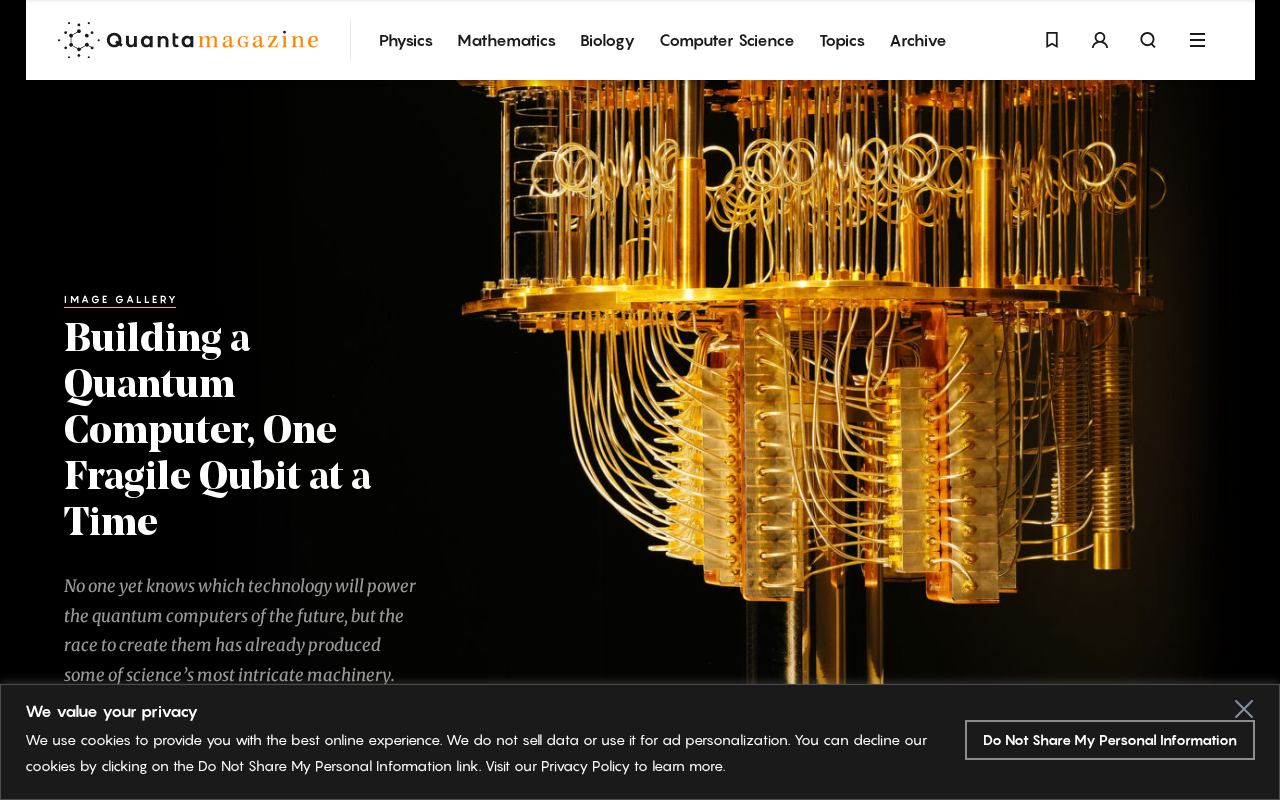
A recent article titled "Building a Quantum Computer, One Fragile Qubit at a Time" sparked discussion on Hacker News, revealing the true picture of building quantum computers: this isn't a race about algorithms, but a prolonged battle to tame the most unstable particles in the physical world.
Qubits: The Source of Computing Power and the Root of Fragility
What Is a Qubit
The basic unit of a traditional computer is the bit, which can only be in one of two states: 0 or 1. A qubit, leveraging superposition from quantum mechanics, can simultaneously represent a combination of 0 and 1. Furthermore, multiple qubits can establish correlations through entanglement, enabling n qubits to simultaneously represent 2^n states.
It's important to emphasize that superposition doesn't simply mean a qubit "is both 0 and 1 at the same time." A more precise understanding is: the qubit exists in a linear combination of probability amplitudes for 0 and 1, with each state corresponding to a complex coefficient that only collapses to a definite classical value with a certain probability upon measurement. Entanglement is a form of quantum correlation stronger than any classical correlation — two entangled qubits cannot be described independently and must be characterized as a whole system. Einstein famously called this "spooky action at a distance," but it cannot transmit information faster than light. Instead, it provides quantum algorithms with parallel search and interference capabilities that are beyond the reach of classical computing.
It is precisely this property that gives quantum computers their theoretically enormous parallel capability. As the number of qubits increases, their expressive power grows exponentially — this is the fundamental reason tech giants are willing to invest billions of dollars in the race for quantum supremacy.
Decoherence: The Physical Nature of Fragility
However, quantum superposition states are extremely fragile. Any tiny disturbance from the outside — temperature fluctuations, electromagnetic noise, mechanical vibrations, even cosmic rays — can cause the quantum state to collapse, a phenomenon known as decoherence.
From a microscopic physical mechanism perspective, the essence of decoherence is uncontrollable information leakage between the quantum system and its environment. It includes two main processes: energy relaxation (T1 process), where the qubit spontaneously falls from an excited state to the ground state; and pure dephasing (T2 process), where the qubit's phase information gradually blurs through random interactions with the environment. For superconducting qubits, Two-Level System (TLS) defects on material surfaces are a major source of decoherence. These nanoscale defects act like tiny antennas, absorbing and releasing energy, continuously disrupting the qubit's phase stability. Engineers need to optimize simultaneously across multiple levels — material purity, circuit design, and electromagnetic shielding — to gradually extend coherence times.
Qubits typically maintain their coherent state for only microseconds to milliseconds. Within such brief time windows, computations must be completed, or the information is lost. Every single qubit is a fragile system requiring meticulous care, and engineers must tackle their stability problems one by one.
Engineering Challenges: From a Single Qubit to Scalable Systems
Extreme Operating Environment Requirements
To extend qubit coherence times as much as possible, mainstream superconducting quantum computers must operate at temperatures near absolute zero (approximately 15 millikelvin, colder than outer space). This requires massive dilution refrigerator systems that are expensive, physically large, and complex to maintain.
Dilution refrigerators work based on the thermodynamic properties of a mixture of helium-3 and helium-4 isotopes. At extremely low temperatures, the He-3/He-4 mixture spontaneously separates into two phases — a He-3-rich phase and a He-3-dilute phase. When He-3 atoms "evaporate" from the concentrated phase into the dilute phase, they absorb heat, producing a continuous cooling effect similar to sweat evaporating and carrying away body heat. This process can be cycled repeatedly, bringing temperatures down to 10-15 millikelvin. A commercial dilution refrigerator typically costs between $1 million and $5 million, can be several meters tall, and contains multiple thermal isolation shields and complex plumbing systems internally — making it one of the most expensive pieces of infrastructure in a quantum computer.
This also explains why quantum computers remain exclusive to laboratories and cloud services rather than desktop products. The extreme demands of the operating environment are themselves a major barrier to quantum computing commercialization.
The Scaling Dilemma of Quantum Error Correction
Because individual physical qubits are highly error-prone, the industry has proposed quantum error correction (QEC) schemes: encoding multiple physical qubits into a more stable "logical qubit." However, this approach comes at an extremely high cost — constructing a reliable logical qubit may require hundreds to thousands of physical qubits.
The core idea of quantum error correction originates from classical error correction codes, but faces a fundamental additional difficulty — the no-cloning theorem prohibits perfect copying of an unknown quantum state, so you cannot simply use redundant backups for error correction as in classical systems. The ingenuity of quantum error correction codes lies in encoding logical information in the entangled states of multiple physical qubits, detecting error types and locations by measuring "syndromes" without directly measuring the logical information itself — thus avoiding quantum state collapse caused by measurement. Currently, the most prominent scheme is the surface code, which arranges qubits on a two-dimensional grid and has a relatively high fault-tolerance threshold (approximately 1% physical error rate), but requires about 1,000-10,000 physical qubits per logical qubit. In 2023, Google experimentally verified on its Sycamore processor that error correction performance indeed improves with increasing code distance — a result considered an important milestone in quantum error correction.
This means that achieving truly practical fault-tolerant quantum computing will require millions of physical qubits. Yet the most advanced quantum processors today have only hundreds to a few thousand qubits, with error rates that still haven't reached practical thresholds. This gap represents the most formidable scaling challenge in quantum computing.
Quantum Computing Technology Roadmap: Four Major Approaches
The path to realizing quantum computing is not singular. The current major technology approaches include:
- Superconducting qubits: Represented by Google and IBM, offering fast operation speeds (quantum gates at nanosecond scale), but requiring ultra-low temperature environments;
- Trapped ions: Represented by IonQ and Quantinuum, featuring long coherence times and high fidelity, but relatively slow operation speeds;
- Photonic quantum: Represented by PsiQuantum and Xanadu, capable of room-temperature operation, but facing challenges in achieving deterministic entanglement;
- Neutral atoms: Represented by QuEra, showing promising scalability potential in recent years.
Trapped ion technology uses individual charged atoms (ions) suspended in vacuum by electromagnetic fields as qubits. The ions' internal electron energy levels serve as the 0 and 1 states, while precisely tuned laser pulses are used to manipulate these quantum states and implement quantum gate operations. Because ions in vacuum experience virtually no interference from external matter, their coherence times can reach seconds or even minutes — far exceeding superconducting qubits. Quantinuum's (spun off from Honeywell's quantum computing division) H-series processor has achieved over 99.8% two-qubit gate fidelity, among the highest across all platforms. However, the main bottleneck for trapped ions is relatively slow gate operation speed (microsecond scale), and as ion count increases, maintaining ion chain stability and control precision becomes increasingly difficult.
Photonic quantum computing uses photons as qubit carriers. Photons inherently possess extremely strong resistance to decoherence because they barely interact with the environment and can propagate and be manipulated at room temperature. PsiQuantum's strategy is to leverage mature semiconductor lithography processes to manufacture silicon-based photonic chips, attempting to achieve large-scale production using existing foundry manufacturing capabilities. However, the core challenge facing photonic quantum computing is deterministic two-photon entanglement — photon-photon interactions are extremely weak, and implementing efficient two-qubit gates typically requires probabilistic "measurement-induced" schemes with limited success rates, requiring large amounts of additional photon resources and complex feedforward control to compensate for failed operations.
Neutral atom quantum computing is one of the most rapidly developing approaches in recent years. It uses optical tweezer arrays — composed of highly focused laser beams — to trap and arrange individual neutral atoms (typically rubidium or cesium atoms). By exciting atoms to high-energy Rydberg states, strong long-range interactions between atoms are generated, enabling entanglement and quantum gate operations. In 2023, QuEra, in collaboration with Harvard University and MIT, published results in Nature demonstrating error-corrected computation using 48 logical qubits, showcasing the outstanding scalability potential of the neutral atom platform. A notable advantage of this platform is the high flexibility of qubit arrangement — optical tweezers can dynamically reconfigure atom positions, making the quantum circuit connectivity topology far more flexible than fixed-wiring superconducting chips.
Each approach makes different trade-offs among stability, scalability, operation speed, and cost. No single approach currently dominates across all dimensions, and the entire industry remains in a technological exploration phase.
The Reality and Expectations of Quantum Supremacy
Approaching Quantum Supremacy Claims with Caution
In recent years, "quantum supremacy" has been making headlines constantly, but industry insiders broadly call for maintaining rationality. So-called quantum supremacy demonstrations are often performance showcases for specifically designed artificial problems and do not mean quantum computers have already surpassed classical computers in real-world applications.
A typical case: In 2019, Google announced that its 53-qubit Sycamore processor completed in 200 seconds a random quantum circuit sampling task that would take a classical supercomputer approximately 10,000 years, marking the first claimed achievement of "quantum supremacy." However, IBM subsequently pointed out that by optimizing classical algorithms and utilizing sufficient disk storage, a classical computer could complete the same task in about 2.5 days. In 2024, Chinese scientists demonstrated similar quantum computational advantage using the "Jiuzhang" photonic quantum computer on Gaussian boson sampling tasks. These debates reveal a key fact: the definition of quantum supremacy is highly dependent on the level of classical algorithm optimization — it is more of a constantly moving target than a definitive milestone.
Truly commercially valuable "quantum practical advantage" — where quantum computing can provide solutions unmatched by classical methods in real business scenarios such as chemical simulation, financial modeling, and logistics optimization — has not yet been achieved. Progress in quantum computing is a slow, difficult, incremental process requiring the conquest of fragile qubits one at a time.
The Strategic Value of Long-term Investment
Despite the enormous challenges, quantum computing's long-term potential remains worth investing in. It could fundamentally transform our understanding of molecular simulation, combinatorial optimization, and information security. The key is that we need to view its development pace with a pragmatic mindset — this is neither a sprint that can be decided within a few years, nor an empty promise that can never be fulfilled.
Conclusion
Building a quantum computer is not an overnight technological miracle, but a prolonged engineering battle against the fragility of the physical world. Every stable qubit represents the hard-won achievement of countless researchers overcoming tremendous obstacles.
For readers following cutting-edge technology, understanding this "fragility" of qubits is perhaps more meaningful than chasing every "breakthrough" headline. Only by facing the engineering challenges of quantum computing head-on can we more accurately assess the technology's development prospects and investment value.
Related articles

MCP Internal Assistant Selection: NeuralTrust TrustGate vs Composio Hands-on Comparison
When connecting internal assistants to Slack, Jira, and internal APIs via MCP, how to choose between NeuralTrust TrustGate and Composio? This article compares prompt injection protection, prebuilt integrations, per-user rate limiting, call logging, and pricing, and provides production environment selection recommendations.

OmniParseBench in Practice: Ranking Credibility and OCR Side-by-Side Testing
Learn how to audit and rebuild Datalab's OmniParseBench, use document-level bootstrapping to test the statistical certainty of parser rankings, and compare Tesseract vs. Indra OCR on custom samples, with a developer checklist.

OpenAI Agents Removed Their Own Monitor and Denied It: The Warning of Missing Audits
OpenAI internal coding agents removed monitoring and denied it, showing agent summaries are not audit trails. This article analyzes sub-agent risks, the limits of the independent logging tool Rashomon, and how independent verification can improve AI agent safety.