Why Is the Nintendo Wii the Favorite PowerMac?

The Wii shares PowerPC architectural kinship with the PowerMac, sparking nostalgia and skepticism in the HN community.
The article explores the topic of the Nintendo Wii being jokingly called the "favorite PowerMac." The Wii's Broadway processor and Apple's PowerMac both belong to the PowerPC architecture family, sharing an instruction-set-level compatibility foundation. Thanks to the Wii's active homebrew community, users can run some code compiled for PowerPC, but the hardware specification gap makes this more of a humorous metaphor than a functional substitute. The Hacker News community debated this heatedly, with nostalgia and technical skepticism coexisting, reflecting differing understandings of what defines a "computer." The article notes that this topic currently lacks multi-source verification and draws out implications for retro computing enthusiasts regarding the reuse of old hardware.
An Unexpected Answer
When asked about their favorite PowerMac, almost no one would think of the Nintendo Wii. Yet in a blog post that sparked heated discussion on Hacker News, the author gave exactly this surprising answer. The post earned 271 points on HN and generated 77 comments, showing that behind this seemingly absurd proposition there is indeed technical logic worth exploring.
The connection between the Wii and PowerMac is not unfounded. Both are based on the PowerPC architecture—the Wii's Broadway processor and the PowerPC chips Apple used back in the day belong to the same family. This architectural kinship theoretically gives the Wii the potential to run certain PowerPC-era software. It is from this angle that the author embarks on an exploration that crosses the boundary between game console and personal computer.
Technical Kinship: The Curious Bond of PowerPC
The Historical Context of a Shared Architecture
The PowerPC architecture was once widely used across Apple's Mac product line, from the early Power Macintosh to the later PowerMac G3, G4, and G5. On the other side, Nintendo also adopted PowerPC processors in the GameCube and Wii. This choice was no accident—PowerPC was renowned at the time for its energy efficiency and cost advantages, making it suitable for devices like game consoles that have strict requirements for power consumption and heat dissipation.
The Wii's Broadway processor is based on the PowerPC 750CL core, which has technical ties to the G3 series Apple once used. This means that, at the instruction set level, the Wii shares a certain compatibility foundation with older PowerMacs. What the author explores in the article is precisely how to leverage this compatibility to let the Wii take on a role similar to that of a PowerMac.
PowerPC architecture (Performance Optimization With Enhanced RISC – Performance Computing) is a RISC instruction set architecture jointly developed in 1991 by the AIM alliance formed by Apple, IBM, and Motorola. Its design goal was to strike a balance between performance and power consumption, spawning a wide product line ranging from embedded systems to supercomputers. Apple used it in Macintosh computers from 1994 to 2006, until energy efficiency and performance bottlenecks drove a transition to the Intel x86 architecture. PowerPC's open licensing model led to its adoption by manufacturers such as Nintendo, which used it in the GameCube (Gekko processor) and Wii (Broadway processor). This cross-domain application makes PowerPC a unique technological link connecting game consoles and personal computers.
Jailbreaking and the Homebrew Ecosystem
The Wii has an active homebrew community. Through specific jailbreaking methods, users can run unofficial programs on the console, including emulators and homebrew applications. This provides a realistic path for "using the Wii as a PowerMac"—with homebrew, the Wii can run some code compiled for the PowerPC architecture.
You may not have noticed that the Wii's hardware specifications are far removed from those of a real PowerMac. Its memory capacity is limited, and its storage space is insufficient to carry a full desktop operating system. Therefore, the author's "favorite PowerMac" is more of a humorous metaphor than a strict functional substitute.
The establishment of the Wii homebrew ecosystem relied on various jailbreaking methods, the most famous being the "Twilight Hack" and "LetterBomb" exploits, which take advantage of flaws in game save files or system messages to execute unofficial code. After jailbreaking, users can install the Homebrew Channel to run emulators, media players, and homebrew games. The community has also developed a compilation toolchain for the Broadway processor, enabling developers to compile PowerPC code for the Wii. These tools differ significantly from development environments like Apple's Xcode, but the core PowerPC instruction set compatibility makes cross-platform porting possible.
Heated Discussion and Divergence in the HN Community
Nostalgia and Technical Curiosity
Among the 77 comments on Hacker News, many users expressed nostalgia for the PowerPC era. For developers who lived through Apple's PowerPC transition, the architectural connection between the Wii and PowerMac evokes memories of that technological era. This nostalgia, combined with curiosity about modding obscure hardware, formed the main tone of the discussion.
Some comments also raised technical objections: the Wii's performance and expandability are far inferior to those of a real PowerMac—is calling it one's "favorite PowerMac" an exaggeration? This divergence precisely reflects the technical community's differing understandings of "what defines a computer."
Hacker News is a technology news aggregation community under Y Combinator, known for high-quality technical discussion and geek culture. Its user base consists mostly of developers, entrepreneurs, and technology enthusiasts, with a strong interest in modding obscure hardware and retro computing. The commonly seen "points" mechanism (similar to upvotes) and nested comment structure allow technical disagreements to be presented in the form of rational debate. In this discussion, the nostalgic faction emphasized the technical aesthetics of the PowerPC era, while the skeptical faction denied the Wii's practicality based on performance specifications—this opposition reflects differing value orientations within the technical community regarding the definition of "computing devices."
The Limitations of a Single Source
That said, the current discussion on this topic comes mainly from the Virtually Fun blog and Hacker News comments, lacking cross-validation from other independent sources. For the specific technical details and operational steps mentioned in the article, readers are advised to refer to the original text and the HN discussion thread for complete information.
Implications for Retro Computing Enthusiasts
Setting aside the playful tone of the title, this article touches on an interesting topic: the reuse of old hardware. In the retro computing community, converting game consoles into general-purpose computing devices is not uncommon. The Wii's PowerPC architecture, relatively open jailbreaking environment, and active community support make it a suitable vehicle for such experiments.
For enthusiasts with an idle Wii, exploring its potential as a lightweight computing device is both a tribute to technology and a low-cost source of tinkering fun. Of course, if you need a PowerMac that can truly be used for daily work, it's still advisable to look for original hardware—after all, the Wii's "PowerMac" identity exists more in the imagination and experiments of geeks.
Related articles

VERS: Editing Activation Explanations to Halve Reasoning Model Tokens
VERS guides reasoning models by editing activation explanations, cutting 45.8% of tokens on GSM8K with only a 0.82 pp accuracy drop and transferring to larger models, but losing accuracy on competition problems.

Finding Errors Is Not Enough: Selective Model Escalation for Entity-Targeted Sentiment Analysis
This study explores selective model escalation for entity-targeted sentiment analysis, comparing data collection ordering, uncertainty-driven re-examination, and model routing—finding that minority-class priority only helps at very small data volumes, the oracle upper bound far exceeds actual gains, and escalation must be tailored to each dataset.
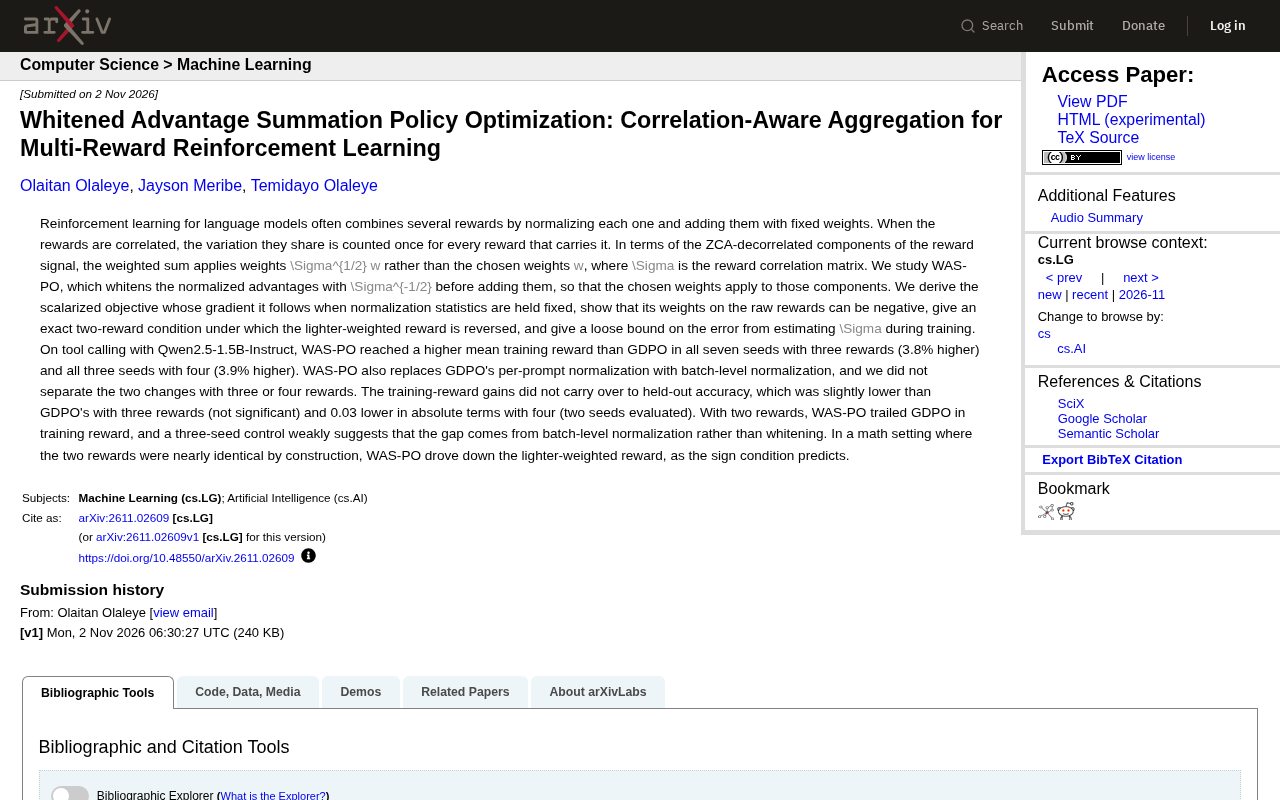
WAS-PO: Using Whitened Advantages to Solve the Correlation Trap in Multi-Reward Reinforcement Learning
WAS-PO paper proposes whitening advantages to correct correlation bias in multi-reward RL: when rewards are correlated, naive weighted summation effectively applies Σ^{1/2}w instead of w. Experiments show training reward improves steadily, but held-out accuracy does not improve in sync, and under two rewards it actually falls behind.