Why Is Tipping Culture So Hard to Kill in America? A Look at Habit and Game Theory

America's tipping system is locked in by wage laws, game theory, and cultural inertia — a trap everyone resents but no one can escape alone.
America's tipping culture persists because it is deeply tied to service-industry wage law: federal rules allow tipped workers to receive a base wage far below the standard minimum, meaning abolishing tips would require restructuring the entire sector's pay model. This creates a classic prisoner's dilemma — individual customers who refuse to tip only hurt workers without changing the system, merchants who drop tipping are undercut on price, and high-earning veteran servers may actively oppose reform. The spread of digital payment terminals has made things worse, using default high-tip options and social pressure to extend tipping into counter-service contexts. Real change is more likely to come from legislation mandating a unified minimum wage or from leading businesses restructuring their pricing than from any individual consumer protest.
Why Is Tipping Culture So Hard to Kill in America? A Look at Habit and Game Theory
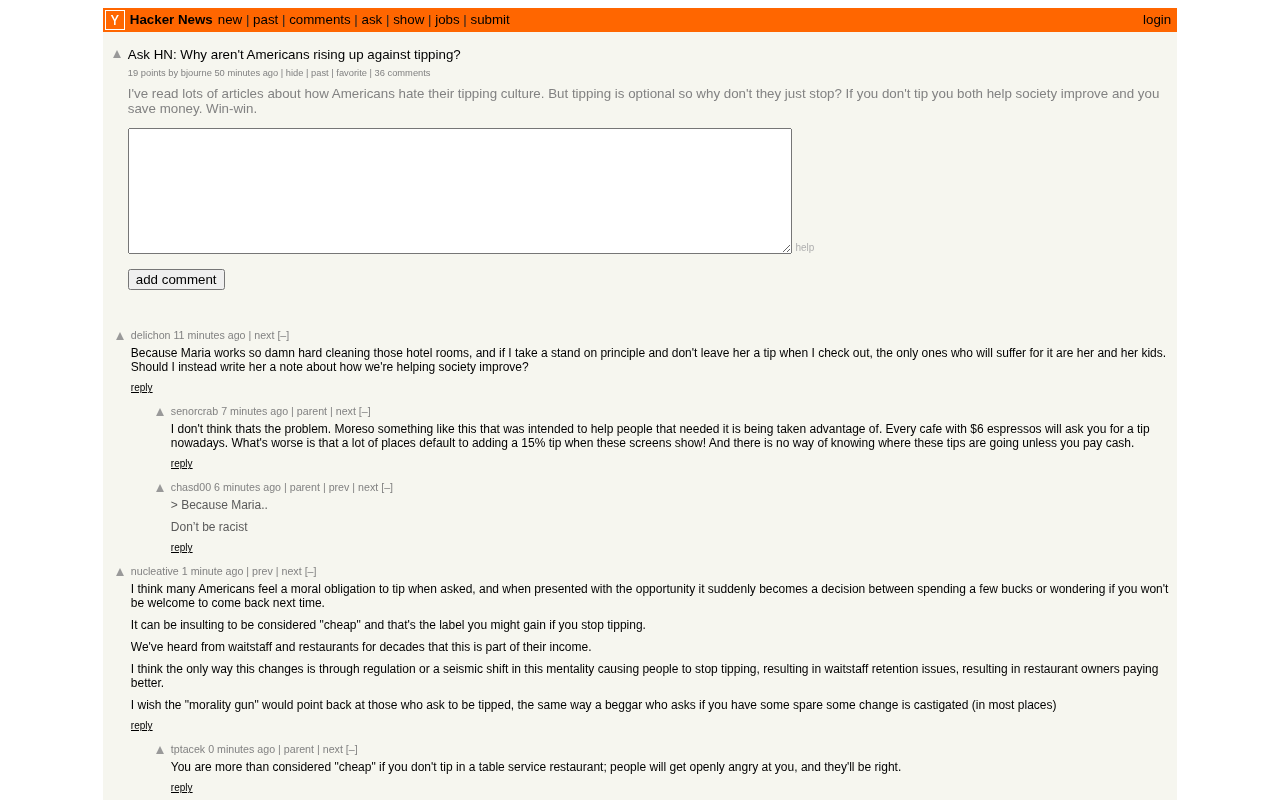
America's tipping culture has long been a curiosity for outsiders. Whether you're at a restaurant, a coffee shop, or using a rideshare app, that "suggested tip" prompt seems to have infiltrated every corner of daily spending. A thread on Hacker News posed a sharp question: if so many people complain about tipping, why haven't Americans actually risen up to change it?
The Core Problem: A System Everyone Gripes About but Nobody Changes
The thread's title cuts right to the point — why don't Americans revolt against the tipping system? On the surface, it looks like a simple question about consumer habits. But underneath, it involves a complex web of labor economics, social contracts, and individual psychology.
The discussion itself wasn't explosive (14 points, 15 comments), yet it reflects a topic that keeps coming up without ever getting resolved. The "stubbornness" of tipping is precisely this: nearly everyone involved admits something is wrong, but no one can offer an alternative that could be implemented right now.
Institutional Inertia: Why Change Is So Difficult
Tipping isn't simply a "voluntary gesture" from customers. In many U.S. states, the legal minimum wage for tipped workers is allowed to fall below the standard minimum wage — the so-called tipped minimum wage — meaning workers rely heavily on tips to make up the difference. This means any attempt to abolish tipping is, in effect, a restructuring of the entire service industry's compensation model.
This creates a classic prisoner's dilemma:
The Customer's Dilemma
A single customer refusing to tip won't change the system — it will simply cut into a worker's actual income. So even when people resent the practice, most go along with it to avoid moral guilt or social awkwardness.
The Merchant's Incentive
For restaurant owners, the tipping model offloads part of labor costs onto customers, keeping menu prices visibly lower and more competitive. Establishments that eliminate tipping and raise prices directly often find themselves at a disadvantage in price-sensitive markets.
A Divided Workforce
Notably, workers in the service industry are not uniformly opposed to tipping. Experienced servers at high-volume venues can earn tip income that far exceeds what a fixed-wage model would offer, so they may have no interest in abolishing the system. This entrenched self-interest further weakens the momentum for change.
The federal tipped minimum wage has been frozen at $2.13 per hour since 1991 — roughly one-third of the standard federal minimum wage of $7.25. The logic is that if a tipped worker's combined earnings (tips plus base wage) fall below the standard minimum wage during a pay period, the employer must make up the difference — though enforcement of this guarantee is inconsistent in practice. State policies vary significantly: California, Washington, and others have abolished the two-tier system and require a single minimum wage for all workers, while Texas, Georgia, and others still follow the federal standard, allowing employers to pay servers as little as $2.13 per hour. This patchwork of state laws makes federal legislative reform extremely difficult and keeps the "abolish tipping" debate confined largely to local experiments.
"Tip Creep": How Technology Amplifies the Frustration
What's been generating even more resentment in recent years is the steady expansion of tipping contexts. Self-order screens and mobile payment terminals now display default tip options of 15%, 20%, or 25% at checkout — extending a custom once reserved for sit-down table service into counter pickups, takeout orders, and other transactions where there's almost no traditional service involved.
This phenomenon, known as "tip creep," has made a growing number of consumers feel socially pressured. The default-option design of digital interfaces exploits people's reluctance to tap "no tip" while a worker is watching, effectively raising both the prevalence and the percentage of tips.
Behavioral economists call this the "default effect": when faced with preset options, people tend to accept the default rather than actively change it, driven by cognitive laziness and loss aversion. When a tablet or phone payment terminal is turned toward the customer with the server standing right there, hitting "no tip" becomes socially excruciating — researchers call this the "audience effect." Payment software providers like Square and Toast also have an indirect financial stake in tip percentages, since higher transaction amounts mean more fee revenue, which creates a commercial incentive to set high default tip options and further entrenches tip creep.
Why There's No "Revolt": The Collective Action Problem
Actually changing tipping culture would require coordinated mass action — merchants simultaneously restructuring pricing and wages, legislatures eliminating the tipped minimum wage, and consumers converging on a new norm. In practice, none of these pieces have a single coordinator.
- No organizer: No single party has enough motivation and capacity to drive systemic change.
- Asymmetric risk: Whoever moves first — whether customer, merchant, or worker — typically absorbs the greatest loss.
- Cultural internalization: Tipping has become a social ritual and a form of self-expression. Many people see generous tipping as a virtue, which means "resistance" itself takes on a moral dimension.
In other words, Americans haven't revolted not because they're satisfied, but because the cost of any unilateral action far outweighs the benefit — and collective action is nearly impossible to organize.
Economist Mancur Olson laid out the theoretical foundation of this dilemma in his 1965 book The Logic of Collective Action: when a reform produces diffuse public benefits but concentrates the costs on a few early movers, rational individuals will tend to "free ride" — waiting for others to push for change while reaping the benefits themselves. Tipping reform fits this model precisely: abolishing tipping would benefit all consumers, but the first customers to refuse to tip must bear the social stigma and potential decline in service quality alone. Without an external coordinating mechanism — such as legislation — this game-theoretic structure almost inevitably preserves the status quo, even when most people are dissatisfied with it.
Some Possible Paths to Change
One idea implicit in the discussion is that real change is more likely to come from institutions than from individuals. Some cities and states have begun gradually eliminating the tipped minimum wage in favor of a full-wage model. Some upscale restaurants have experimented with "no-tipping" pricing, folding service costs directly into menu prices.
These top-down efforts, or those led by prominent establishments, are more realistic than hoping consumers will stage a collective revolt. Once institutions change the rules of the game, the individual prisoner's dilemma dissolves on its own.
Conclusion
The tipping problem is hard to solve not because there aren't critics, but because it is a systemic issue deeply embedded in both economic structure and social psychology. Individual consumer frustration cannot convert into the momentum for change. The real leverage points lie in wage legislation and a restructuring of business models. This modest thread on Hacker News reflects a dilemma that plays out across modern society: systems that everyone dislikes but no one can break alone.
Related articles

OpenAI Partners with Shield: How the Astra Agent Revolutionizes IT Troubleshooting
OpenAI and Shield launch the Astra agent, which autonomously logs into computers and legacy systems to fix IT issues in real time, 35-40% faster than traditional models, with humans involved only when judgment is needed.

iPhone Duo Battery Life Tested: One Charge a Day Is Unavoidable, and the Large Screen Is the Culprit
iPhone Duo battery test: heavy use needs at least one charge a day, and about 30% remains after 6.5 hours of screen-on time. How often the large screen is unfolded is key; a MagSafe battery pack helps, and long-term degradation is also worth watching.

Kimi K3.1 Pro Open-Sourced: 2.8 Trillion Parameters Close In on Opus
Moonshot releases the open-source MoE model Kimi K3.1 Pro, with 2.8T total parameters and 104B activated, trailing Opus 5.5 by under 1 point on Terminal Bench 4.0.