Why "Next-Token Predictor" Is the Wrong Mental Model for Understanding Large Language Models
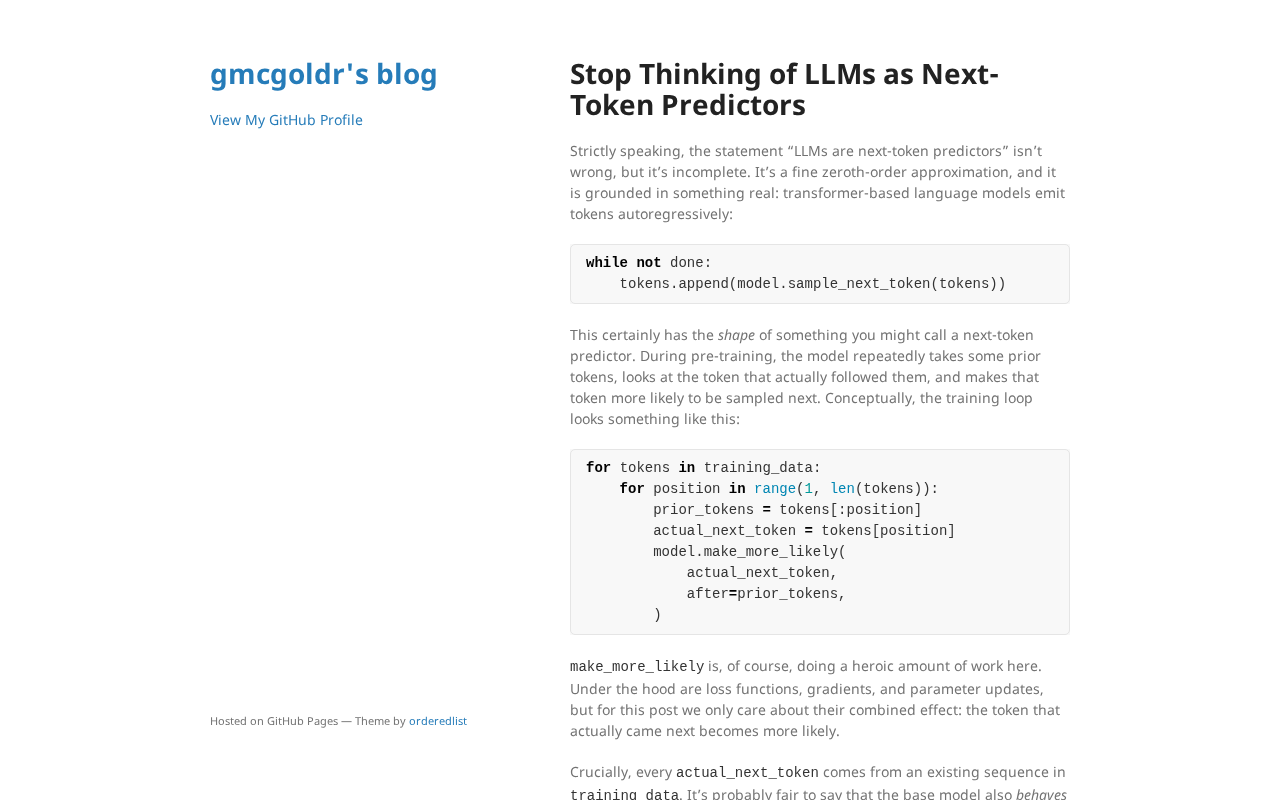
Why reducing LLMs to "next-token predictors" obscures their true capabilities and limitations.
This article argues that while "next-token predictor" accurately describes how LLMs are trained, it fails as a mental model for understanding what they actually learn. Drawing on mechanistic interpretability research, it shows that models develop structured internal representations far richer than simple statistical lookup. The piece advocates for a balanced view that neither mystifies LLMs as emergent intelligence nor reduces them to stochastic parrots.
An Oversimplified Cognitive Trap
When discussing large language models (LLMs), the most common refrain is: "It's just a next-token predictor, that's all." Technically, this isn't wrong — from a training objective perspective, the core of GPT-style models is indeed predicting the probability distribution of the next token based on preceding context.
A common misconception worth clarifying here: a token is not the same as a "word" as we normally understand it. In practice, models use subword tokenization algorithms like BPE (Byte Pair Encoding) to split text into finer-grained segments. For example, the English word "unbelievable" might be split into three tokens — "un", "believ", and "able" — while a common word like "the" remains a single token; in Chinese text, a single character typically corresponds to 1–2 tokens. GPT-4's vocabulary contains roughly 100,000 tokens. So when we say the model "predicts the next token," it's not predicting the next complete word but rather outputting a probability distribution over the entire vocabulary at this finer granularity.
However, a recent opinion piece that sparked heated discussion on Hacker News (52 points, 130 comments) argues that using "next-token prediction" as a mental model for understanding LLM capabilities is precisely misleading.
The reason this topic ignited so much debate is that it touches on a deeper philosophical and engineering question: There is an enormous gap between the training objective and the internal representations the model actually learns. Using the training objective to fully describe a model's capabilities is like using "surviving and reproducing through natural selection" to explain why humans can compose symphonies — the description isn't wrong, but its explanatory power is severely lacking.
Training Objective ≠ Internal Mechanism
"How It's Trained" and "What It Learned" Are Two Different Things
The article's core argument can be summarized as: a system's optimization objective cannot directly tell you what computational structures have formed inside that system.
To be more technically precise, GPT-style models use a training objective called "Causal Language Modeling," which is mathematically about maximizing the log-likelihood probability of each token in the training corpus given its preceding context. Given a text sequence, the model must output a probability distribution covering the entire vocabulary at each position, assigning as high a probability as possible to the token that actually appears. This seemingly simple objective is powerful because it provides extremely dense learning signals — every token position constitutes a training sample, so a 1,000-token article provides 999 training signals. By contrast, in image classification tasks, a single image typically provides only one label as a learning signal. It is precisely this enormous advantage in training efficiency that enables LLMs to extract knowledge from massive text corpora far beyond what "the next word" alone would suggest.
Consider the human brain as an analogy. Evolution's "objective function" is gene survival, but to achieve this goal, the brain evolved abstract reasoning, language, emotion, planning, and a host of other complex capabilities. You cannot derive the fact that humans play chess or prove mathematical theorems from the objective of "reproducing offspring."
Likewise, to better "predict the next token," the model is forced during training to compress the patterns underlying massive amounts of text. To accurately predict the next line of code, the model needs to implicitly understand syntactic structure, variable scope, and even program logic; to predict the next step in a mathematical derivation, the model must construct some form of computational representation internally. Prediction is merely the outward behavior; it is the internal world models that emerge in service of prediction that are the true source of capability.
Evidence of Emergent Capabilities
Research in mechanistic interpretability provides empirical support for this argument. Mechanistic interpretability is one of the most active research directions in AI safety, with the core goal of "reverse-engineering" a neural network's internal computations into human-understandable algorithms. Landmark works in this field include Anthropic's 2022 research on "induction heads" and their 2023 breakthrough using Sparse Autoencoders to extract millions of interpretable features from Claude models. These studies are gradually delivering on the promise of "opening the black box," though they still face scaling challenges — current methods primarily work on smaller models, and complete mechanistic explanations for frontier models with hundreds of billions of parameters remain far out of reach.
Researchers have discovered multiple structured computational circuits inside large language models:
- Neurons specifically tracking "whether parentheses are properly paired"
- Direction vectors representing geographic spatial relationships
- Circuit structures like "induction heads" capable of in-context pattern copying
Among these, induction heads are a precisely identified computational circuit, systematically described by Olsson et al. in their 2022 paper In-context Learning and Induction Heads. They typically consist of two cooperating attention heads: the first is a "previous token head" that copies information from each token to its subsequent position; the second is the induction head itself, which uses the information passed by the first head to find patterns in the history that match the current context and predict the token that should follow that pattern. For example, if the text previously contained "Harry Potter is a wizard," when the model later encounters "Harry Potter is" again, the induction head can trace back to the earlier pattern and predict "a wizard." The significance of this discovery is that it shows the model's in-context learning ability is not some vague statistical association but a precise algorithm implemented by specific, localizable neural circuits.
These findings demonstrate that the model's internals are not simple statistical lookup tables but rather computational circuits with clearly defined functions.
The Other Side of the Debate: Reductionism Isn't Entirely Wrong
Legitimate Concerns from Dissenters
Those holding different views raise counterarguments worth taking seriously:
First, the description "next-token prediction" is at least precise and falsifiable. Terms like "understanding" and "world model" are often vaguely defined and can easily slide into anthropomorphic over-interpretation. When we say a model "understands," what exactly do we mean? Without a measurable definition, replacing "next-token prediction" with "world model" may simply be trading a precise description for a vaguer one.
Second, over-mystification is equally dangerous. Packaging LLM capabilities as inexplicable "emergent intelligence" may lead people to overlook fundamental limitations — such as hallucinations, lack of reliable factual consistency, and fragility in out-of-distribution scenarios.
The hallucination problem is deeply connected to the next-token prediction training mechanism. What the model learns during training is "what text looks plausible," not "what is factual" — and there is a fundamental gap between these two. When the model faces the boundaries of its knowledge or uncertainty, its probability distribution still tends to generate fluent, seemingly confident text, because uncertain or ambiguous expressions are relatively rare in training data. Moreover, the model lacks a reliable mechanism for "self-awareness" — it cannot accurately distinguish between knowledge it genuinely "knows" and content it "fabricates" through statistical interpolation. Current approaches to mitigating hallucinations include Retrieval-Augmented Generation (RAG), Reinforcement Learning from Human Feedback (RLHF), and Chain-of-Thought prompting, but these methods can only reduce rather than eliminate hallucinations.
Fragility in out-of-distribution (OOD) scenarios is equally concerning. When a model encounters inputs that differ significantly from its training data distribution, its performance often degrades sharply. For example, a model might excel in common programming languages yet make basic syntax errors in niche ones; or produce answers that conflate historical data with events occurring after its training data cutoff. The strength of out-of-distribution generalization is, in fact, a critical litmus test for whether a model has learned superficial statistical correlations or deeper causal structures. These issues can be reasonably explained by "it's fundamentally still doing probabilistic prediction."
Two Perspectives Are Really Different Levels of Abstraction
A more mature view holds that this debate is essentially a dispute over levels of abstraction, not a dispute over right and wrong:
- At the training and implementation level, "next-token prediction" is an accurate description
- At the capability and behavior level, using "predictor" to explain why a model can reason, translate, and write code is grossly insufficient
This is like describing a computer: saying it "just switches transistors on and off" isn't wrong, but you can't use that statement to explain how it runs an operating system or renders a 3D game. Different levels require different explanatory frameworks.
Why This Mental Model Matters
Mental Models Directly Shape Our Judgments About AI
Which mental model we adopt directly influences how practitioners, investors, and even policymakers judge AI:
- If we insist on "merely a next-token predictor," it's easy to conclude that "LLMs have no real intelligence and a low capability ceiling," thereby underestimating their potential on complex tasks
- If we over-emphasize "emergent world models," we risk overestimating their reliability and ignoring fundamental deficiencies in factuality and robustness
It's worth noting that the concept of the "Stochastic Parrot," widely cited in the industry, is itself a microcosm of this mental model debate. The term comes from the 2021 paper On the Dangers of Stochastic Parrots: Can Language Models Be Too Big? by Emily Bender, Timnit Gebru, and others. Its core argument is that large language models merely stitch together language fragments based on statistical patterns in training data without truly understanding the meaning of language. This paper directly led to both authors' departures from Google and sparked fierce debate in the AI ethics space that continues to this day. Supporters believe the metaphor accurately reveals the fundamental limitations of LLMs, while critics argue it oversimplifies the model's capabilities and ignores the possibility of qualitative changes brought about by scaling.
A more balanced mental model should be: LLMs are systems that, through the training signal of next-token prediction, have acquired partial, biased, but genuinely structured internal representations of the world behind text. They are neither simple "stochastic parrots" nor general intelligences with true understanding.
Implications for Future Research
This discussion also points toward a clear research direction: rather than debating "is it a predictor or not," we should invest more effort in opening the black box, using mechanistic interpretability methods to empirically answer "what structures has the model actually learned internally." Only when we can precisely describe a model's internal computations can we truly move beyond the war of words between "training objective vs. emergent capability."
Conclusion
"Next-token predictor" is not an incorrect description — it's an incomplete mental model. It precisely characterizes how the model is trained, yet obscures the rich internal structures that emerge during the training process. Understanding large language models requires us to hold two perspectives simultaneously: acknowledging their statistical prediction nature while also recognizing the complex representations they have acquired.
At a time when AI capabilities are repeatedly both overestimated and underestimated, building a mental model that neither mystifies nor over-reduces may be the cognitive tool we need most.
Related articles
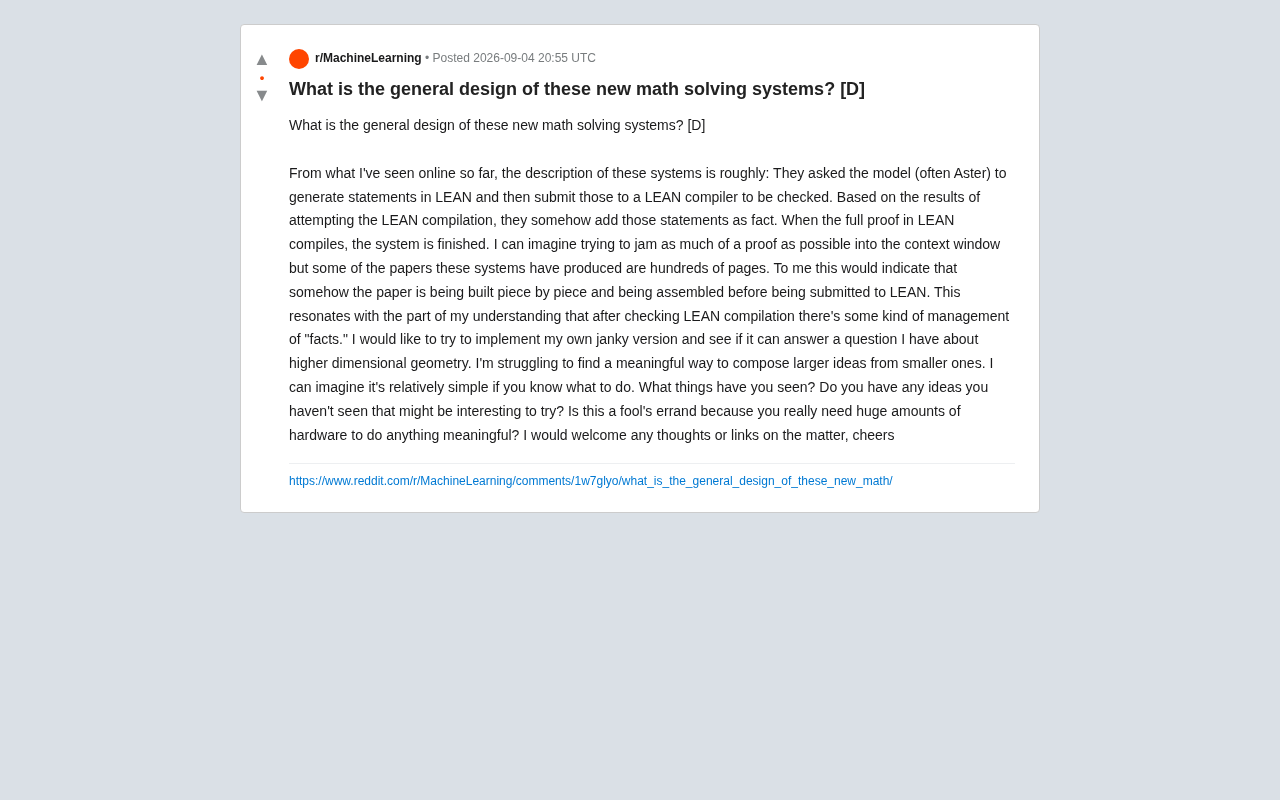
Design Principles of AI Mathematical Solving Systems: A Complete Guide to LEAN Formal Proofs
Deep dive into AI math solving system architecture: generate-verify-iterate workflows, LEAN formal proofs, chunking strategies for long proofs, and practical paths for individual developers.

Tesla Cybercab Bans Children Under 13 — Even With a Parent Present
Tesla's Cybercab robotaxi bans riders under 13, even with a parent. The policy is stricter than Model Y robotaxis, driven by safety, liability, and operational concerns.
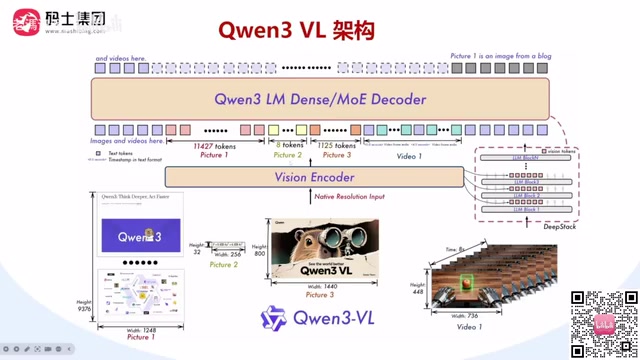
Qwen3-VL Local Deployment & Fine-Tuning in Practice: From Environment Setup to Circuit Board Recognition
A detailed guide to fine-tuning the Qwen3-VL vision-language model, covering VLM architecture, GPU selection, FlashAttention offline installation, circuit board dataset prep, and TF32 mixed-precision optimization.