Why Rockets Don't Land Horizontally Like Airplanes: A Physics and Engineering Trade-off

Rockets don't land like airplanes because wings become dead weight in space—vertical recovery is more launch-efficient.
Starting from the counterintuitive question of why rockets don't glide down like airplanes, the article points out that wings only generate lift in dense atmosphere and become pure dead weight in space, and they must be accelerated to orbital velocity along with thermal protection and brought back, directly eating into payload capacity. Rockets must accelerate payloads to the order of several kilometers per second, so any extra kilogram incurs a multiplicative penalty. The Space Shuttle and X-37B do land on runways as gliders, but at the cost of carrying wings and landing gear throughout. The Falcon 9 reuses existing engines, tanks, and guidance, retaining propellant for vertical landing; the Super Heavy booster is even caught directly by the launch tower, eliminating landing legs. The conclusion: rockets don't land vertically because they can't, but because it's the more cost-effective choice after engineering trade-offs.
A Counterintuitive Question
When people watch videos of the Falcon 9 landing vertically, many of them have the same question: if airplanes can glide down horizontally and return to the ground, why can't rockets just copy that approach? The answer lies in the fundamental physics of the atmosphere and the logic of launch efficiency. A popular science short video on YouTube nails the core point in one sentence: wings and landing gear are only useful in dense atmosphere and during the landing phase, yet a rocket has to carry them all the way to space.
A Wing's "Habitable Zone" Is Only the Atmosphere
The prerequisite for a wing to generate lift is that enough air flows over its surface. In dense atmosphere, wings can indeed provide control moments, cross-range, and runway landing capability. But once a rocket climbs into outer space, where there is almost no air, the wing surface becomes pure dead weight.
The problem is that this "dead weight" doesn't automatically disappear when entering space. It needs to be accelerated to orbital velocity, requires extra structural strength to withstand aerodynamic heating, and needs thermal tiles for protection. According to the video, wings, landing gear, and their thermal protection all have to be carried all the way to orbit and back into the atmosphere. This directly eats into payload capacity—every gram of payload costs more.
Aerodynamic heating is another reason wings and thermal protection systems must accompany the vehicle throughout. When a spacecraft re-enters the atmosphere at hypersonic speed, the bow shock violently compresses the air, and temperatures can reach thousands of degrees Celsius. Protruding surfaces like wings create more complex heat flux distributions and shock-wave interference, requiring specialized thermal tiles or hot structures for protection. For this reason, the Space Shuttle placed reinforced carbon-carbon (RCC) material on the wing leading edges, and the entire thermal protection system consumed considerable weight and maintenance cost. This constraint also applies to the ascent phase—the thermal protection structure must exist as dead weight from launch until it actually serves its purpose during re-entry.
The Velocity Ledger: Every Kilogram Must Be Accelerated
The video mentions a key physical quantity: a rocket must accelerate its payload to the order of several kilometers per second to either turn the booster around or put the spacecraft into orbit. At this scale, any extra kilogram incurs a multiplicative penalty.
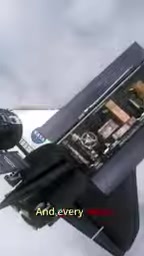
This means designers must trade off between "recovery method" and "launch efficiency." Adding wings and landing gear to a rocket yields a recovery tool that only works during specific phases, yet you pay for it throughout the entire ascent. The video's exact words: airplane-style landing isn't wrong—it's just one of many trade-offs.
The Tsiolkovsky rocket equation is the mathematical basis for understanding why "every kilogram incurs a multiplicative penalty." The formula is Δv = Isp·g₀·ln(m₀/m₁), where Δv is the velocity increment, Isp is the engine specific impulse, m₀ is the total liftoff mass, and m₁ is the final mass after propellant is exhausted. The key lies in the natural logarithm term: when the required Δv approaches or exceeds a significant fraction of the launch vehicle's total velocity capability (roughly 9–10 km/s to reach orbit), a slight increase in final mass forces propellant and structural mass to balloon non-linearly. This explains why dead weight isn't simply "carrying one extra kilogram"—it triggers a cascading amplification throughout the mass chain. The mass saved by removing wings and landing gear can ultimately translate into substantial payload to orbit.
Some Spacecraft Do Land Like Airplanes
To be clear, rockets haven't never landed like airplanes. The Space Shuttle returned to the ground as a glider, and the X-37B follows the same path. They use wings to gain cross-range and perform horizontal landings on runways.
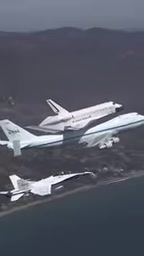
The cost of this approach is exactly what was mentioned earlier: wings, landing gear, and their thermal protection must accompany the vehicle throughout. So it's better suited for spacecraft that inherently pursue large cross-range, runway recovery, and reusability—not boosters seeking extreme launch efficiency.
Cross-range is a key metric for the Space Shuttle's runway landing capability and one of the reasons the U.S. Air Force imposed hard requirements on the Shuttle. It refers to the maximum distance a spacecraft can glide to reach a runway after re-entry even when deviating from the nominal landing point, typically measured in kilometers. Large cross-range allows the spacecraft to choose among multiple alternate airfields within a single orbital pass, enhancing mission flexibility and safety. Ordinary wingless re-entry capsules can only land along ballistic impact points, with extremely limited cross-range capability. For reusable boosters, this runway adaptability isn't needed, so carrying wings and landing gear for them isn't cost-effective.
Let Rockets Land Like Rockets
Reusable boosters already have engines, tanks, and guidance systems built in. The Falcon 9's approach is straightforward: retain some propellant, turn around, and land vertically on legs. The entire recovery system reuses components the rocket already has, without carrying an extra "airplane kit."
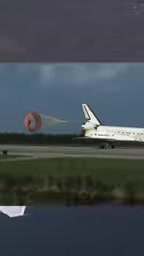
SpaceX's Super Heavy booster takes this even further—the launch tower directly "catches" the returning booster, eliminating even the landing legs. The video's conclusion is simple: if all you want is to get the booster back, letting a rocket land like a rocket may be cheaper than taking an airplane to space.
This Isn't a Battle of Approaches, but a Debate Over Trade-offs
Seeing this comparison as a right-or-wrong contest between "airplane camp vs. rocket camp" misses the point. Horizontal landing brings cross-range and runway adaptability; vertical landing delivers structural weight savings and system reuse. Both answer the same question: how low can recovery costs go?
For launch missions where orbital mass is king, integrating the recovery system into the rocket itself and letting the vehicle return like a vehicle is the more cost-effective engineering solution. For spacecraft that need gliding maneuvers or runway access, wings remain irreplaceable. Rockets don't land like airplanes not because they can't, but because after doing the math, they don't need to.
Related articles

Can AI Governance Tools Block Agent and API Calls?
A Reddit developer questions whether AI governance tools only flag Agent calls rather than block them. We analyze the flagging vs. real-time blocking capability gap, vendor demo mismatches, and key questions to ask when buying.

Perplexity's New Default Setting: The Experience and the Logic Behind It
Exploring the significance and impact of Perplexity's default setting change, analyzing how defaults guide user experience and speculating on model, search scope, or answer style adjustments.

Real or Fake? Gaussian Splatting + Physics Engine Tackles Robot Simulation Challenges
Reddit developer shares a photorealistic robot simulation built with Gaussian Splatting, MuJoCo Warp physics, and mesh models—generating interactive scenes from iPhone scans to tackle sim-to-real.