Why the AI Era Urgently Needs "Default Hard Budget Caps"

Simon Willison argues cloud services should default to hard budget caps, and AWS and Google Cloud are starting to comply.
Prominent developer Simon Willison argues that as coding agents lower the barrier to deploying paid services, the risk of unexpected runaway bills grows in parallel. He contends that soft warning emails can't stop bills from spiraling — only hard "cut-off-at-the-limit" caps can truly protect users, and they should be on by default, requiring users to actively opt out. AWS recently launched project-level spend limits, and Google Cloud rolled out Spend Caps months earlier, signaling an emerging industry trend. Willison further envisions coding agents themselves prioritizing vendors with hard caps, moving financial risk prevention upstream to the decision-making phase.
When coding agents and personal agents make "writing code to run services" easier than ever before, a hidden financial risk is amplified right alongside it — waking up in the middle of the night to discover your service burned through thousands of dollars while you slept. Prominent developer Simon Willison recently wrote that within the next few years, virtually every pay-as-you-go service and API should offer hard budget caps by default.
What Are "Hard Budget Caps"?
A hard budget cap means: once a service's monthly spend reaches the configured $X limit, the system immediately cuts off the service and returns an error — rather than continuing to charge. This stands in sharp contrast to a "soft cap," which merely sends a warning email while costs keep accumulating.
Willison's core argument is straightforward: soft caps simply aren't enough. Nobody wants to learn from a midnight alert email that their runaway service racked up hundreds or thousands of extra dollars while unattended. Warning emails cannot stop bills from ballooning — only a true "kill switch" can protect users.
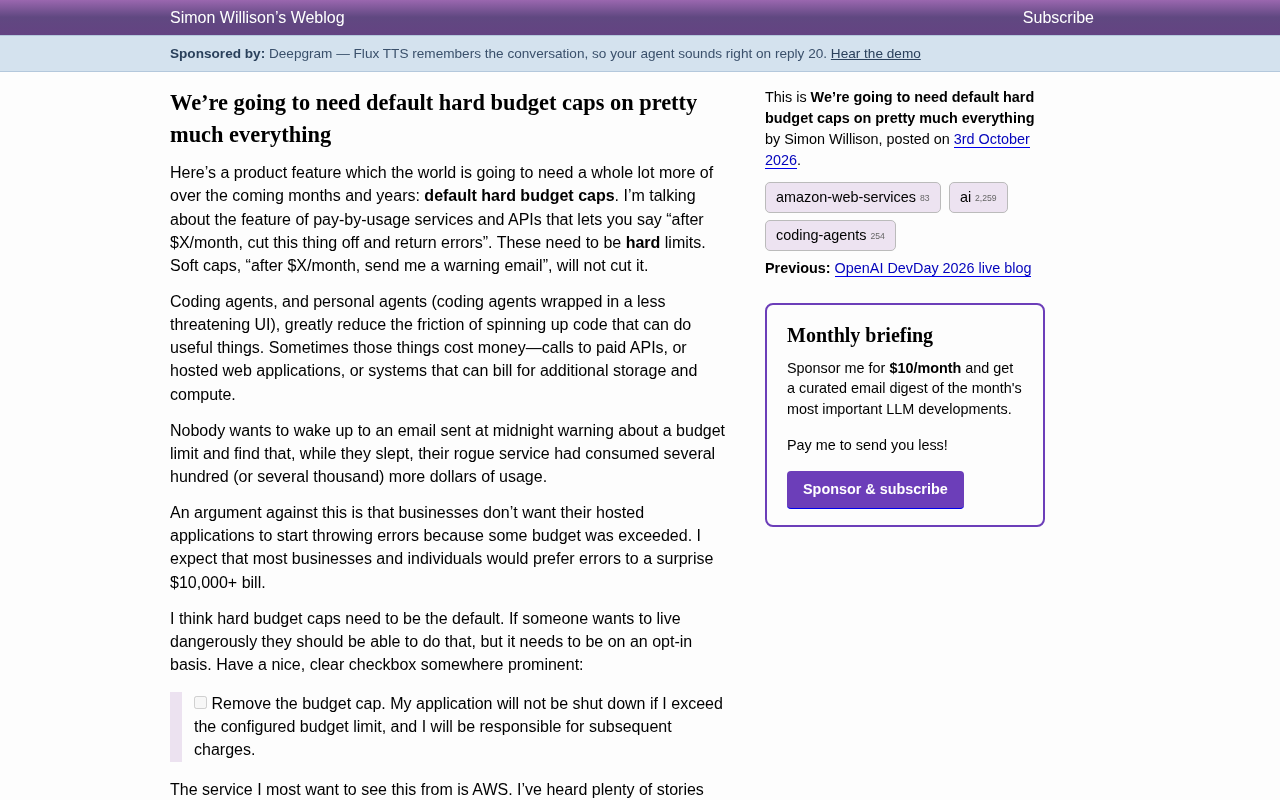
Agents Amplify the Risk of Financial Runaway
Coding agents — and personal agents wrapped in friendlier interfaces — have dramatically lowered the bar for "making code do something useful." But those "useful things" often cost money: calling paid APIs, running hosted web applications, or systems that charge extra for storage and compute.
The problem is that lowering the programming barrier has also led many inexperienced newcomers to deploy services without fully understanding the billing model. Once a bug appears or a traffic attack hits, systems without hard caps can generate astronomical bills in a short amount of time.
This kind of financial runaway is far from rare in the developer community — there's even a dedicated term for it: "Cloud Bill Shock." Typical scenarios include: a bug in a loop calling an LLM API that generates thousands of dollars in fees within hours; an unprotected public endpoint with no rate limiting getting hammered by scrapers; or a data pipeline script that repeatedly writes data due to a logic error, generating massive storage charges. AWS and GCP's per-second billing models mean a runaway can spiral in minutes, while users often remain completely unaware until the billing cycle ends. For newcomers deploying services via coding agents, they typically focus on "getting the feature working" rather than proactively reading billing documentation or configuring alert thresholds — making their actual financial exposure far greater than that of experienced engineers.
Why It Should Be the "Default"
The common argument against hard caps is that businesses don't want their live applications throwing errors and interrupting service just because they've gone over budget. But Willison argues this logic doesn't hold — for the vast majority of businesses and individuals, accepting a service error is far preferable to receiving an unexpected bill for tens of thousands of dollars.
He advocates for hard caps to become the default configuration. Users who genuinely want to "live dangerously" can of course opt out — but this must be an opt-in action. He even envisions a clear checkbox:
☐ Remove budget cap. My application will not be suspended even if it exceeds the configured budget limit, and I will be responsible for any charges incurred thereafter.
This design shifts the default burden of risk from "an unprepared user" to "a user who has been explicitly informed and actively accepts responsibility" — which aligns with the fundamental principles of security-by-design.
"Secure by Default" is a classic principle in software security design: a system's initial state should protect the users least familiar with the risks, not cater to the most experienced ones. Setting hard budget caps as the default is a direct application of this principle at the financial security level. A comparable example is Privacy by Default: GDPR requires products to adopt the strictest privacy settings by default, rather than having users opt into protections themselves. Willison's proposed opt-in checkbox design closely mirrors the "informed consent" mechanism — users must actively read and acknowledge the risk before removing the protection. This design shifts the cognitive burden from "newcomers who don't understand billing models" to "experienced users who explicitly choose to accept the risk," which is consistent with the Principle of Least Astonishment: most users intuitively expect that exceeding a limit will cut off the service, rather than continuing to charge.
Cloud Providers Are Following This Trend
The good news is that major cloud providers have already started acting. The service Willison most wants to see this feature on is AWS — he's heard too many stories of people refusing to run personal projects on AWS out of fear that a runaway service could bankrupt them, and plenty more who got badly burned because they didn't anticipate the risk.
And indeed, AWS recently (on September 16) announced in a post titled New AWS experience helps builders get started and ship faster that it has introduced a spending limit feature:
When you're ready to upgrade to a paid plan, you can set monthly spend limits for your projects based on your usage patterns to ensure you don't go over budget. If a project's usage reaches the spend limit, the project will be suspended for the remainder of the month.
However, the official documentation notes that this new experience is currently only available to a limited number of customers — it's hoped this will roll out to existing accounts as soon as possible.
Not Just AWS — Google Cloud Has Also Joined In
This isn't AWS acting alone. Google Cloud rolled out a similar Spend Caps feature in July, allowing users to "set monthly financial limits on specific services within a project." With two major cloud providers launching comparable features around the same time, it's clear that "hard budget caps" are evolving from a vocal demand into an industry-wide trend.
Can Agents Help?
At the end of his post, Willison raises a forward-looking idea: in an ideal world, agents themselves should be part of this risk management ecosystem.
If coding agents, when recommending service providers, could preferentially favor vendors that offer hard budget caps and proactively warn inexperienced newcomers away from using uncapped services for applications that could get them into trouble, then financial safety could shift from "after-the-fact damage control" to "the decision-making phase."
This also reveals a deeper point: as AI tools make "building" increasingly easy, the accompanying guardrail mechanisms must evolve in step. Lowering the technical barrier should not mean raising the financial risk. Default hard budget caps are among the most fundamental — and most urgently needed — of these guardrails.
Related articles

Why Does the Tesla Roadster Need to Fly? A Deep Dive into Musk's Wild Demo
Tesla's Roadster launch showed wall-climbing, upside-down driving, and flying stunts—but The Vergecast notes the demo car may lack a battery, the Rocket version is invite-only and not street-legal, and the website terms don't guarantee delivery. After nine years of delays, why does this car still need to exist?

AI Is Not a Replacement: Human-AI Collaboration Through the Lens of Factory Root Cause Analysis
Starting from factory root cause analysis, this article explains how AI accelerates evidence chain construction rather than replacing human experts, exploring the pragmatic implementation logic and business value of 'AI supporting people rather than replacing them.'

AI Agent Decision Auditing: Building an Evidence Chain in Regulated Workflows
Starting from a Reddit discussion, this article analyzes three core issues in AI agent decision auditing within regulated workflows: what fields audit records should contain, how to handle feedback latency for erroneous decisions, and how to continuously calibrate LLM judge consistency with human judgment.