Why Voice AI Hasn't Had Its ChatGPT Moment Yet

Voice AI hasn't replicated ChatGPT's breakthrough due to structural flaws in context understanding.
Multiple industry executives argue that voice AI has yet to reach a ChatGPT-style tipping point. The core issue is the fragility of the voice AI pipeline: errors in ASR, semantic understanding, dialogue management, and response generation stack on top of each other, and failures in the context layer routinely cause the entire chain to collapse. Unlike text interaction, voice's real-time, continuous nature means every mistake is instantly amplified — and users have very little tolerance for it. Technical progress alone doesn't guarantee product maturity; voice AI must cross the reliability threshold that makes ordinary users genuinely willing to depend on it. Multimodal large models are seen as the most promising path forward, though barriers to commercial deployment remain.
Voice AI's "ChatGPT Moment" Keeps Getting Delayed
When ChatGPT reshaped public perception of AI with its remarkable conversational abilities, the entire industry began searching for the next breakthrough. Voice AI was once seen as the most promising frontier after text-based interaction. Yet, multiple industry executives believe voice AI has yet to reach its own "ChatGPT moment" — that critical threshold where a technology crosses from niche to mainstream and fundamentally changes how people interact with it.
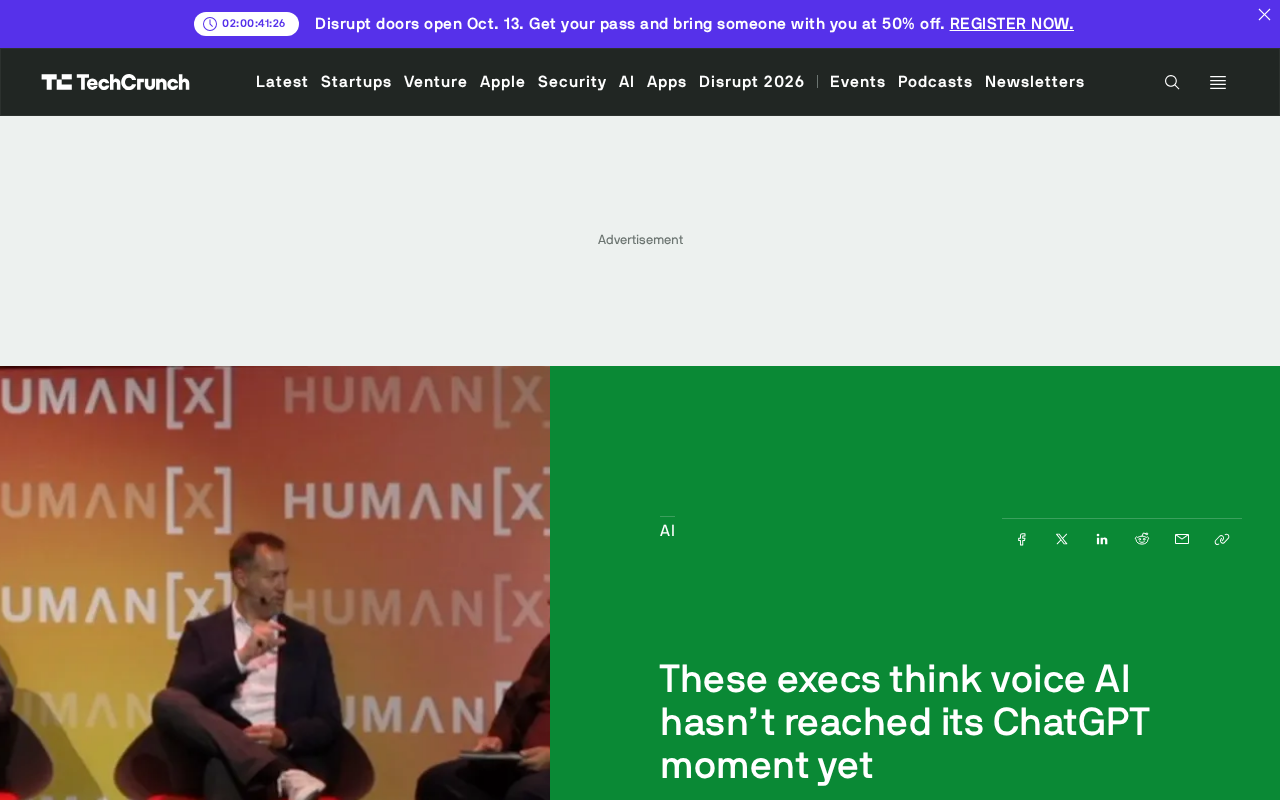
This assessment reflects the structural challenges voice AI continues to face in real-world deployment. While the quality of speech recognition and speech synthesis has improved dramatically in recent years, building a truly reliable, fluid voice interaction system capable of understanding complex context remains extremely difficult.
Context Understanding: Voice AI's Critical Weakness
Industry observers point out that one of voice AI's most fundamental problems is that its "context layer" frequently misses critical information. In conversation, a user's intent often depends on prior exchanges, environmental cues, and implicit background knowledge. When the system misinterprets context, the entire processing pipeline can collapse.
This is fundamentally different from pure text-based large language models. In text interactions, users can take their time to organize their thoughts and correct their phrasing. In voice scenarios, interaction is real-time and continuous — any error in any step is immediately amplified. A voice AI pipeline typically includes automatic speech recognition, semantic understanding, dialogue management, response generation, and speech synthesis. Errors at each stage propagate and accumulate downstream.
In other words, voice AI isn't a problem that can be solved by a breakthrough in any single technology. It's an end-to-end systems engineering challenge. The failure to reliably understand context is precisely the weak link that makes the entire chain fragile.
Why Context Is So Hard to Handle
The real-time nature of voice interaction demands that a system complete multi-turn reasoning in milliseconds, while simultaneously handling accents, speaking pace, background noise, and colloquial expressions. Compared to the relative cleanliness of text input, voice input is inherently unpredictable. When a system fails to accurately capture the user's true intent, everything that follows is built on a flawed foundation — ultimately manifesting as a broken user experience.
The voice AI pipeline is the key framework for understanding its fragility. A typical pipeline includes at minimum: Automatic Speech Recognition (ASR, converting audio to text), Natural Language Understanding (NLU, parsing intent and entities), Dialogue State Tracking (DST, maintaining multi-turn context), dialogue policy and response generation, and finally Text-to-Speech (TTS) synthesis. Each stage carries its own error rate, and these errors don't cancel each other out — they stack. If ASR mishears a phrase, every subsequent step of reasoning is built on a false premise. This "error cascade" effect barely exists in text interaction, because the user's typed input is itself accurate — a guarantee that voice interaction fundamentally lacks.
The Gap Between Technology and Product
The executives' perspective reveals a deeper industry reality: improvements in technical capability don't automatically translate into product maturity. ChatGPT became a phenomenon not only because of its powerful underlying model, but because it delivered a stable, coherent, and predictable experience within a specific interaction paradigm.
For voice AI to replicate that success, it needs a qualitative leap in reliability. Users actually have a very low tolerance for voice assistants — one misheard command, one irrelevant response, and a user may give up entirely. This is the core reason voice AI hasn't achieved true mainstream adoption: it hasn't yet reached the reliability threshold that makes ordinary users "willing to depend on it repeatedly."
It's worth examining why ChatGPT's rise was considered a "moment" rather than gradual progress. After ChatGPT launched in November 2022, it surpassed one million users in five days and exceeded 100 million monthly active users within two months — the fastest growth ever recorded for a consumer application. The underlying logic of this explosion was that it crossed a threshold, across a wide enough range of tasks, of being "useful enough that it needs no instruction manual." Researchers describe this as the "perceived reliability tipping point" — when a technology's failure rate drops below a certain threshold, users' mental model shifts from "occasionally useful tool" to "default dependency." Voice assistants (Siri, Alexa, Google Assistant) have existed for over a decade; while user penetration is high, rates of deep reliance have remained consistently low, precisely because they've never crossed this tipping point. The core challenge facing voice AI today is essentially how to replicate ChatGPT's crossing of that threshold in the significantly harder interaction domain of voice.
Where Does the Industry Go Next?
To reach a voice AI "ChatGPT moment," the key may lie in redesigning the entire context-handling architecture — giving systems stronger fault tolerance and contextual memory. As multimodal large models advance, unified modeling of voice, text, and environmental information holds the potential to fundamentally improve the quality of context understanding.
For founders and product teams, this means resisting the temptation to chase voice interaction's hype and instead confronting its engineering complexity honestly. Whoever solves the reliability problem at the context layer first may well define the next era of voice AI.
For now, voice AI remains on the eve of a breakthrough. The pieces of the technical puzzle are gradually coming together, but the decisive tipping point has yet to arrive.
Multimodal large models represent the most anticipated technical path forward. Models natively built for multimodality — such as GPT-4o and Google Gemini — attempt to jointly model voice, text, and images as a unified input stream, rather than following the traditional pipeline approach of converting speech to text before understanding it. The advantage of this architecture is that the semantic information carried in vocal prosody, pauses, and tone isn't discarded at the ASR stage — the system can extract emotional and intentional cues directly from acoustic features. The real-time voice mode of GPT-4o, demonstrated by OpenAI in 2024, showcased the potential of this approach: response latency dropped to approximately 200 milliseconds, approaching the natural rhythm of human conversation, with the ability to perceive the speaker's emotional state. However, the training data requirements, inference costs, and robustness of native multimodal voice models in noisy real-world environments remain the primary bottlenecks to commercial deployment.
Related articles

Gemini 4 Argon Hands-On: AI Builds Board Games, Constructs Temples, and Trains Robots Autonomously
Gemini 4 Argon hands-on roundup: AI autonomously builds a desk racetrack and temple in Blender, writes a ray tracing engine, trains a humanoid robot to sink 7 shots, plus API pricing and developer access.

The Magic Octagonal Coin: Why Only 9% of People Can Predict Its Flip?
Only 9% of people can correctly predict the Magic Octagon coin flip. This article explains its spatial rotation mechanism, common cognitive pitfalls, and a new hypothesis based on Relevance Theory, exploring the limits of human spatial reasoning.

Sam Altman: AI Is Entering the Era of Scientific Discovery — Math Breakthroughs Will Replicate in Biology and Energy
Sam Altman says AI is entering the era of scientific discovery — math breakthroughs will replicate in biology, materials science, and energy to help develop new drugs and energy sources.