Why You Shouldn't Use AI to Write Substantive Content: A Creator's Reflection

AI writing skips the cognitive process that matters most — and long-term reliance quietly erodes independent thinking.
This article builds on a contrarian claim: in an age of generative AI, you should almost never use AI to write substantive content. The core argument is that writing is inherently an act of thinking — the struggle to organize vague ideas into clear arguments is where cognition deepens. AI's fluent output bypasses this step while masking the absence of real thought. The article draws a practical boundary: AI is fine for formatted text and polishing, but opinion pieces and original analysis shouldn't be outsourced. The deeper risk is that habitual AI reliance causes silent atrophy in reasoning, argumentation, and the capacity to form independent views — a decline the person experiencing it rarely notices until it's too late.
Core Argument: AI Shouldn't Think for You
An article sparking discussion on Hacker News makes a somewhat contrarian claim — almost never use AI to write anything substantive. In an era when generative AI tools are everywhere and AI assistants have infiltrated nearly every writing context, this perspective stands out. Yet it cuts to a question many people avoid: when we outsource our writing to machines, what exactly do we lose?
Writing has never been a purely mechanical process of converting thoughts into words. Truly valuable writing is, at its core, an act of thinking. When you're forced to organize a vague idea into clear, coherent sentences, you often discover that what you thought you understood is riddled with gaps. That moment of being "stuck" is precisely the critical juncture where cognition deepens — and AI intervention skips over exactly this most valuable part.
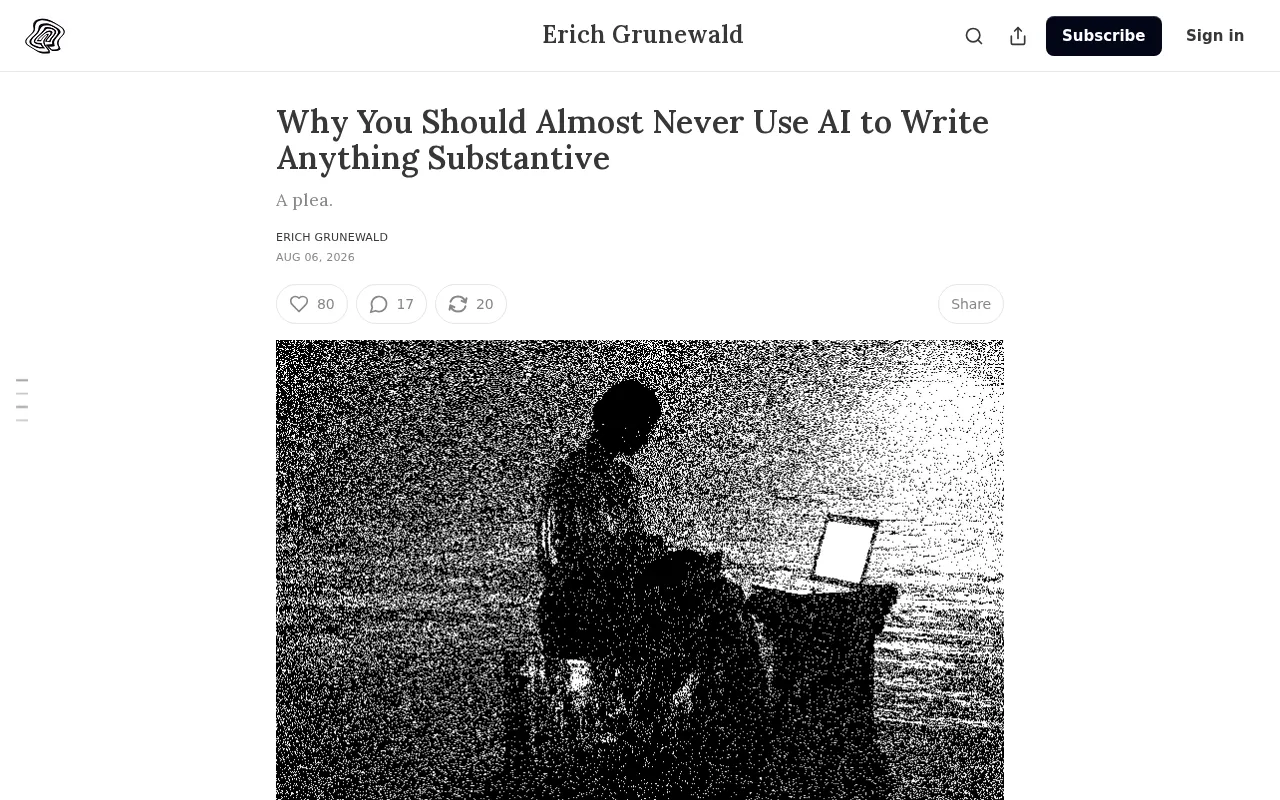
Writing Is Thinking: The Cognitive Process Being Bypassed
The central logic of this argument lies in distinguishing two types of writing: formatted, low-cognitive-load text (routine emails, templated notifications), and "substantive content" requiring independent judgment and original thinking. Using AI to boost efficiency on the former is perfectly reasonable; handing the latter to AI erodes the author's own thinking capacity.
When you ask AI to write an opinion piece, an analytical report, or a structured argument, what you typically receive is an answer that "looks reasonable." But that answer is a statistical fit to vast amounts of text — not the product of your own reasoning. Over time, relying on this kind of output causes people to gradually lose the ability to construct complex arguments, identify logical flaws, and form distinctive viewpoints. This is a subtle, hard-to-detect form of cognitive atrophy.
Fluency Is Not Depth
The most deceptive quality of AI-generated content is its fluency. Perfect grammar, clean structure, polished phrasing — these surface characteristics are easily mistaken for quality. But the value of substantive content lies precisely in the parts that can't be smoothly generated: genuine insight, judgment drawn from personal experience, and the willingness to stake out a position that diverges from the mainstream. AI tends to produce "averaged-out," middle-of-the-road expression — which is often the opposite of deep thinking.
Cognitive science offers a useful explanation for this phenomenon. Large language models (LLMs) are trained to predict "the next most likely token," which means they naturally gravitate toward the most statistically common, broadly accepted expressions. Researchers call this the "regression to the mean" effect — model output is a distributed compression of the training corpus, not an original derivation from the problem at hand. Research on "cognitive fluency" in psychology also shows that readers tend to mistake "easy to read" for "trustworthy" — a dynamic that maps perfectly onto the deceptiveness of AI-generated text. In other words, AI's fluency doesn't just fail to signal depth; it can actually make weak arguments harder to detect by fooling readers' intuitive judgment.
When to Use It, and When Not To
This argument doesn't wholesale reject AI writing tools. The "almost never" in the title leaves room for clear boundaries. The sensible approach is to calibrate AI involvement based on the cognitive load the content requires.
Appropriate use cases for AI:
- Formatted, repetitive text (meeting notes, standard replies)
- Grammar checking and polishing (after you've completed the core expression yourself)
- Divergent brainstorming in early ideation phases (but not as final output)
Cases where AI shouldn't be used:
- Opinion pieces that require expressing personal stance and judgment
- Professional content involving original analysis and argumentation
- Anything you're hoping to "think through" via the act of writing
The key distinction is this: AI should be a supporting tool after you've finished expressing your ideas, not the agent that does your thinking for you. Once that order is reversed, the core value of writing evaporates.
The Deeper Concern: Cognitive "Use It or Lose It"
This discussion points to a longer-term problem — the atrophy of cognitive capacity. Writing, reasoning, and organizing arguments are all skills that require sustained practice to maintain. If a generation grows accustomed to delegating these tasks to AI, the muscles for independent thinking and expression will gradually weaken.
The analogy to calculators and mental arithmetic doesn't fully hold here. The decline of mental math has limited consequences because mathematical calculation has definitive correct answers, and the tool is reliable. But "substantive writing" has no standard answer — it depends on judgment, values, and creativity. These are precisely the capacities hardest to recover and least appropriate to outsource. When AI writes down "your" opinions, are they still your opinions?
It's worth noting that this original article generated modest traction on Hacker News (6 points, no comments at the time), making it more of a personal position than a broadly validated consensus. But the questions it raises are worth taking seriously by every knowledge worker navigating the AI era.
Cognitive science research on "cognitive offloading" provides empirical support for this concern. Columbia University researchers found that when people know information can be retrieved from an external device at any time, their retention and internalization of that information drops significantly — a phenomenon dubbed the "Google Effect." Writing skill degradation may follow a similar mechanism: when the brain anticipates "AI can just write it anyway," its motivation to engage in deep processing decreases. Unlike muscle atrophy, the decline of cognitive skills is often painless and invisible. People feel almost no subjective sense of degradation as it happens — until they're called upon to independently complete a high-cognitive-load task and the gap is suddenly exposed. This makes the "use it or lose it" risk more concerning than the calculator replacing mental arithmetic.
Conclusion: Use AI as a Tool, Not as Your Brain
Generative AI is undeniably a powerful productivity tool — but "can be used" doesn't mean "should be used." In pursuing efficiency, preserving those "inefficient" processes that genuinely shape our thinking may be the wiser choice. For anyone whose core competitive advantage is the ability to think, writing is something worth doing yourself.
Related articles

Why Does the Tesla Roadster Need to Fly? A Deep Dive into Musk's Wild Demo
Tesla's Roadster launch showed wall-climbing, upside-down driving, and flying stunts—but The Vergecast notes the demo car may lack a battery, the Rocket version is invite-only and not street-legal, and the website terms don't guarantee delivery. After nine years of delays, why does this car still need to exist?

AI Is Not a Replacement: Human-AI Collaboration Through the Lens of Factory Root Cause Analysis
Starting from factory root cause analysis, this article explains how AI accelerates evidence chain construction rather than replacing human experts, exploring the pragmatic implementation logic and business value of 'AI supporting people rather than replacing them.'

AI Agent Decision Auditing: Building an Evidence Chain in Regulated Workflows
Starting from a Reddit discussion, this article analyzes three core issues in AI agent decision auditing within regulated workflows: what fields audit records should contain, how to handle feedback latency for erroneous decisions, and how to continuously calibrate LLM judge consistency with human judgment.