Wii Sports Returns on Switch 2: Why Classic Motion Control Is Still Unbeatable

Wii Sports' spiritual successor hits Switch 2, reaffirming living-room social value via intuitive motion.
Nintendo's original motion-sports game returns to Switch 2 as a spiritual successor, framed as a reaffirmation of motion gaming's essence rather than a rehash. Wii Sports was Nintendo's best-selling software ever. The Switch 2 version keeps the "body as controller" design and uses new hardware to improve precision and response rather than adding complexity. The article argues motion gaming's moat is low-barrier multiplayer fun, not specs, and that it strengthens Switch 2's home-entertainment positioning. Long-tail success depends on content updates and online features; nostalgia alone may fade fast.
Nintendo's original motion-sports game returns to Switch 2 in a new form—not just a nostalgic rehash, but a reaffirmation of what motion gaming is really about.
Wii Sports occupies a special place in Nintendo's history—it is the company's best-selling software ever, seeped into pop culture in unexpected ways, and helped Nintendo recover after a sustained downturn. It also launched an important yet understated series. Now, the spiritual successor to that series arrives on Switch 2, and it still "packs a punch."
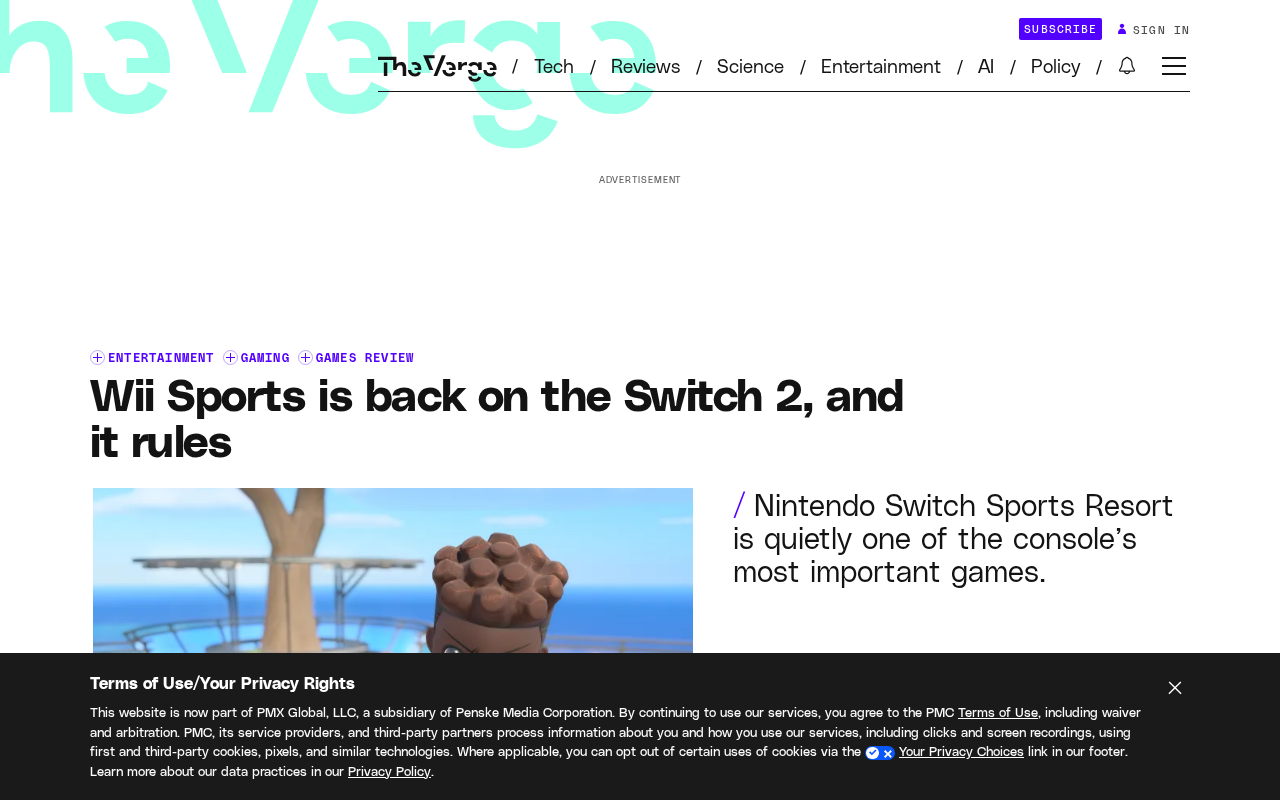
The Foundational Value of Motion Gaming
Wii Sports didn't succeed on graphics or story—it captured the intuition of "action as input." Swinging a racket, pitching a ball, throwing a punch—these actions need no tutorial; anyone can pick up the controller and understand. Switch 2's hardware upgrades provide more refined feedback space for this intuitive experience, but the core design philosophy remains unchanged: let the body be the controller.
From an industry perspective, this return comes after years of motion gaming being marginalized. VR fitness, mobile AR sports, and other attempts each had their highlights, but none replicated the "living-room social" magic of Wii Sports. The value of the Switch 2 version is to remind the market: the moat of motion gaming isn't technical specs—it's low-barrier multiplayer fun.
Technical Background of "Action as Input"
"Action as input" means players map real body movements directly into game commands without button combinations. The three-axis accelerometer built into the Wii Remote was the key hardware foundation for this design: it could sense the controller's tilt, swing, and acceleration changes, translating swings and pitches into in-game events. But the original Wii Remote lacked a gyroscope and couldn't precisely track rotation and spatial orientation—which is why the Wii MotionPlus accessory later appeared. Switch's Joy-Con integrates both accelerometer and gyroscope, and supports infrared depth sensing, greatly improving the dimensions and precision of motion detection. The Switch 2 version builds on this hardware evolution to give "intuitive actions" more nuanced feedback while preserving the core experience of pick-up-and-play without tutorials.
Modernizing a Classic IP
The original series gradually added more sports and complex mechanics in later entries, but reception was mixed. This Switch 2 version clearly takes a more restrained path—preserving the feel of core events and using new hardware to improve detection precision and response speed rather than piling on content.
The risk of this strategy is a lack of novelty; the benefit is reducing the cognitive load for veteran players. For a new generation that never experienced the Wii era, it's still a complete introductory experience; for veteran players, familiar action logic plus smoother feedback creates a comfort zone where "you don't have to relearn."
The Wii Sports Series Timeline
Wii Sports launched with the Wii in 2006, featuring five events—tennis, baseball, bowling, golf, and boxing—and sold over 82 million copies worldwide, making it Nintendo's best-selling software ever. Its sequel Wii Sports Resort (2009) introduced Wii MotionPlus and added events like fencing, archery, and jet skiing that relied more on precise motion detection. The series later appeared on Wii U as Wii Sports Club, experimenting with online play and downloadable modes, but market response was limited. When the article mentions "later entries added more events and complex mechanics, with mixed reviews," it refers to this evolution from the concise five events toward content expansion. Understanding this timeline makes clear that the Switch 2 version's choice of a "restrained path" is an active correction based on the series' historical lessons.
Significance for the Switch 2 Ecosystem
The return of a motion-sports game in the launch lineup sends a signal: Switch 2 isn't just pursuing performance upgrades—it's reinforcing its positioning as a "home entertainment terminal." As mainstream consoles increasingly lean toward hardcore narrative and online services, a title emphasizing face-to-face same-screen interaction becomes a differentiating asset.
Of course, the long-tail performance of such games depends on subsequent content updates and online feature design. If driven only by nostalgia, the buzz may fade quickly; if it can sustain operation around Switch 2's new features (such as more precise motion control or social sharing mechanisms), it has the potential to replicate the original's long-seller curve.
"Home Entertainment Terminal" and Differentiated Positioning
"Home entertainment terminal" means the console serves not just a single hardcore player, but multiple users of all ages in the living room. Switch 2 continues Nintendo's hybrid form factor (handheld + docked TV output), and its same-screen multiplayer and local co-op design is naturally suited to family settings. Current mainstream consoles (PlayStation, Xbox) increasingly lean toward high-budget narrative blockbusters and online service games, emphasizing single-player immersion or online matchmaking rather than face-to-face same-screen interaction. Motion-sports games fill exactly this gap: they don't require each player to buy a separate account or high-performance peripherals—one console and a few controllers let the whole family participate at once. This low-barrier social attribute is an important chip for Switch 2 to build a differentiated ecosystem beyond the performance race.
Conclusion
Wii Sports' return isn't simple reheated leftovers—it's a look back at Nintendo's own DNA. It proves that good motion design doesn't go out of style; it just needs the right hardware soil. Whether Switch 2 can make this motion-gaming wave sweep living rooms again depends on whether Nintendo can find that familiar balance between nostalgia and innovation.
One-line Summary
Wii Sports' spiritual successor arrives on Switch 2, reaffirming living-room social value through intuitive motion control.
Paragraph Summary
Nintendo's original motion-sports game returns to Switch 2 as a spiritual successor, positioned as a reaffirmation of motion gaming's essence rather than a simple rehash. Wii Sports was Nintendo's best-selling software ever, helping the company emerge from a downturn and launching an important series. The Switch 2 version continues the intuitive "body as controller" design, using new hardware to improve detection precision and response speed rather than piling on complex mechanics. The article notes that motion gaming's moat lies in low-barrier multiplayer fun, not technical specs; the title also reinforces Switch 2's differentiated positioning as a home entertainment terminal. Its long-tail performance depends on subsequent content updates and online feature design—if driven only by nostalgia, the buzz may fade quickly.
Related articles

Gemini 4 Argon Hands-On: AI Builds Board Games, Constructs Temples, and Trains Robots Autonomously
Gemini 4 Argon hands-on roundup: AI autonomously builds a desk racetrack and temple in Blender, writes a ray tracing engine, trains a humanoid robot to sink 7 shots, plus API pricing and developer access.

The Magic Octagonal Coin: Why Only 9% of People Can Predict Its Flip?
Only 9% of people can correctly predict the Magic Octagon coin flip. This article explains its spatial rotation mechanism, common cognitive pitfalls, and a new hypothesis based on Relevance Theory, exploring the limits of human spatial reasoning.

Sam Altman: AI Is Entering the Era of Scientific Discovery — Math Breakthroughs Will Replicate in Biology and Energy
Sam Altman says AI is entering the era of scientific discovery — math breakthroughs will replicate in biology, materials science, and energy to help develop new drugs and energy sources.