Will AI Subscription Perks Eventually Disappear? Pricing Concerns Behind the Opus 5.5 Frenzy

A power user's data reveals today's AI subscription prices may be a subsidized illusion before pay-per-use takes over.
A heavy user spending $100–200/month on an AI coding assistant shared a striking data point on Reddit: they burned through thousands of dollars worth of compute in a week at API pricing, far exceeding their subscription cost. The article analyzes this gap as a classic subsidized user-acquisition play, argues that API pricing is vendors' true measure of service value, and draws parallels to cloud storage, streaming, and ride-hailing to conclude the subscription era's end is a matter of "when," not "if" — urging developers and creators to manage dependency risk while the window remains open.
A Power User's Real Anxiety
A Reddit user recently posted about their experience with an AI coding assistant — a post filled with both excitement and a subtle undercurrent of unease. They're currently on a $100/month subscription plan and plan to upgrade to the $200 tier next billing cycle. The reason is straightforward: Opus 5.5 is just that good.
In their own words, the model "talks to me in a way I can understand, actually gets things done, and it knows what I want and what I actually need." Even the previous generation, Opus 5, didn't give them major problems — it just felt slightly more effort to communicate with.
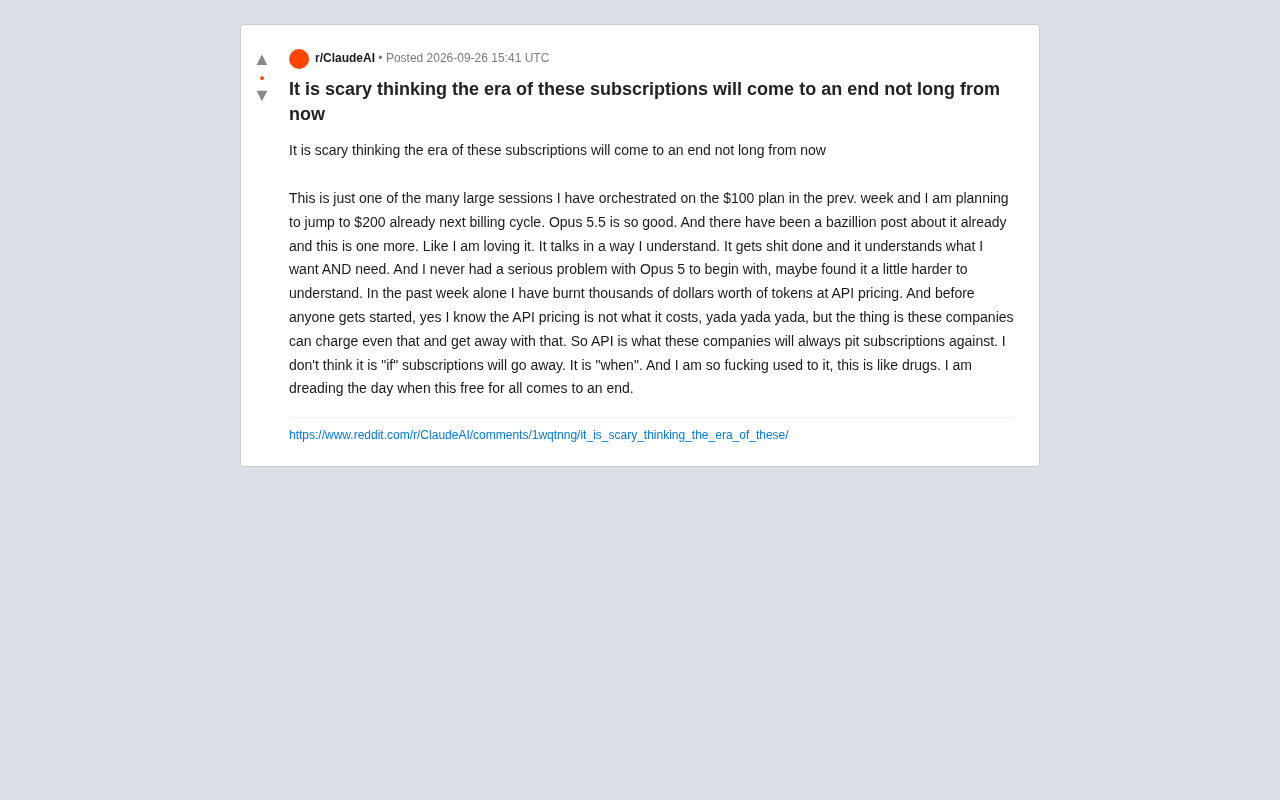
This kind of "experience sharing post" has become commonplace in the community, and the author openly admits it's "just another one among countless others." But what's truly worth paying attention to isn't the praise for the model — it's the concern about future pricing.
How Long Can the Subsidies Last?
There's a key data point in the post: the author claims that over the past week, they burned through what would amount to "thousands of dollars" worth of tokens at API pricing — while only paying a monthly subscription fee of one or two hundred dollars.
This massive gap is the core contradiction of today's AI subscription model. The author anticipates pushback — "Yes, I know API pricing doesn't equal actual cost" — but they emphasize a more sobering reality: even if API prices aren't reflective of true costs, these companies still have the ability to charge at those rates and have the market accept them.
In other words, API pricing is the true yardstick these companies use to measure the value of their subscription services. When a user's monthly compute consumption — priced at official API rates — could run into thousands of dollars, while their subscription fee is a fraction of that, the "unlimited use for a flat monthly fee" model is commercially difficult to sustain long-term.
The structural gap between API pricing and subscription pricing is key to understanding this contradiction. API pricing is typically metered by token (a unit of text roughly corresponding to a word or character fragment), where you pay for what you use, directly reflecting compute consumption. Subscriptions, by contrast, offer a fixed monthly fee with near-unlimited usage. For light users, subscriptions often mean "paying more than you use," effectively subsidizing heavy users like the post's author. This internal cross-subsidization may hold up initially, but as the proportion of heavy users grows and model inference costs remain high, average per-user compute consumption could consistently exceed subscription revenue limits. Major providers like Anthropic and OpenAI have not publicly disclosed average per-user compute costs, making it difficult to precisely calculate the subsidy scale — but consumption estimates from frontline users at least provide a useful order-of-magnitude reference.
"If" or "When"
The author makes a pointed judgment: the end of flat-rate subscriptions isn't a question of "if" — it's a question of "when."
This observation cuts to the heart of the pricing evolution logic across the entire AI application industry. The current strategy of fixed monthly fees with near-unlimited usage is fundamentally a subsidized play for user acquisition and market education. Vendors use below-cost pricing to cultivate usage habits, capture mindshare, and collect massive amounts of real-world usage data.
This pattern isn't new in internet history. From early cloud storage to streaming services to ride-hailing, the cycle has always followed the same arc: burn cash on subsidies → get users hooked → gradually raise prices or introduce tiered pricing. With AI compute costs far exceeding those of traditional software, the sustainability of this subsidy game is even more questionable.
The Heavy User's "Addiction" Dilemma
The author uses a blunt analogy: "I'm so used to it, it's like a drug." They openly admit they're "afraid of the day this free ride ends."
This perfectly captures the mindset of many heavy AI users today. When a high-quality model becomes deeply embedded in daily workflows — writing code, doing analysis, handling complex tasks — dependency builds rapidly. If the pricing structure shifts from "unlimited monthly use" to "pay per use," these users will face a very real cost shock.
For developers and creators who rely on AI as a core productivity tool, this isn't just a money issue — it's about having their entire way of working repriced.
Looking back at internet business history, "burn cash on subsidies → lock in users → monetize through price increases" is a classic platform economy playbook. Dropbox offered vast amounts of free storage early on to build its user base. Netflix priced below its content acquisition costs when entering new markets. Uber and Didi subsidized each ride at multiples of actual cost during their expansion phases. The common outcome in all these cases: once the market stabilized and competitive intensity declined, platforms began tiered pricing or outright price hikes. What makes AI compute unique is that its marginal cost doesn't trend toward zero as scale increases, the way traditional software does — each model inference still consumes real GPU compute and electricity, and the downward trajectory of cost curves is constrained by chip supply, energy prices, and other factors. This makes the "scale your way to profitability" logic harder to achieve than in virtually any previous software category.
Thinking Rationally About the Subscription Honeymoon
Setting aside personal sentiment, this post reflects several questions worth considering for both the industry and its users.
For users, we are genuinely in a relatively favorable window right now. Frontier model capabilities are improving rapidly while subscription prices have yet to fully reflect true compute costs. But building long-term workflows entirely around a service that could see dramatic price increases is itself a risk exposure.
For vendors, finding the balance between "subsidize for growth" and "sustainable profitability" is critical to long-term competitiveness. Tightening pricing too early risks losing users; sustained losses are equally untenable. Tiered subscriptions, usage caps, and hybrid pay-as-you-go models will likely emerge as the dominant direction.
It's worth noting that specific details mentioned in the post — such as "Opus 5.5" — come from a single user's personal account, represent subjective experience, and any pricing judgments are personal speculation rather than official information. But authentic feedback from frontline heavy users often reflects the actual value and potential concerns of a product more accurately than any marketing copy.
Final Thoughts
This post resonates because it articulates something many people are reluctant to say out loud: we're enjoying an AI golden period that may not last. The more capable the models become, the deeper our dependency grows — and the greater the impact when pricing structures eventually change.
Rather than mindlessly getting hooked during this period of abundance, it's worth being clear-eyed: today's low prices are likely just a temporary feature of a competitive market phase. Using AI thoughtfully, diversifying dependencies, and keeping a close eye on vendor pricing trends may be homework every serious AI user should be doing.
Related articles

Why Does the Tesla Roadster Need to Fly? A Deep Dive into Musk's Wild Demo
Tesla's Roadster launch showed wall-climbing, upside-down driving, and flying stunts—but The Vergecast notes the demo car may lack a battery, the Rocket version is invite-only and not street-legal, and the website terms don't guarantee delivery. After nine years of delays, why does this car still need to exist?

AI Is Not a Replacement: Human-AI Collaboration Through the Lens of Factory Root Cause Analysis
Starting from factory root cause analysis, this article explains how AI accelerates evidence chain construction rather than replacing human experts, exploring the pragmatic implementation logic and business value of 'AI supporting people rather than replacing them.'

AI Agent Decision Auditing: Building an Evidence Chain in Regulated Workflows
Starting from a Reddit discussion, this article analyzes three core issues in AI agent decision auditing within regulated workflows: what fields audit records should contain, how to handle feedback latency for erroneous decisions, and how to continuously calibrate LLM judge consistency with human judgment.