WindBorne Wins Nearly $50 Million Weather Data Contract from U.S. Air Force

Silicon Valley startup WindBorne wins a nearly $50M U.S. Air Force contract with weather balloons and AI, marking AI weather services entering defense procurement.
WindBorne Systems has secured a nearly $50 million weather data contract from the U.S. Air Force. Its solution uses low-cost, recoverable weather balloons to collect atmospheric data at the edge of the stratosphere, then applies AI models to convert sparse observations into high-resolution forecasts, filling observation gaps for satellites and ground stations in specific regions. The military's stringent demand for timeliness and precision, reflected in the contract amount, validates the path of AI weather startups entering defense budgets through vertical data services.
Silicon Valley startup WindBorne Systems has secured a U.S. military contract worth nearly $50 million, leveraging weather balloons and AI technology. This order from the U.S. Air Force is not just another funding-style headline — it marks a landmark moment for AI-driven weather data entering the defense procurement system.
The Technology Path Behind the Contract
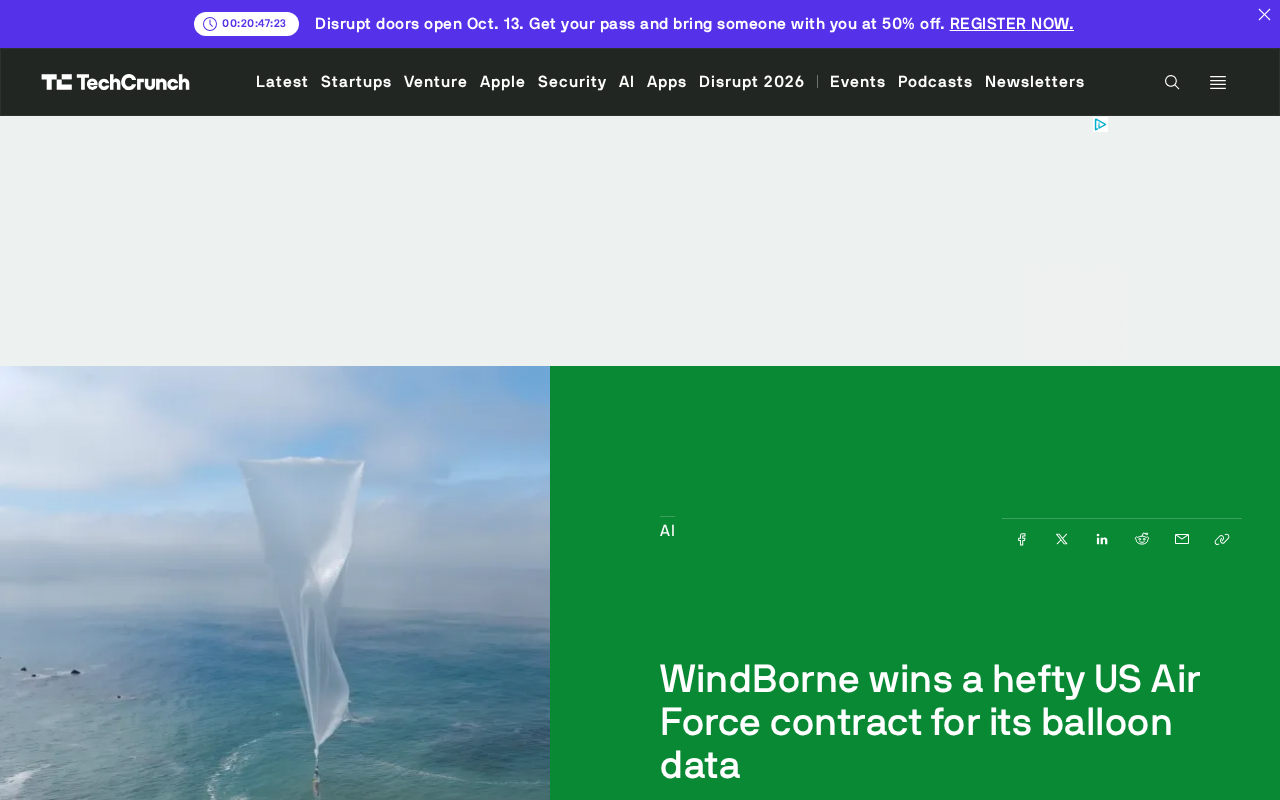
WindBorne's approach is not complicated: it uses low-cost, recoverable weather balloons to collect atmospheric data at the edge of the stratosphere, then applies AI models to transform sparse observation points into higher-resolution, more timely weather forecasts. Compared to traditional weather monitoring systems that rely on satellites and ground stations, the balloon approach offers advantages in cost and flexible deployment — it can be deployed to regions with weak satellite coverage or scarce ground stations.
According to reports, the company's weather data has already been used to improve forecast accuracy, and what the U.S. Air Force values is precisely this ability to rapidly acquire atmospheric intelligence in complex environments. Military weather support has far higher requirements for timeliness and precision than civilian scenarios, and the contract amount itself demonstrates that the buyer has considerable confidence in the technology's maturity.
The edge of the stratosphere typically refers to the atmospheric layer between 10 and 25 kilometers in altitude, located above the tropopause and below the middle stratosphere. Atmospheric motion at this altitude is relatively stable, and wind speed and direction are minimally affected by surface friction. The temperature, humidity, pressure, and wind field data collected by weather balloons at this height are particularly important for numerical weather prediction models — because data below the cruising altitude of commercial airliners (approximately 10 to 12 kilometers) is already relatively dense, while in-situ observations in the 10 to 25 kilometer range have long depended on a limited number of radiosonde stations. By deploying balloons to this altitude, WindBorne essentially fills a gap of scarce measured data between satellite remote sensing and ground-based observations.
Why the Military Is Willing to Pay for "Balloons + AI"
Weather conditions directly affect flight mission planning, drone operation windows, missile trajectory correction, and even logistics scheduling. Traditional military meteorology relies on government agencies and satellite networks, and response speed and regional granularity sometimes struggle to meet tactical-level needs. WindBorne's balloon constellation can rapidly fill coverage gaps in specific areas, while AI is responsible for fusing scattered observations into actionable data products.
From a procurement logic perspective, a contract worth nearly $50 million signals a shift from pilot programs to scaled delivery. This is also a typical path for AI startups entering the defense market in recent years: first validate technology in civilian scenarios, then enter military budgets through data services. WindBorne is not the only company doing this, but it has secured a relatively vertical niche — meteorology — that is highly sensitive to precision.
Data assimilation is a core step in weather forecasting, referring to the fusion of observational data from different sources and spatiotemporal resolutions (such as balloon soundings, satellite radiances, and ground station records) with the background field of a numerical prediction model to generate a physically consistent initial field. The quality of assimilation directly determines the accuracy of the forecast's starting point: if observation points are sparse or errors are large, the model struggles to accurately characterize the atmospheric state. The value of AI models in this step lies in their ability to learn the mapping relationship between historical observations and actual atmospheric evolution, inferring variable distributions on finer grids from sparse observations, thereby partially replacing the computationally expensive iterative processes in traditional variational assimilation or ensemble Kalman filtering.
What It Means for the AI Weather Industry
Weather forecasting has long been dominated by a handful of national-level institutions, with relatively closed data sources and models. Companies like WindBorne are attempting to break through with commercial observation networks and AI models, with a value proposition of "cheaper, more flexible, and more timely" data supply. Winning an Air Force contract amounts to a strong endorsement, helping it attract more government and commercial customers.
At the same time, it's important to recognize that the core competitiveness of weather AI companies lies in the scale of observational data and model iteration capability. Balloon deployment density, recovery and reuse rates, and data assimilation effectiveness — these engineering and research metrics determine whether contracts can be renewed. Revenue from military contracts can support constellation expansion, but it also brings stricter security and compliance requirements.
The closed system dominated by national meteorological agencies refers to the global observation networks and numerical prediction models long monopolized by national meteorological bureaus (such as NOAA in the U.S. and ECMWF in Europe). These institutions operate the world's largest supercomputer clusters and maintain long-lived, high-precision polar-orbiting and geostationary weather satellites. Their model code and initial field data are often provided externally with delays, reduced resolution, or for a fee. If commercial weather companies want to independently generate forecasts based on their own observations, they must solve two challenges: first, observation density is insufficient to support global assimilation; second, model development requires years of accumulation. WindBorne's approach is not to replace national-level models, but to enter through regional rapid gap-filling and AI post-processing, positioning itself as an incremental data supplier outside the existing system.
Key Points to Watch
- WindBorne provides weather forecast data using weather balloons combined with AI models, winning a nearly $50 million contract from the U.S. Air Force.
- The technical selling point is low cost and rapid deployment capability, filling observation blind spots of satellites and ground stations in specific regions.
- Military meteorology has stringent requirements for timeliness and precision, and the contract amount reflects the buyer's recognition of the technology's maturity.
- This is a typical case of an AI weather startup entering defense budgets, with vertical data services becoming a commercialization path.
- The key going forward lies in balloon deployment density, data assimilation effectiveness, and whether it can continuously meet military-grade compliance requirements.
The significance of this contract may not lie in the amount itself, but in the fact that it confirms one thing: AI-driven new weather observation is no longer just a laboratory topic, but a real supply capability that can enter defense procurement lists.
One-line Summary
Silicon Valley startup WindBorne wins a nearly $50 million contract from the U.S. Air Force with weather balloons and AI technology, marking AI weather services entering the defense procurement system.
Paragraph Summary
WindBorne Systems has won a nearly $50 million weather data contract from the U.S. Air Force. Its approach uses low-cost, recoverable weather balloons to collect atmospheric data at the edge of the stratosphere, then applies AI models to transform sparse observations into high-resolution weather forecasts, filling observation blind spots of satellites and ground stations in specific regions. Military meteorology has stringent requirements for timeliness and precision, and the contract amount reflects the buyer's recognition of the technology's maturity. It also validates the path of AI weather startups entering defense budgets through vertical data services. The key going forward lies in balloon deployment density, data assimilation effectiveness, and whether it can continuously meet military-grade security and compliance requirements.
Related articles

AgentCore in Practice: Connecting Custom Tools and MCP Servers to Agents
DebuggerCafe tutorial shows how to connect custom tools and MCP servers to Amazon Bedrock AgentCore agents, covering tool contract design, MCP reuse, and production concerns.

816B Parameters Scores Only 39? The Real Cost-Effectiveness of the Open-Source LLM Parameter Race
Meta's 816B Muse Spark Open scores just 39 on Artificial Analysis, while 180B Qwen3.8-Flash-Next scores 40. This article analyzes 11 open-weight models' parameters vs. scores, exploring the real impact of activated parameters, quantized size, and deployment cost.

Aerial Manipulators: The Next Step for Drones from 'Seeing' to 'Changing'
Starting from a Reddit discussion, this article analyzes the technical challenges, potential applications, and deployment bottlenecks of aerial manipulators, exploring the key challenges for drones moving from environmental perception to physical manipulation.