Windows 11 Allegedly Collects Developer Tool Usage Data: AI Coding Tools in the Monitoring Spotlight
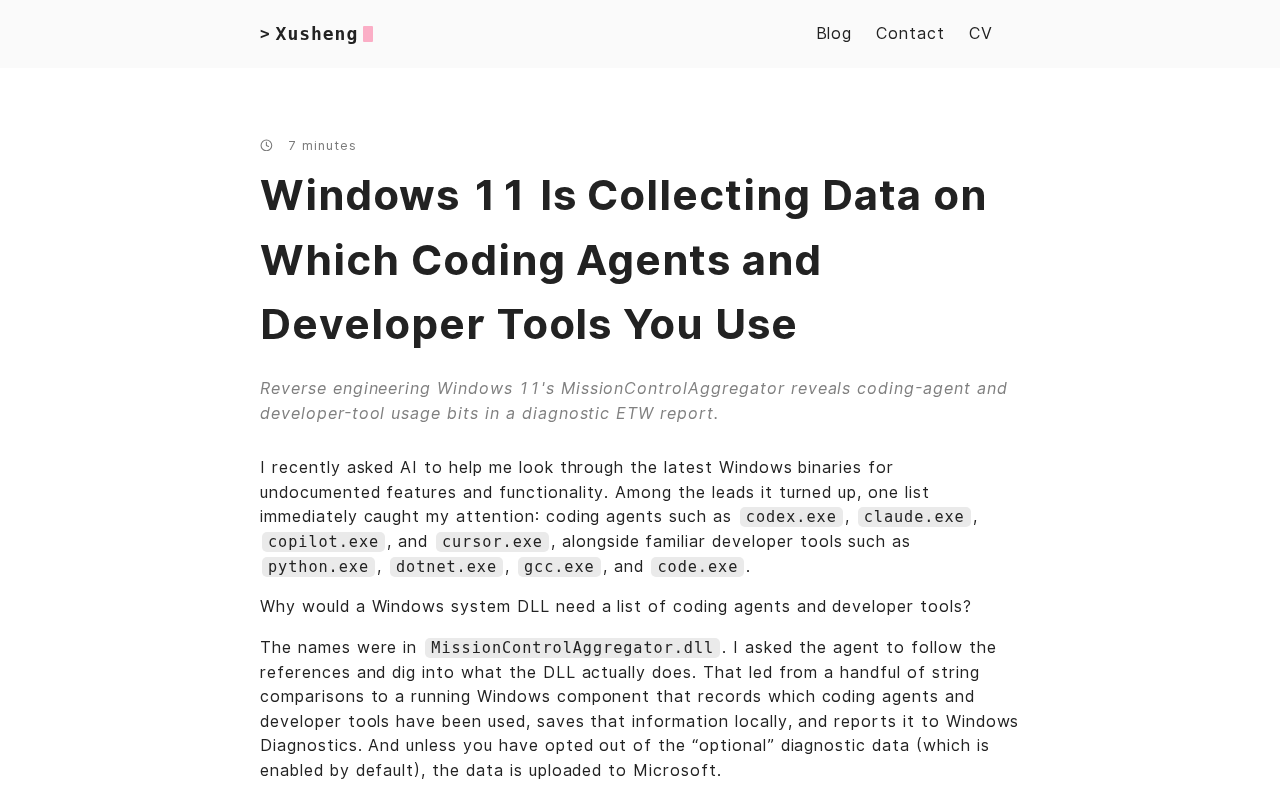
Windows 11 is alleged to use telemetry to identify coding agents used by developers, sparking privacy and trust controversy.
A Hacker News discussion disclosed that Windows 11 telemetry may extend to identifying coding agents and development tools used by developers, causing community unease. The article points out that developers' tolerance for telemetry depends on data granularity: tracking crash rates is different from identifying which AI coding assistant you use. Coding agents need to read code context and sit at a key position in the trust chain, so related collection touches sensitive boundaries such as source code, keys, and project structure. The discussion also covers enterprise compliance pressure, behavioral data monitoring dimensions brought by the spread of AI tools, and response approaches such as adjusting telemetry levels and incorporating system telemetry into the development environment security baseline. Since Microsoft has not yet provided a complete official statement, transparency is seen as key to rebuilding trust.
Event Core: From System Telemetry to Tool Identification
Another adjustment by Microsoft to Windows 11 telemetry is stirring new unease in the developer community. According to a discussion disclosed on Hacker News, Windows 11 is alleged to be collecting data on which coding agents and development tools users are using. For developers who switch daily between IDEs, terminals, and AI coding assistants, this news strikes a sensitive nerve: to what extent does the operating system "know" what you're writing and what you're writing it with?
According to the discussion thread on Hacker News, the focus of the issue is that Windows 11's telemetry mechanism appears to have expanded to the level of identifying developer toolchains, including detection of AI-assisted development tools such as coding agents. The discussion accumulated dozens of comments in a short time, indicating that this topic has considerable attention in the technical community.
From a technical logic perspective, operating system-level telemetry typically covers device health, performance metrics, and crash reports. But when the monitoring scope extends to specific developer tools—especially tools like coding agents that carry code context and project information—the nature changes. Developers' tolerance for being "observed" often depends on data granularity: knowing the system is tracking crash rates is one thing; knowing the system is identifying which AI coding assistant you use is another.
The atmosphere of the Hacker News discussion reflects that many developers have reservations about Microsoft's communication on telemetry issues. Lack of transparency is the core controversy: users find it difficult to clearly determine from public documentation what data is collected, at what granularity, and how long it is retained.
Telemetry in the operating system context refers to the mechanism by which the system automatically collects and sends back usage and diagnostic data. Windows 10/11 offers four diagnostic data levels: Security (only basic security information), Basic (minimal dataset related to device and quality), Enhanced (additional diagnostic information), and Full (the most comprehensive diagnostic data). The lower the level, the smaller the collection scope. Enterprise environments can set it uniformly through management tools such as Group Policy and Intune, and personal settings may be overridden by organizational policies. Understanding the differences between these levels is a prerequisite for judging whether "tool identification" data may be collected—some diagnostic fields are only enabled at the "Enhanced" level and above.
Why Developers Are Particularly Sensitive to This Type of Telemetry
Developer tools differ from ordinary applications in that they directly touch source code, API keys, project structure, and business logic. The rise of coding agents has blurred this boundary further—such tools need to read code context to provide completions or generation suggestions, placing them at a key position in the trust chain.
When the operating system is alleged to also be collecting information about related tool usage, developers naturally ask: Is it collecting tool names or activity within the tools? Is the data associated with device identifiers? Will it be uploaded to the cloud and bound to accounts? The original discussion did not provide these details, but it is precisely this uncertainty that amplifies concerns.
Another practical factor is compliance pressure. Many enterprise development teams need to explain the observability boundaries of their development environments to security and legal departments. If operating system-level telemetry covers AI coding tools, enterprises' software asset management and data governance strategies need to be re-evaluated.
Coding Agent refers to AI tools that can complete programming tasks autonomously or semi-autonomously, typically including completion/chat assistants within IDEs, command-line agents in terminals, and intelligent agents that can execute multi-step tasks. Unlike traditional code completion, coding agents usually need to read project context, call tools, and even execute commands, so they come into contact with source code, dependency configurations, and even credential information. This also means that once the operating system level can identify "which coding agent is being used," its data sensitivity is higher than mere IDE version statistics, because it touches the innermost part of the trust boundary in developers' workflows.
New Monitoring Dimensions Brought by the Spread of AI Coding Tools
Coding agents becoming a telemetry target is itself a signal worth noting. In the past, developer tool monitoring mainly revolved around IDE versions, compilers, and runtime environments for compatibility diagnostics. But coding agent usage is closer to behavioral data—it can reflect a team's development approach, technology choices, and even work rhythm.
According to viewpoints in the Hacker News discussion, once such data is systematically collected, it may be used for product analysis, market research, or ecosystem promotion. For Microsoft, understanding which AI tools developers use has commercial value; but for developers, whether this value exchange is informed and voluntary is the key question.
This also explains why calls for alternatives appeared in the discussion. Some developers prefer to limit telemetry levels in sensitive projects or move to development environments with more conservative telemetry policies. The migration cost is not low, but once trust is damaged, willingness to switch increases.
Development Environment Security Baseline is a set of minimum security and observability requirements set by an enterprise for development endpoints, usually covering patch levels, disk encryption, endpoint protection, plugin whitelists, and log retention. Incorporating operating system telemetry configuration into the baseline means clearly recording diagnostic data levels, prohibiting or restricting fields sent back to the cloud, and documenting approvals for exceptions. The benefit is that when security or legal departments are asked "what data leaves the development machine," the team can provide verifiable answers rather than relying on default settings.
Response Approaches Developers Can Take
For developers concerned about this issue, a pragmatic approach is to first understand the current system's telemetry configuration. Windows 11 provides multiple diagnostic data settings, and setting the level to the minimum can limit some data collection, but Group Policy and management tools in enterprise environments may override personal settings.
At the team level, it is recommended to incorporate operating system telemetry into the development environment security baseline, placing it on equal footing with IDE plugin management and dependency auditing. For projects handling sensitive code, consider isolating the development environment to reduce the operating system's visibility into the toolchain.
It should be noted that the original discussion did not provide Microsoft's complete official response to this matter, nor did it disclose a specific list of data fields. Therefore, the above judgments are based on community discussion and technical common sense, and final conclusions still await Microsoft's official statement or independent technical analysis.
Trust Is the Underlying Protocol of the Developer Ecosystem
This controversy over Windows 11 is essentially a renegotiation of the trust agreement between the platform and developers. The operating system wants more observability to improve products, while developers want to retain control over their workflows. The two are not irreconcilable, but the premise is transparency: a clear data list, clear retention policies, and verifiable opt-out mechanisms.
For developers who are introducing AI coding tools into their daily workflows, this discussion is a reminder—the convenience and observability of toolchains often grow together, and the right to choose should always remain in the hands of users. The value of this round of discussion on Hacker News is not in providing final answers, but in getting more people to start asking where the data goes.
Related articles

Jensen Huang Returns to Nvidia: The Power Game Behind an "Aggro Reset"
Nvidia's board reappointed Jensen Huang as CEO less than two weeks after his scandal-driven resignation. This analysis explores the board's decision-making, Trump's political intervention, media power failure, and market reaction behind the dramatic return.

Why Voice AI Can't Understand Kenyans' Everyday Conversations
Swahili speech recognition hits 3.24% error on read text, but everyday Kenyan speech mixes English, Sheng slang, and accents—leaving mainstream voice AI struggling.

Data Centers Build Their Own Natural Gas Plants: AI Compute's Breakout Around a Decade-Long Grid Wait
Grid interconnection approvals can take a decade, so xAI and others are building off-grid natural gas plants to power AI clusters. This article analyzes the drivers, costs, and impact of behind-the-meter generation on AI infrastructure.