Wizstar: An AI Tool That Makes Digital Avatars Perform Like Professional Actors

Wizstar brings professional actor-level performance to AI digital avatars with gestures, object interaction, and robust lip sync.
Wizstar is an AI digital avatar tool that topped Product Hunt with 173 votes by addressing three key limitations of current digital humans: natural gesture generation, object interaction, and lip sync stability during head turns and occlusions. Targeting creators and brands who need scalable multilingual video production, it reduces localization costs by over 90% while maintaining brand consistency across markets.
When Digital Avatars Start "Acting"
Digital human technology isn't new, but most products remain stuck at the "talking head" stage—the face moves, the body stays stiff, and gestures are disconnected from speech.
The development of digital human technology has gone through several distinct phases. The earliest stage involved CG animation-based virtual characters requiring extensive manual work. Then came deep learning-based facial driving technology—DeepFake in 2017 brought face-swapping to the masses. More recently, 3D reconstruction approaches based on NeRF (Neural Radiance Fields) and 3D Gaussian Splatting have made it possible to generate realistic digital humans from just a few photos or videos. However, most commercialized products still operate within the "talking head" paradigm—only driving facial expressions and lip movements while the body either stays static or loops through preset animations, resulting in an unnatural overall appearance.
Wizstar, which topped the Product Hunt daily chart with 173 votes, aims to push AI digital avatars toward a higher goal: making them move and perform like professional actors.
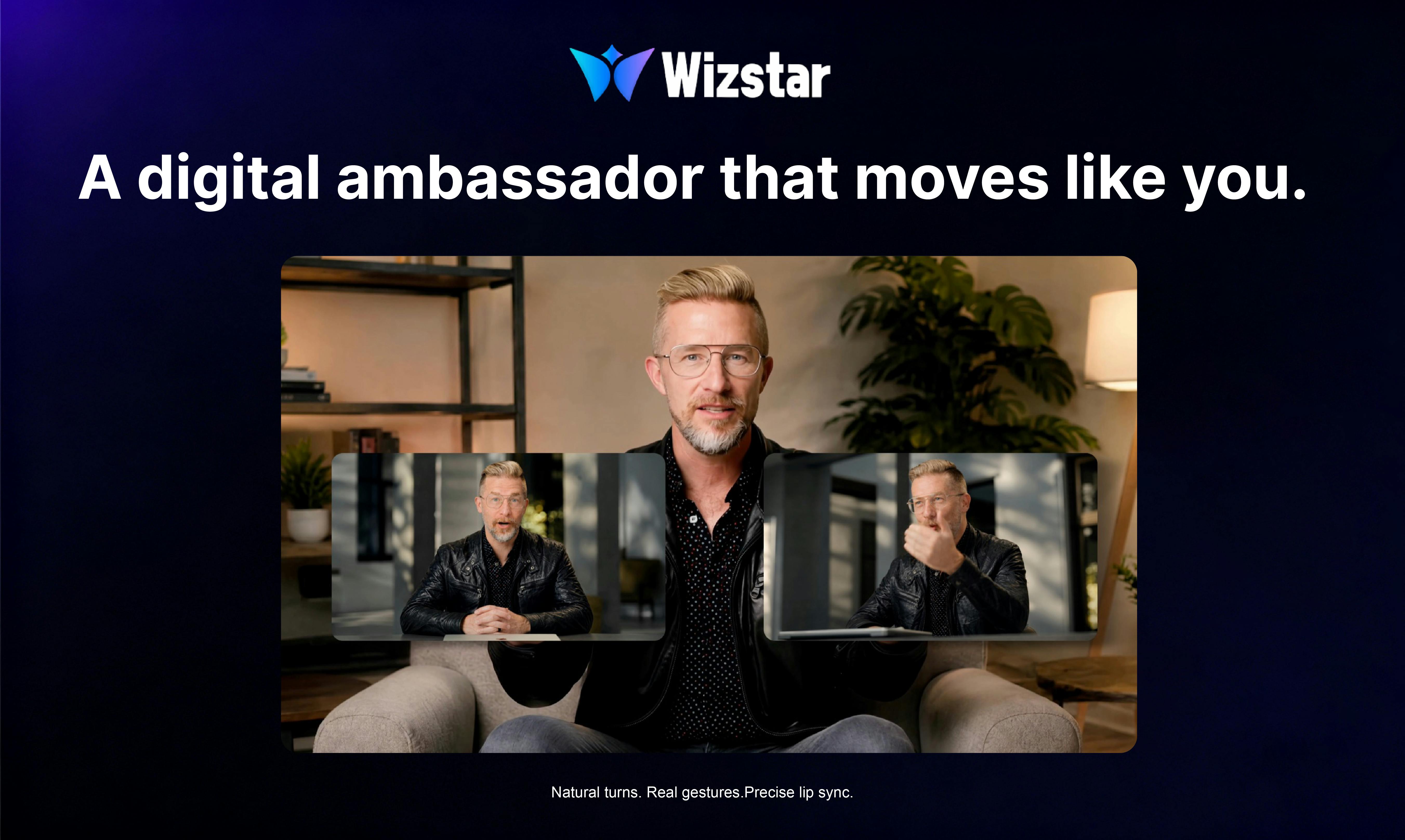
According to its official introduction, Wizstar helps entrepreneurs, content creators, and product teams build an "expressive, visually accurate digital ambassador"—one that doesn't just look like you, but moves like you. It can naturally gesture, interact with objects, and maintain precise lip sync even when the head turns or obstructions appear in front of the face. These three capabilities address the most common pain points of mainstream digital human products today.
Three Core Technical Challenges Wizstar Solves
Natural Gestures and Body Language
When people speak, gestures, posture, and tone form a unified whole. Traditional digital humans typically only drive the face, creating an uncanny "talking sculpture" effect. Wizstar emphasizes that its digital avatars can "gesture naturally," meaning it has established stronger correlations between speech, semantics, and movement, making expressions more convincing.
This direction is known in academia as Co-speech Gesture Generation. The core challenge is that gestures aren't random decorative movements—they're tightly coupled with speech prosody, semantic emphasis, and emotional state. For example, speakers raise fingers when emphasizing quantities and point in specific directions when describing spatial concepts. Achieving this effect requires models that simultaneously understand audio features (pitch, rhythm, energy) and textual semantics, mapping them into temporally coherent skeletal animation sequences. In recent years, diffusion model-based gesture generation methods, such as research like BEAT and DiffGesture, have demonstrated convincing results at the academic level, but engineering them into stable commercial products remains challenging. Wizstar's ability to deliver this capability at the product level suggests it has found a viable path between academic frontiers and engineering implementation.
Object Interaction Capabilities
Wizstar specifically mentions that avatars can "interact with objects." This capability is particularly critical for marketing and product demonstrations—imagine a digital avatar picking up a product, pointing to an interface, or showcasing a physical item. This is far more immersive than static narration and represents one of its core differentiators from pure talking-head digital humans.
From a technical implementation perspective, enabling digital humans to interact with objects involves challenges at multiple levels. First is physical plausibility—hands shouldn't clip through objects or float above them during contact. Second is grasp pose diversity—objects of different shapes and sizes require different grasping approaches. Finally, there's temporal coordination—action sequences like picking up, displaying, and putting down must be precisely aligned with speech content. In traditional CG workflows, these typically require motion capture actors working with props. If Wizstar can automatically generate such interactive animations through AI, it likely employs physics simulation-based hand contact modeling or generative models trained on large amounts of real human interaction data. This is a highly cutting-edge technical direction and represents a key barrier distinguishing it from competitors.
Lip Sync in Complex Scenarios
What best demonstrates technical depth is its ability to maintain precise lip sync when the head turns or obstructions appear in front of the face. These two scenarios typically cause traditional lip sync algorithms to break down because they rely on stable detection of a front-facing face. Wizstar's emphasis on stability in these edge cases indicates that its underlying modeling accounts for more realistic head movement and spatial relationships.
Traditional lip sync algorithms (like Wav2Lip) work by detecting facial keypoints and replacing the mouth region with audio-matched lip shapes. But this approach fails when the head rotates at large angles (beyond 30 degrees to the side) or when the face is occluded by hands, microphones, or other objects, because keypoint detection becomes unstable or the target region is invisible. Possible technical approaches to solving this include: full-head modeling based on 3D facial models (such as 3DMM or FLAME models) that can infer mouth movements even from non-frontal angles; or implicit 3D representations like NeRF/3D Gaussian Splatting that render consistent facial animations from arbitrary viewpoints. This fully 3D modeling approach naturally supports multi-angle rendering unaffected by single-viewpoint occlusion, representing a fundamental upgrade from 2D pixel manipulation to 3D spatial understanding in lip sync technology.
The Real Value of AI Digital Avatars for Creators
From a product positioning perspective, Wizstar targets a very specific scenario: creators and teams who don't want to appear on camera every time.
Its listed applications include product update videos, employee training content, localized videos, and brand content. These content types share common characteristics—they require frequent updates, multiple language versions, and scalable production, but the cost of repeatedly filming real people is extremely high.
Global brands face enormous cost pressure when localizing content. In the traditional approach, covering 10 markets with a single product video means 10 voiceovers, potential reshoots (because lip sync doesn't match), and extensive post-production. According to industry data, a professional-grade localized video typically costs between $5,000-$20,000, with production cycles lasting several weeks. AI digital human technology compresses this workflow to: input translated text, automatically generate lip sync and facial animations in the corresponding language, and even adjust the digital human's appearance to suit different markets' aesthetic preferences. This enables multilingual versions of the same video to be completed within hours at over 90% cost reduction.
Digital avatars here don't solve the problem of "replacing humans" but rather "freeing up human time." One modeling session enables reuse across markets, languages, and channels. For brands going global and SaaS companies, using the same digital persona to output multilingual marketing content maintains brand consistency while dramatically reducing localization filming costs. High-frequency content like product update videos and help documentation videos can truly achieve simultaneous global release. This value proposition is quite pragmatic.
The Next Competitive Landscape in the Digital Human Space
Wizstar is categorized under productivity, marketing, and artificial intelligence—which itself shows that the commercialization path for digital human technology is converging: it's no longer a flashy demo but a component in the content production pipeline.
The current AI digital human market has formed a clear competitive landscape. HeyGen (valued at approximately $500 million) focuses on video translation and digital human marketing, known for its streamlined workflow and multilingual cloning capabilities. Synthesia (valued at approximately $2.2 billion) focuses on enterprise training and internal communication scenarios, with over 160 preset digital human avatars. D-ID specializes in conversational AI and real-time interaction. The Chinese market is equally active, with products like Silicon Intelligence and Shanijian rapidly penetrating e-commerce livestreaming and short-form video. The common trend among these products is evolution from "tool" to "content production infrastructure"—no longer generating a single video at a time, but embedding into enterprise content pipelines to enable continuous, scalable video output.
For Wizstar to break through in this landscape, it relies on "expressiveness" as its differentiating dimension. As lip sync and avatar cloning capabilities converge across competitors, whoever can make digital humans' physical performances more natural and closer to professional actor standards will secure a position in the next phase of competition. Product differentiation is shifting from "likeness fidelity" to "expressive richness" and "scenario generalization capability," meaning the focus of technical competition is also migrating from facial rendering toward full-body motion generation and scene understanding.
Of course, there's often a gap between product page promises and actual results. Gesture naturalness and the generalization ability of object interactions need to be validated through real usage. But at least from its community response—topping the daily chart, 173 votes, 24 comments—the market clearly has strong expectations for "digital humans that can perform better."
Conclusion
Wizstar's emergence reflects the evolution of digital human technology from "does it look like me?" to "can it perform well?" When cloning a face has become a baseline capability, how to make the "person" behind that face move and come alive is what truly creates differentiation. For creators and brands that need to produce video content at scale, AI digital avatar tools like this are worth keeping an eye on.
Related articles

Why Does the Tesla Roadster Need to Fly? A Deep Dive into Musk's Wild Demo
Tesla's Roadster launch showed wall-climbing, upside-down driving, and flying stunts—but The Vergecast notes the demo car may lack a battery, the Rocket version is invite-only and not street-legal, and the website terms don't guarantee delivery. After nine years of delays, why does this car still need to exist?

AI Is Not a Replacement: Human-AI Collaboration Through the Lens of Factory Root Cause Analysis
Starting from factory root cause analysis, this article explains how AI accelerates evidence chain construction rather than replacing human experts, exploring the pragmatic implementation logic and business value of 'AI supporting people rather than replacing them.'

AI Agent Decision Auditing: Building an Evidence Chain in Regulated Workflows
Starting from a Reddit discussion, this article analyzes three core issues in AI agent decision auditing within regulated workflows: what fields audit records should contain, how to handle feedback latency for erroneous decisions, and how to continuously calibrate LLM judge consistency with human judgment.