Work or PhD? The Career Path Dilemma for AI Researchers

A rational framework for AI researchers deciding between industry work and pursuing a PhD.
This article explores the common dilemma facing young AI researchers: whether to take a well-paying industry position or pursue a PhD. It analyzes how industry research experience impacts PhD applications, examines why top Research Scientist roles typically require a PhD, and provides a decision framework balancing short-term gains with long-term career goals.
A Real Dilemma
In the AI field, an increasingly common career dilemma is troubling many young researchers: when faced with a well-paying industry position that includes a research component, is it still worth investing four to five years in pursuing a PhD?
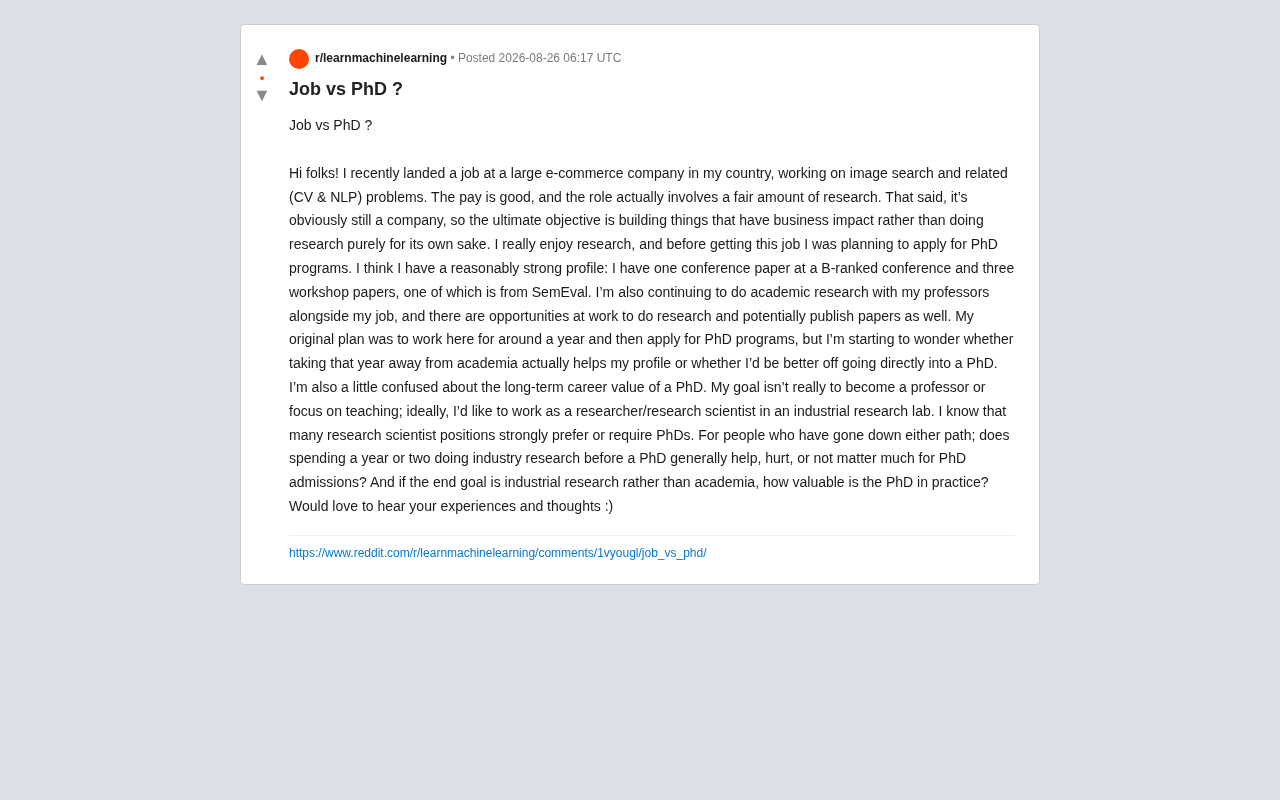
Recently, a Reddit user shared their real situation, sparking widespread community discussion. This user had just landed a job at a large e-commerce company in their country, working on image search and related computer vision (CV) and natural language processing (NLP) problems. Their description is highly representative: "The salary is good, and the position does involve quite a bit of research work. But at the end of the day, it's still a company—the ultimate goal is building commercially valuable products, not research for research's sake."
Image search is one of the core modules in e-commerce technology, combining computer vision techniques such as image feature extraction, object detection, and image similarity matching, along with NLP capabilities like query understanding and semantic matching. The "search by photo" functionality on modern e-commerce platforms typically involves deep learning models creating vector representations (embeddings) of product images, then using approximate nearest neighbor search to quickly retrieve similar products from databases containing billions of items. The research dimension of such roles lies in the need to continuously optimize model architectures, explore multimodal fusion (such as CLIP-style models that map images and text into the same semantic space), and solve open problems like long-tail category recognition. Therefore, these positions truly sit at the intersection of engineering and research.
This tension between "wanting to do research" and "facing practical choices" is a crossroads that virtually every technically-minded person who loves academia but works in industry will encounter.
The Person's Background and Dilemma
From a personal profile perspective, this questioner has a fairly solid academic foundation. They have one B-tier conference paper, three workshop papers (one from SemEval), and continue to maintain academic collaborations with professors outside of work. More importantly, their company also provides opportunities to conduct research and even publish papers.
In computer science, academic work is primarily published through conference papers rather than journals—a significant departure from other disciplines. Conferences are ranked by impact into A-tier (e.g., NeurIPS, CVPR, ACL), B-tier (e.g., AAAI, ECCV, EMNLP), C-tier, and other levels, typically following classification standards like CCF (China Computer Federation) or CSRankings. Workshop papers are published at specialized symposia affiliated with main conferences, with relatively lenient review standards and shorter page limits, generally considered a "preliminary stage" for full conference papers. SemEval (Semantic Evaluation) is a semantic evaluation competition and corresponding workshop under ACL, where participants submit systems on standardized tasks and write technical papers—it has high recognition in the NLP community. Having a B-tier conference paper plus multiple workshop papers represents a quite strong research foundation for someone who hasn't yet started a PhD program.
Their original plan was to work for about a year, then apply to PhD programs. But as time passed, several core questions began to emerge:
- Is this year away from pure academia a plus or a minus? Should they accumulate industry experience before applying for a PhD, or would it be better to enter a PhD program directly?
- If the ultimate goal isn't becoming a professor, how much value does a PhD really have? They candidly admitted they don't want to pursue a teaching or academic career—their ideal is to become a Research Scientist at an industrial research lab.
These two questions seem simple but actually touch on the most fundamental trade-offs in the AI talent development ecosystem.
How Industry Research Experience Affects PhD Applications
Regarding the question of "whether working for a year or two helps PhD applications," the general consensus in the field is: it depends on what you do during that time, not simply the length of time.
If during that year you can continuously produce high-quality research output—especially publishing papers at top conferences or completing impactful projects in industry—then this experience will not only not weaken your application but will significantly strengthen your competitiveness. Admissions committees value evidence of your research ability, and industry experience can demonstrate your capacity to translate ideas into real systems.
Conversely, if that year is consumed entirely by routine engineering tasks and business pressures with no substantial research output, then its benefit to a PhD application is indeed limited. The key point is that the questioner's position itself "involves quite a bit of research work" and offers opportunities to publish—this is precisely the most ideal transitional state.
On a specific note, they also mentioned "continuing academic research with professors outside of work." This approach is very wise—maintaining connections with academia not only preserves recommendation letter resources but also ensures an uninterrupted research rhythm. In North American PhD applications, the importance of recommendation letters is often underestimated. Strong recommendation letters (especially from well-known professors recognized by target institutions) can decisively influence admissions outcomes. Maintaining recent deep collaboration ensures that at application time, one can obtain a letter based on actual research interaction, rather than a generic letter written from stale memories. Additionally, the Statement of Purpose in PhD applications needs to demonstrate a clear narrative of evolving research interests and future directions. Industry experience can provide a "problem-driven" real-world anchor for this narrative—you can clearly articulate "what real problems I encountered in industry, why existing methods are insufficient, and what I want to systematically solve during my PhD." This is more convincing than narratives derived purely from coursework or classroom projects.
The Practical Value of a PhD for Industry Research Scientist Positions
This is perhaps the part of the entire question that requires the most rational weighing. The questioner's goal is crystal clear: to become a Research Scientist at an industrial research lab, not an academic.
The reality is that the vast majority of Research Scientist positions at top tech companies (such as Google DeepMind, Meta FAIR, Microsoft Research, etc.) strongly prefer or even require a PhD. The reasons are:
The Core Value of PhD Training
A PhD is not just a piece of paper—it represents a complete training in independent research capabilities, including identifying problems, designing experiments, systematically solving open-ended challenges, and defending your work through peer review. These abilities are precisely the core requirements of Research Scientist positions.
Differences in Career Ceilings
In many research labs, Research Scientists and Research Engineers follow two different promotion tracks. The former typically requires a PhD background and leads research directions; the latter focuses more on engineering implementation. If someone's ambition is to lead research agendas and publish impactful papers, then a PhD is nearly an unavoidable prerequisite.
Google DeepMind, Meta FAIR (Fundamental AI Research), Microsoft Research, and similar industrial research labs represent the organizational form in industry closest to academic research. These labs typically have independent research budgets and publication freedom—researchers can pursue cutting-edge topics like university professors while also considering long-term impact on the parent company's technology stack. For example, DeepMind's AlphaFold project solved the protein structure prediction problem, and Meta FAIR released the LLaMA series of open-source large language models—achievements that have both pure scientific value and build technological moats for their companies. Research Scientists at these labs typically need to independently propose research agendas, mentor junior researchers, and consistently publish at top conferences. The corresponding Research Engineers focus more on engineering research prototypes, building experimental infrastructure, and optimizing model deployment efficiency. The salary gap between the two may not be large, but there are fundamental differences in research autonomy and academic influence.
But a PhD Is Not the Only Path
It should be objectively noted that with the advent of the large model era, industry's emphasis on "ability to produce results" is increasingly surpassing its attachment to "credential labels." A small number of people who have made breakthrough contributions in open-source communities or actual projects can also enter top research positions through non-traditional paths. However, these are exceptional cases—for most people, a PhD remains the most reliable path to industrial research positions.
Since ChatGPT triggered the large model wave in 2022, talent evaluation standards in the AI industry have been undergoing profound changes. Traditionally, research ability was measured by paper count and citations, but the large model era has introduced new forms of contribution: open-source model weights, high-quality training datasets, inference optimization tools, and innovative engineering practices (such as LoRA fine-tuning, engineering implementations of mixture-of-experts architectures, etc.). Some engineers without PhDs who have made major contributions to open-source communities—for example, early core contributors to Hugging Face or key technical personnel at Stability AI—have also gained opportunities to join top research teams. However, this path demands extremely high levels of self-motivation, technical judgment, and community influence, and it lacks the systematic methodological training of the PhD stage. When facing entirely novel research problems without precedent, one may encounter bottlenecks.
How to Make a More Rational Career Decision
Taking everything into account, for someone like this questioner with clear goals and an established research foundation, the decision can be weighed along several dimensions:
First, assess whether your current position can sustain research output. If the company genuinely provides space for publishing papers, then "working while applying for a PhD" is a win-win strategy: accumulating experience and salary while demonstrating a stronger profile at application time.
Second, clarify the hard requirements of your long-term goal. Since the goal is to become an industrial Research Scientist, and that position generally requires a PhD, pursuing one is essentially a necessary step—the question is only "when" rather than "whether."
Third, evaluate the opportunity cost. A year of industry experience typically won't harm your application and may actually help you more clearly understand what research direction you truly love, allowing you to be more targeted when choosing advisors and topics. Many people only figure out what they should research after working.
Lessons for Others Facing Similar Dilemmas
This Reddit user's dilemma is essentially a problem faced by many AI practitioners: in an industry with rapid technological iteration and abundant opportunities, how do you balance short-term gains with long-term development?
There's no one-size-fits-all answer, but several principles are worth remembering:
- If you love research and your goal is a Research Scientist position, the long-term value of a PhD typically outweighs its time cost.
- An industry "gap year" that produces results is a positive, not a negative.
- Maintaining connections with academia (continuing collaborations, publishing papers) matters more than simply "where you are."
Ultimately, career choices have no absolute right or wrong—only whether they align with personal goals. For someone who has both research passion and practical implementation ability, spending a year polishing skills in industry while maintaining academic output before entering a PhD program may well be the optimal path that balances reality with ideals.
Key Takeaways
Related articles

Gemini 4 Argon Hands-On: AI Builds Board Games, Constructs Temples, and Trains Robots Autonomously
Gemini 4 Argon hands-on roundup: AI autonomously builds a desk racetrack and temple in Blender, writes a ray tracing engine, trains a humanoid robot to sink 7 shots, plus API pricing and developer access.

The Magic Octagonal Coin: Why Only 9% of People Can Predict Its Flip?
Only 9% of people can correctly predict the Magic Octagon coin flip. This article explains its spatial rotation mechanism, common cognitive pitfalls, and a new hypothesis based on Relevance Theory, exploring the limits of human spatial reasoning.

Sam Altman: AI Is Entering the Era of Scientific Discovery — Math Breakthroughs Will Replicate in Biology and Energy
Sam Altman says AI is entering the era of scientific discovery — math breakthroughs will replicate in biology, materials science, and energy to help develop new drugs and energy sources.