WorkBuddy Full Guide: How an AI Coworker Takes Over Workplace Automation

WorkBuddy evolves from a chat advisor into an autonomously executing AI coworker, with workflow capability as the new dividing line.
The article notes that WorkBuddy is not another chat tool but a full-scenario autonomous execution AI agent: give it one instruction, and it plans steps, reads local files, processes tasks in parallel, and delivers verifiable results like PPTs, cleaned Excel files, and visualization reports. Its capabilities rely on an autonomous execution pipeline, desktop local-first and ecosystem integration, and multi-agent division of labor, letting individuals and small teams act as project managers commanding multiple AI experts. The core judgment: prompt techniques are no longer the core competency—building agent workflows and having AI handle 80% of mechanical work is the new dividing line.
From "Advisor" to "Coworker": WorkBuddy's Positioning Difference
Most people still think of AI tools as a chat window—you ask a question, it answers with a paragraph, and the rest—copy-pasting, formatting, making charts, running data—is all up to you. This tutorial on Bilibili opens with a key insight: WorkBuddyAd is not another chat app competing with Doubao or Qwen, but a full-scenario autonomous execution AI agent.
Traditional AI is like an advisor—it only gives verbal suggestions; WorkBuddy is more like a coworker—give it a one-sentence instruction, and it plans the steps itself, reads local files, processes tasks in parallel, and finally delivers verifiable results. PPTs, cleaned Excel files, formatted research reports, and runnable code are all forms of its deliverables. This positioning difference determines all the usage logic that follows—you're not "asking questions," you're "assigning work."
Delivering Results Rather Than Reference Text: The Practical Value of Autonomous Execution
The Leap from Half-Finished Products to Deliverables
Ordinary AI hands you an outline, and you still have to fill in the charting and formatting yourself; WorkBuddy's difference lies in its autonomous execution pipeline. The tutorial gives a typical scenario: drop hundreds of megabytes of sales data on it, and it runs code analysis itself, creates visualization charts, and exports a complete report.
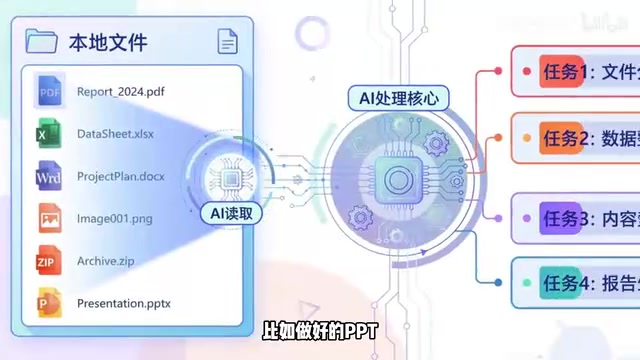
The significance of this process isn't just saving time. In the traditional approach, data processing, chart creation, and report writing are three disconnected steps, and information can be lost at every handoff; once the agent connects the pipeline, intermediate products can be reused directly. The cleaned Excel and visualization charts shown in the tutorial are exactly two nodes on this pipeline.

AI Agent is the key concept for understanding this article. Its core difference from ordinary conversational AI lies in "autonomy": an agent can autonomously plan steps based on goals, invoke tools (such as code interpreters, file read/write, charting libraries), execute and verify results, forming a closed loop of "perception—planning—action—feedback." The industry often breaks this capability into three components: planning, memory, and tool use. It is precisely because of tool invocation and multi-step execution capabilities that the agent can connect data analysis, charting, and report writing into an uninterrupted pipeline, rather than waiting for human intervention at every step like a chat model. This also explains why the article emphasizes that it delivers "verifiable results" rather than "reference text."
Local-First and Ecosystem Integration
The old problem with web-based AI is repeatedly uploading files and worrying about data leaks. WorkBuddy takes the desktop route, supporting direct authorized processing of local files with local-first data. Chores like batch renaming, file organization, and information extraction can be assigned all at once. At the same time, it deeply integrates with the Tencent and Qiwei ecosystems, allowing AI to plug into daily collaboration workflows rather than staying outside them.

Local-first is a software design orientation: data and computation stay on the user's device as much as possible, interacting with the cloud only when necessary. For AI tools, it means files don't need to be repeatedly uploaded to web servers—processing happens on the desktop, the data flow path is shorter, and the exposure surface is smaller. This orientation is especially important when dealing with business data and customer information, and it is also a differentiating advantage of desktop AI over web-based AI. Note that local-first does not mean fully offline—model inference may still call cloud services, and the specific data boundaries depend on the product implementation; check its privacy statement before use.
Multi-Agent Parallelism: One Person Is a Whole Team
WorkBuddy supports loading different skills and industry expert roles: one gathers information, one handles data accounting, one takes care of aesthetic formatting—multiple agents work in parallel. The user shifts from executor to project manager commanding multiple AI experts.
This model is especially meaningful for individual creators and small teams. In the past, a solo operator could only run tasks serially; now, after breaking down tasks and assigning them to different roles, they advance in parallel, and both output speed and coverage take a step up. The "from beginner to expert in one hour" emphasized in the tutorial is essentially about mastering this approach to task decomposition and assignment, not memorizing where a certain button is.
Multi-agent collaboration means breaking a large task into several subtasks, having agents with different role settings or skill configurations handle them separately, and then aggregating the results. A common architecture is the "orchestrator—executor" model: a main agent handles decomposition and scheduling, while multiple sub-agents execute in parallel. Compared with a single agent processing serially, the advantage of multi-agent lies in parallel speedup and specialized division of labor, but it also brings coordination costs—when subtask boundaries are unclear or results conflict, human arbitration is needed. Therefore, the article emphasizes task decomposition and assignment capabilities, not the number of agents itself.
The Real Barrier to Workplace Automation Workflows
Prompt Engineering Is No Longer the Core Competency
The most realistic judgment in the tutorial is this: learning to write prompts is no longer a core advantage—mastering agent workflows is the dividing line. Whoever can fastest get an agent to eliminate 80% of their mechanical repetitive work can free up energy for strategy, decision-making, and more valuable things.
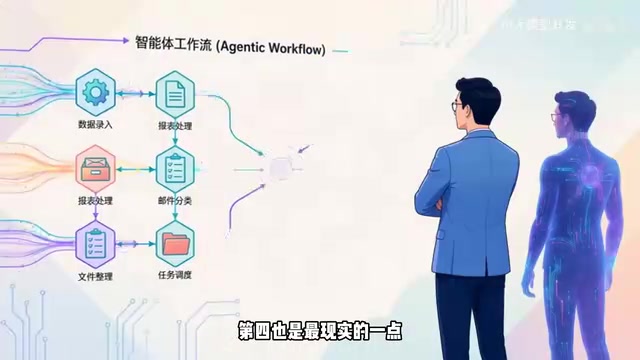
This statement deserves elaboration. Prompt techniques address "single-conversation quality," while workflows address "automation rate of repetitive tasks." The former is a craft, the latter is an asset—a workflow built once can run repeatedly, with marginal cost approaching zero. Tool iteration is essentially a reconstruction of productivity distribution, and watching from the sidelines or rejecting it won't change this trend.
Suggested Getting-Started Path
For zero-base beginners, it's not advisable to build complex workflows right away. A more practical path is: first run a single task through the closed loop of "instruction→execution→verification," such as having it clean a spreadsheet; then try connecting two or three steps into a fixed workflow; only then introduce multi-agent division of labor. The ten lessons covered in the tutorial are quite substantial, but the core logic is just this one main thread.
Common Questions
What's the difference between WorkBuddy and ordinary AI chat tools? The former delivers verifiable results, the latter provides reference text. The difference lies in autonomous execution capability, not the model itself.
Is local file processing safe? Desktop local-first is its design orientation—compared with repeatedly uploading to the web, the data flow path is shorter.
Can a zero-base user learn it? The tutorial is positioned as a one-hour introduction, but "mastery" depends on your ability to decompose tasks and design workflows, which requires hands-on accumulation.
One-line Summary
WorkBuddy has evolved from a chat advisor into an autonomously executing AI coworker, with workflow capability becoming the new dividing line.
Paragraph Summary
The article points out that WorkBuddy is not another chat tool, but a full-scenario autonomous execution AI agent: give it a one-sentence instruction, and it plans steps itself, reads local files, processes tasks in parallel, and delivers verifiable results such as PPTs, cleaned Excel files, and visualization reports. Its capabilities rest on an autonomous execution pipeline, desktop local-first and ecosystem integration, and multi-agent parallel division of labor, enabling individual creators and small teams to command multiple AI experts as project managers. The core judgment is: prompt techniques are no longer the core competency—whether you can build agent workflows and have AI handle 80% of mechanical work is the new dividing line. Zero-base beginners should start with a single-task closed loop, then connect workflows and introduce multi-agent.
Related articles

Trump's Request to Rename the Atlantic Rejected by Google; 1Password Lets AI Agents Log In Securely
The Vergecast roundup: Trump's request to rename the Atlantic the 'Trump Ocean' was politely declined by Google's CEO; 1Password's new feature lets AI agents log into accounts without touching passwords; OPPO launches the world's first 200-megapixel phone, the Find X10 Pro Max. All three point to the boundaries of tech authorization and trust.

The Truth About American College Party Culture: The Risks Schools Won't Admit
Behind American college party culture, the administration's "don't ask, don't tell" attitude is amplifying freshman risks. This article analyzes how the pandemic strengthened Greek dominance, freshmen's difficulty accessing safety information, and the chain reactions caused by a culture of denial.

OpenAI Reportedly Raising $30B at $1.25T Valuation Ahead of IPO
OpenAI is planning a $30B funding round at a possible $1.25T valuation, paving the way for an IPO. If completed, it would set a private company valuation record. This article analyzes the funding size, pre-IPO logic, and industry signals.