Writing Web Novels with DeepSeek: A Complete 6-Step AI-Assisted Fiction Writing Workflow

A systematic 6-step workflow for AI-assisted web novel writing using DeepSeek
This article presents a complete DeepSeek AI-assisted web novel writing workflow with six key steps: generating a novel outline, reviewing story logic chains, refining character profiles (under 150 words each), developing detailed chapter outlines, generating chapter content with auto-correction mechanisms, and content review with AI-voice removal polishing. It also explains the technical principles behind Deep Thinking mode, context window limitations, and semantic drift to help creators understand the logic behind each step.
In recent years, AI-assisted writing has moved from concept to practical application. Many web novel authors have started using large language models to boost their creative efficiency, and DeepSeek has become a top choice for many creators thanks to its powerful Chinese language understanding and generation capabilities. This article breaks down a complete AI-assisted fiction writing workflow—from outline generation to content polishing—to help you understand how to systematically leverage DeepSeek for web novel creation.
Preparation: Enable DeepSeek's Deep Thinking Mode
Before you begin writing, open DeepSeekAd and enable Deep Thinking (Expert Mode). In this mode, the model performs deeper reasoning, producing content with noticeably improved logic and coherence—especially suited for fiction writing scenarios that require complex plot design.
From a technical standpoint, Deep Thinking mode is essentially an enhanced implementation of Chain-of-Thought (CoT) reasoning. In standard mode, large language models tend to output answers directly; in Deep Thinking mode, the model first generates a series of intermediate reasoning steps internally, then derives the final conclusion based on those steps. This approach significantly outperforms direct generation when handling tasks that require multi-step logical deduction. For fiction writing with complex plots and intertwined character relationships, this means the generated outlines and plot designs will be more internally consistent, rather than superficially smooth but logically fragile "patchwork" outputs.
The entire AI web novel writing workflow can be divided into six key steps, each with a clear prompt design rationale, building upon the previous one.
Step 1: Generate a Novel Outline with DeepSeek
The outline is the skeleton of your entire novel. In this step, you need to clearly communicate the following core information to DeepSeek:
- Novel genre: Urban, fantasy, mystery, romance, etc.
- Target word count: Determines plot complexity and pacing
- Core setting: Worldbuilding, main conflict, story tone
Prompt example: "I want to write an urban rebirth novel, approximately 500,000 words. The protagonist is an ordinary office worker who travels back to 2010 and gradually rises to success using memories from their previous life. Please generate a complete novel outline."
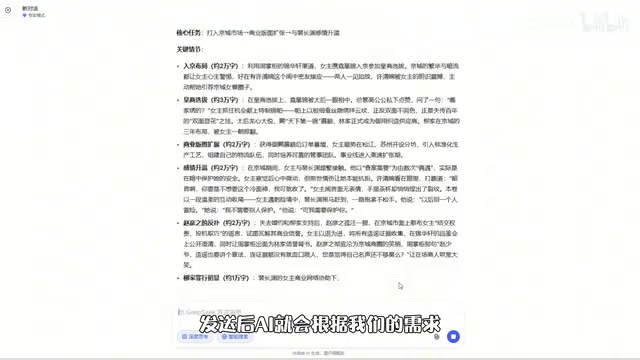
After sending this, DeepSeek will intelligently generate a structured novel outline based on your requirements, including major plot trajectories and key turning points.
Step 2: Review the Story's Causal Logic Chain
After the outline is generated, don't rush ahead. This step is crucial—have the AI review whether its own settings are reasonable.
The specific approach is to have DeepSeek analyze the novel's core settings one by one using a "Problem → Conditions → Solution" framework:
- Is the protagonist's motivation sufficient?
- Are there logical holes in the plot progression?
- Is the antagonist's behavior supported by reasonable cause and effect?
This "AI self-review" approach has a cognitive science basis. Research shows that when a model is asked to re-examine the same content as a reviewer rather than a creator, it often identifies contradictions overlooked during initial generation—similar to the human writing principle of "setting work aside before revising." Switching cognitive perspectives is itself an effective quality improvement technique. Essentially, this leverages the model's reasoning capabilities to compensate for logical flaws that may appear during initial generation. After this review round, the story's causal chain becomes more rigorous, and subsequent writing is less likely to contain internal contradictions.
Step 3: Refine Character Profiles (Keep Under 150 Words Each)
Great novels depend on vivid characters. The key prompt requirements for this step are:
- Each character description should be no more than 150 words
- Emphasize personality traits and behavioral motivations
- Clearly define the relationship network between characters
Limiting word count is a highly practical technique with clear technical logic behind it. Large language models process information within a limited context window—the maximum text length the model can "see" during a single inference. Even modern models with large context windows experience "attention dilution" during long text generation—information farther from the current generation position carries less weight in influencing the output. Keeping character descriptions under 150 words ensures that key character information maintains high weight within the model's effective attention range, thereby maintaining personality consistency across subsequent chapter generation. Overly long character descriptions actually make it harder for the AI to "remember" key points during subsequent generation. A concise 150-word description ensures distinct personalities while being easy for the model to continuously reference within context.
Step 4: Develop Detailed Chapter Outlines
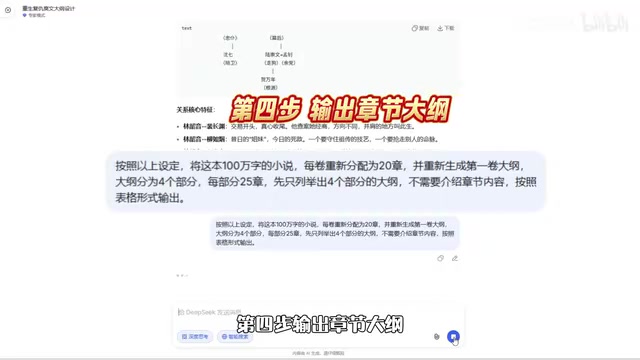
With the master outline and character profiles in place, the next step is breaking the outline down into specific chapter-level detailed outlines.
Core prompt requirements:
- Based on all previously output settings, subdivide the outline into specific chapters
- Don't provide chapter content summaries—instead provide each chapter's main plot details
- Clearly define each chapter's core events, conflict points, and progression direction
The quality of this step's output directly determines the effectiveness of subsequent chapter-by-chapter generation. The more detailed the chapter outline, the less likely DeepSeek is to go off-track when generating the actual text.
Step 5: Generate Chapter Content One by One
When entering the text generation phase, there's a key prompt technique worth noting—include this instruction:
"Please be careful not to deviate from the main storyline. If deviation is detected, automatically correct it."
This sentence acts as an "auto-correction mechanism" for the AI, and its necessity stems from the underlying generation principles of large language models. The "topic drift" phenomenon in long text generation is academically known as Semantic Drift. Its root cause lies in the autoregressive generation mechanism: the model predicts the next word based only on previously generated text, and as text length increases, the weight of early constraints in the probability distribution gradually decreases, causing generated content to deviate from the original intent. Explicitly including an "auto-correction" instruction in the prompt effectively reinforces attention weight on the original constraints at each generation step—a simple yet effective engineering solution.

Subsequent chapters can be generated one by one following the same approach. Note that constraints in your prompts should be as detailed as possible, including word count requirements, style requirements, plot points to cover, etc. The more information provided, the higher the output quality.
Step 6: Content Review and AI-Voice Removal Polish
After generation is complete, two "quality control" processes are still needed:
1. DeepSeek Self-Review
Have DeepSeek review and analyze the generated novel content, checking for:
- Plot contradictions or logical holes
- Character behavior inconsistent with established profiles
- Pacing imbalance or information redundancy
2. Cross-Model Polishing to Remove AI Voice
You can use other AI tools like Kimi for secondary polishing, focusing on removing the AI voice. From a linguistics perspective, "AI voice" is the external manifestation of training data distribution bias in large language models: because models are trained on massive text corpora, they tend to generate statistically "most common" expressions, resulting in formulaic patterns and overly balanced sentence structures that experienced readers can detect. Cross-model polishing leverages different models' distinct training data distributions to break these patterns, producing more natural and varied prose.
Related articles
 Tutorials
ChatGPT Plus Subscription Guide: Are GPT-5.5, image-2, and Codex Worth the Upgrade?
A detailed look at ChatGPT Plus features — GPT-5.5, image-2, and Codex — with a Plus vs Pro comparison and a complete step-by-step subscription guide for users outside the US.
 Tutorials
Harness AI Engineering in Practice: Using Claude Code to Master Enterprise-Level E-Commerce Development
Deep dive into Harness AI Engineering: master enterprise e-commerce development with Claude Code using the Rules, Skills, Wiki, and Changes framework.
 Tutorials
Cursor + Codex Dual-IDE Collaboration: A Practical Methodology for Open-Source Project Customization
A complete methodology for open-source project customization based on real-world experience, detailing the Cursor+Codex dual-IDE workflow, seven-stage process, MVP validation, and AI source code reading techniques.