XBOX Nano Released: A Fully-Featured Wireless Controller in Your Pocket

XBOX Nano retains all 18 inputs in a pocket-sized form, exploring a new path for portable controllers without compromises.
XBOX Nano Controller is a mini controller focused on pocket size, earning 80 upvotes on Product Hunt and ranking sixth for the day. Its core selling point is reducing size while fully retaining 18 inputs, including joysticks, triggers, shoulder buttons, D-pad, and function buttons, distinguishing it from the feature-cut portable controllers commonly found on the market. The product uses Bluetooth for cross-device connectivity and is compatible with phones, tablets, PCs, and consoles, making it especially practical for cloud gaming and mobile streaming scenarios. The article argues that its differentiation lies in "uncompromising inputs," but key parameters such as pricing, release timing, latency, and battery life have not yet been made public, and button layout and accidental-press control in a small body remain engineering challenges to be verified.
In today's world of increasingly homogenized gaming peripherals, XBOX has launched a product that genuinely stands out—the XBOX Nano Controller. This mini controller, which earned 80 upvotes on Product Hunt and ranked sixth for the day, throws a question worth discussing into the market with its selling point of "pocket-sized, with all 18 inputs intact": can controller miniaturization avoid sacrificing operational completeness?
Small Size, Full Completeness: The Core Product Logic of Nano
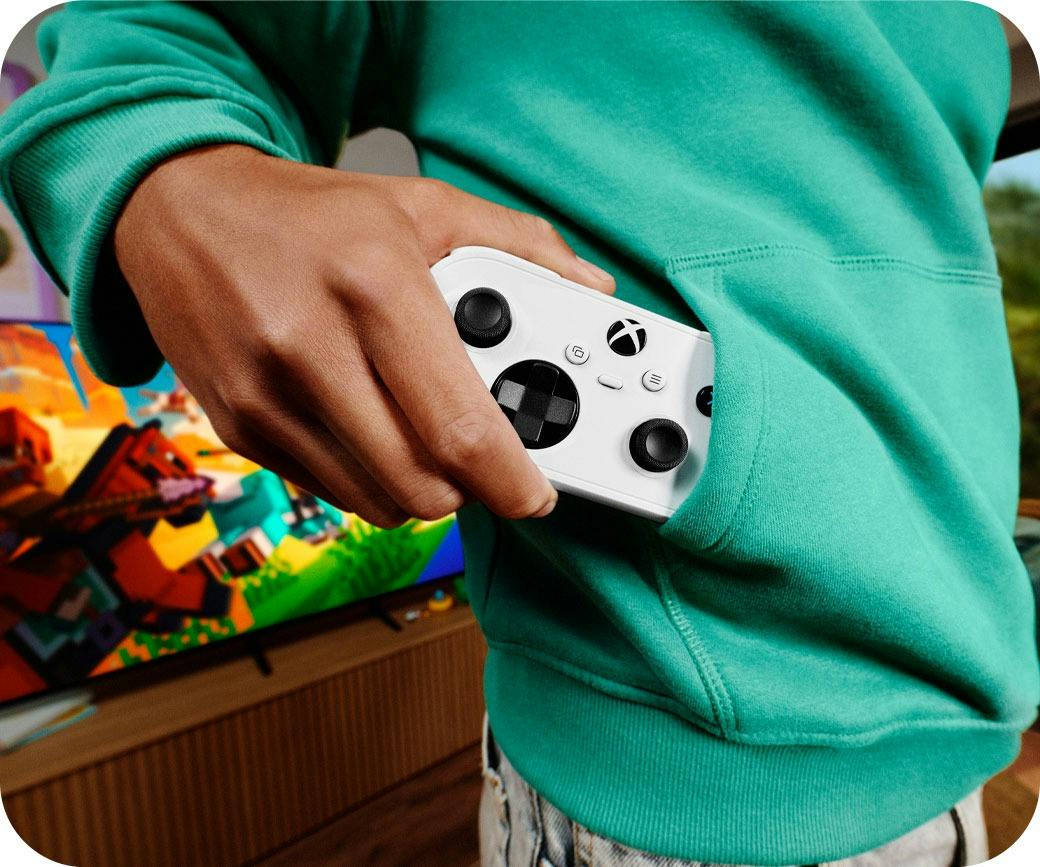
The most direct positioning of the XBOX Nano is "carry it anywhere." The official description repeatedly emphasizes "smaller form factor" and "take play to more places," and the target users are clearly players who want a console-like experience during commutes, travel, or fragmented time.
But what truly makes it stand out among similar products is the number of inputs: 18. This means the joysticks, triggers, shoulder buttons, D-pad, and function buttons are all fully retained in a body that fits in a pocket. Many portable controllers on the market choose to cut rumble motors, simplify trigger travel, or even replace joysticks with sliders in order to reduce size; Nano takes a different path—smaller size, but no subtraction in button mapping.
This trade-off is not easy. Fitting the same number of input components onto a smaller circuit board area is a challenge for both structural design and the supply chain. From the information on the product page, XBOX clearly treats "full inputs" as a core selling point rather than simply pursuing extreme size reduction.
Bluetooth Cross-Device: One Controller Covers Multiple Scenarios
Nano connects via Bluetooth, and the official description explicitly states it can "play across devices." This positioning is very practical in today's gaming ecosystem: players often own a phone, tablet, PC, and console at the same time, and equipping each device with a controller creates both cost and storage burdens.
The significance of cross-device connectivity goes beyond convenience. For cloud gaming and mobile streaming, a Bluetooth controller with controllable latency and complete buttons directly determines whether the experience is "playable" or "enjoyable." Nano's 18-input design comes into play here—AAA titles on cloud gaming platforms often require complete button mapping, and simplified controllers struggle with menu operations and combo keys.
It should be noted that currently available public information only mentions Bluetooth connectivity and does not provide specific latency data, battery life, or a list of compatible devices. These parameters greatly affect the actual experience, so it is advisable to watch for subsequent hands-on feedback.
Button Mapping Requirements for Cloud Gaming and Streaming
When cloud gaming platforms (such as Xbox Cloud Gaming and GeForce Now) stream major console or PC titles, the games themselves are still designed for full-controller interaction: menus require Start/Back buttons, camera control requires the right stick, and shooting requires the linear travel of trigger buttons. Simplified portable controllers often cut these inputs, leaving players unable to save, switch weapons, or aim precisely in-game. Therefore, "18 inputs" is not just a numbers game, but a necessary condition for ensuring that the streaming experience matches local play. Nano's entry with complete button mapping targets exactly this pain point.
Market Position: Another Variable in the Portable Controller Race
Judging from the Product Hunt response, Nano received 80 upvotes and ranked sixth. The discussion热度 is not explosive, but it does show that the portable controller niche still has an audience. There is only one comment in the comment section, which is too small a sample to determine users' specific concerns.
Looking at Nano within the competitive landscape, its differentiation lies in "uncompromising inputs." The portable controller market has long had two approaches: one pursues extreme thinness and lightness while accepting feature cuts; the other retains full functionality but approaches traditional controllers in size and weight. Nano attempts to prove a third possibility—that both can be achieved. Whether this promise holds depends on whether the feel and button layout after mass production are reasonable. With compressed button spacing in a small body, the probability of accidental presses increases—an engineering challenge every mini controller must face.
The Reference Value of Product Hunt Votes
Product Hunt uses a daily voting ranking mechanism, and 80 votes and sixth place fall into the range of "receiving some attention but not becoming a breakout hit." The platform's users are mainly tech professionals and early adopters, and votes reflect more the传播力 of a product concept than mass-market purchase intent. In addition, with only one comment in the comment section, the sample is too small to infer real users' evaluations of button layout or feel. This data should be interpreted cautiously, as an early visibility indicator rather than demand validation.
Several Details Worth Watching
Pricing and release information are not yet clear. The product page does not disclose pricing or launch timing, which is crucial for judging its market competitiveness. Portable controllers are highly price-sensitive, and excessively high pricing would directly weaken the purchase rationale of "a backup to carry around."
The specific composition of the "18 inputs" is not detailed. The official information only gives the total number and does not list the position and function mapping of each button. For players accustomed to specific key layouts, this will affect purchase decisions.
A single comment makes it difficult to form a user profile. Current community feedback is insufficient to support judgments about "user satisfaction"; it mainly reflects early attention.
Conclusion
The proposition put forward by the XBOX Nano Controller is clear: portable does not mean watered down. Today, as Bluetooth cross-device connectivity gradually becomes standard, an official controller that fits in a pocket and lacks no buttons has genuine appeal for mobile players and cloud gaming users. Whether it can deliver on the triple promise of "small size, full inputs, and good feel" still depends on real-world performance and final pricing.
One-line Summary
XBOX Nano retains all 18 inputs in a pocket-sized form, exploring a new path for portable controllers without compromises.
Paragraph Summary
XBOX Nano Controller is a mini controller focused on pocket size, earning 80 upvotes on Product Hunt and ranking sixth for the day. Its core selling point is reducing size while fully retaining 18 inputs, including joysticks, triggers, shoulder buttons, D-pad, and function buttons, distinguishing it from the feature-cut portable controllers commonly found on the market. The product uses Bluetooth for cross-device connectivity and is compatible with phones, tablets, PCs, and consoles, making it especially practical for cloud gaming and mobile streaming scenarios. The article argues that its differentiation lies in "uncompromising inputs," but key parameters such as pricing, release timing, latency, and battery life have not yet been made public, and button layout and accidental-press control in a small body remain engineering challenges to be verified.
Related articles

macOS Is No Longer UNIX: Apple Didn't Renew Certification, But the Technology Is Unchanged
Apple did not renew macOS's UNIX certification, and the Open Group has removed Apple's entry. This article analyzes the technical reality behind the expiration, Apple's possible intentions, and the practical impact on developers.

Building Stateful Multi-Agent Systems with Azure Cosmos DB
Based on the official Azure Cosmos DB tutorial, this article explains how to use the Agent Memory Toolkit to add shared persistent memory to a multi-agent travel planner, covering short-term, long-term, episodic, and semantic memory plus cross-session state continuity.

Production AI Agent Operations: A Three-Step Framework for Observing, Evaluating, and Optimizing
Azure Cosmos DB team proposes a three-step framework for production AI Agent operations: observe trace tracking, evaluate with LLM as a judge and regression testing, optimize cost across RU, retrieval, memory, and LLM layers.