XERJ: A New Way to Search Data for AI, Reducing Token Consumption by 40x

Open-source project XERJ replaces grep with autoindex indexing, claiming 40x token savings for AI agents.
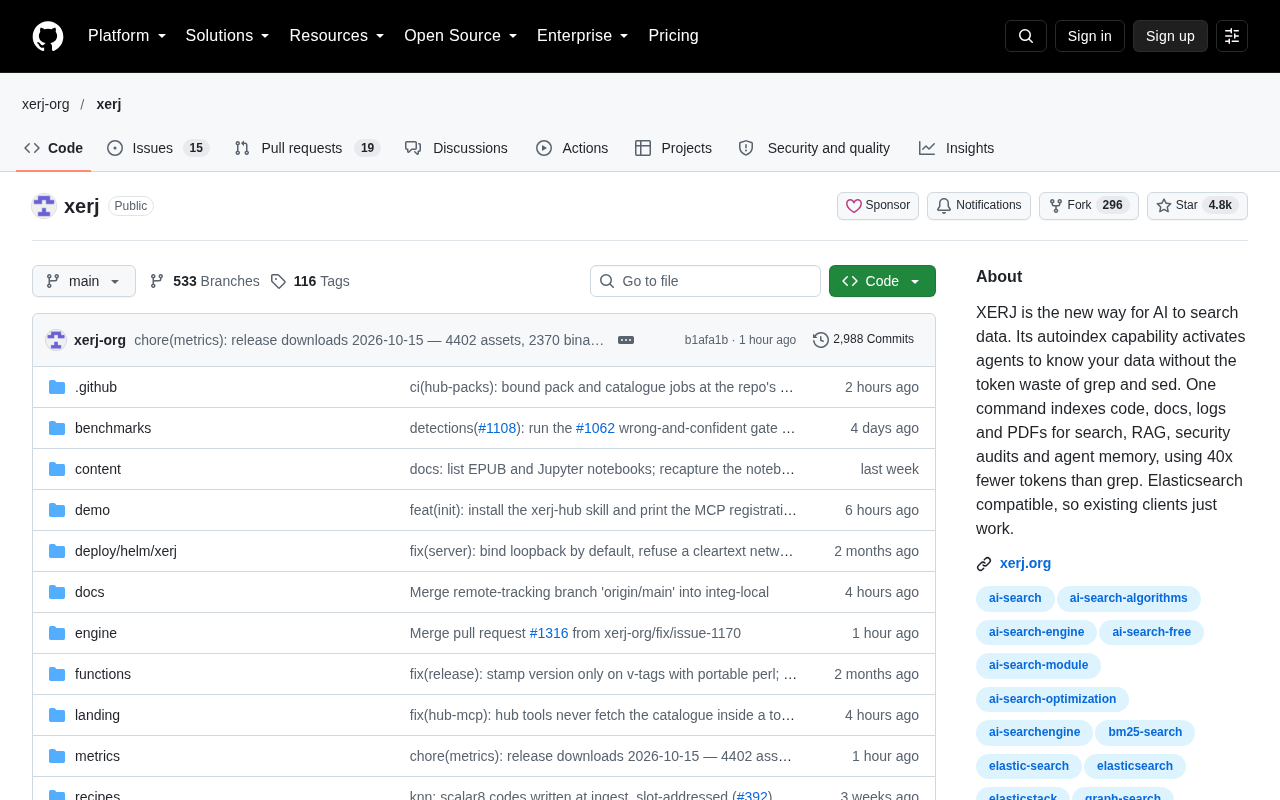
XERJ is a Rust-written open-source project positioned as "a new way to search data for AI," centered on autoindex automatic indexing technology. It addresses the pain point of excessive token consumption when AI agents process code, documents, logs, and PDFs, claiming to save 40x tokens compared to traditional grep methods, thereby reducing inference costs and improving response speed. The project is compatible with the Elasticsearch protocol, allowing existing clients to connect directly with minimal migration barriers, and covers search, RAG, security auditing, and agent memory scenarios. With its positioning as a single tool unifying multiple data sources, XERJ has grown rapidly on GitHub since launch, with 4,751 stars and 295 forks, gaining 725 stars in a single day — but its "40x" claim still requires real-world benchmarking to verify.
As AI agents gradually become everyday tools for developers, an overlooked bottleneck is surfacing: the token cost of data search. Whether it's having AI read code repositories, retrieve logs, or extract information from PDFs, traditional grep and sed approaches require stuffing large amounts of text into the context window, resulting in staggering token consumption. An open-source project on GitHub called XERJ is attempting to solve this problem.
What Is XERJ?
According to the project repository, XERJ positions itself as "a new way to search data for AI." Its core capability is called autoindex: with a single command, it can index code, documents, logs, and PDFs for use in search, RAG (Retrieval-Augmented Generation), security auditing, and agent memory scenarios.
The most critical selling point: compared to grep, XERJ claims to save 40x in tokens. This means AI agents can obtain the same amount of information while occupying far less context window space, directly impacting inference costs and response speed.
The project is written in Rust and currently has 4,751 stars and 295 forks on GitHub, with 725 new stars in a single day — a notably impressive growth rate.
RAG (Retrieval-Augmented Generation) is a technical paradigm that combines external knowledge retrieval with large model generation: the system first retrieves relevant fragments from a knowledge base based on the user's question, then feeds these fragments as context to the model for answer generation. Its value lies in giving models access to the latest or private information beyond their training data while reducing hallucinations. RAG's effectiveness depends heavily on the quality of the retrieval layer — the more accurate the retrieval, the less context the model needs, and the lower the token cost. This is exactly where indexing tools like XERJ come in: it doesn't directly perform generation but provides a more efficient and precise retrieval foundation for RAG.
Why Is Token Efficiency So Important?
To understand XERJ's value, you first need to see the real dilemma AI agents face when processing data.
When an agent needs to locate a function definition in a large codebase, the traditional approach is to run a grep search, returning matching lines and their context. All of this content must enter the model's context window, and a single search in a large project can easily return thousands of lines, causing token consumption to accumulate rapidly. For agent workflows that require repeated searches and multi-turn interactions, costs multiply exponentially.
XERJ's approach is to replace brute-force search with indexing. Pre-built structured indexes allow agents to directly query the information they need without hauling large amounts of raw text into context. The official "40x token savings" claim is the direct benefit of this approach.
Context Window is the maximum number of tokens a large language model can process in a single inference, including input prompts and output results. Mainstream models' context windows range from a few thousand to several hundred thousand tokens, but regardless of window size, input tokens are billed by volume, and the higher the window occupancy, the greater the inference latency and cost. This is why the practice of "stuffing large amounts of raw text into context" in agent workflows is unsustainable: a single grep can return thousands of lines of code, and after a few rounds of interaction, the budget is easily exhausted. The essence of indexed retrieval is transforming "letting the model read raw text" into "letting the model read structured results," carrying equivalent or even more precise information with fewer tokens.
Elasticsearch Compatibility: Lowering the Migration Barrier
XERJ has an easily overlooked but highly practical feature: Elasticsearch compatibility.
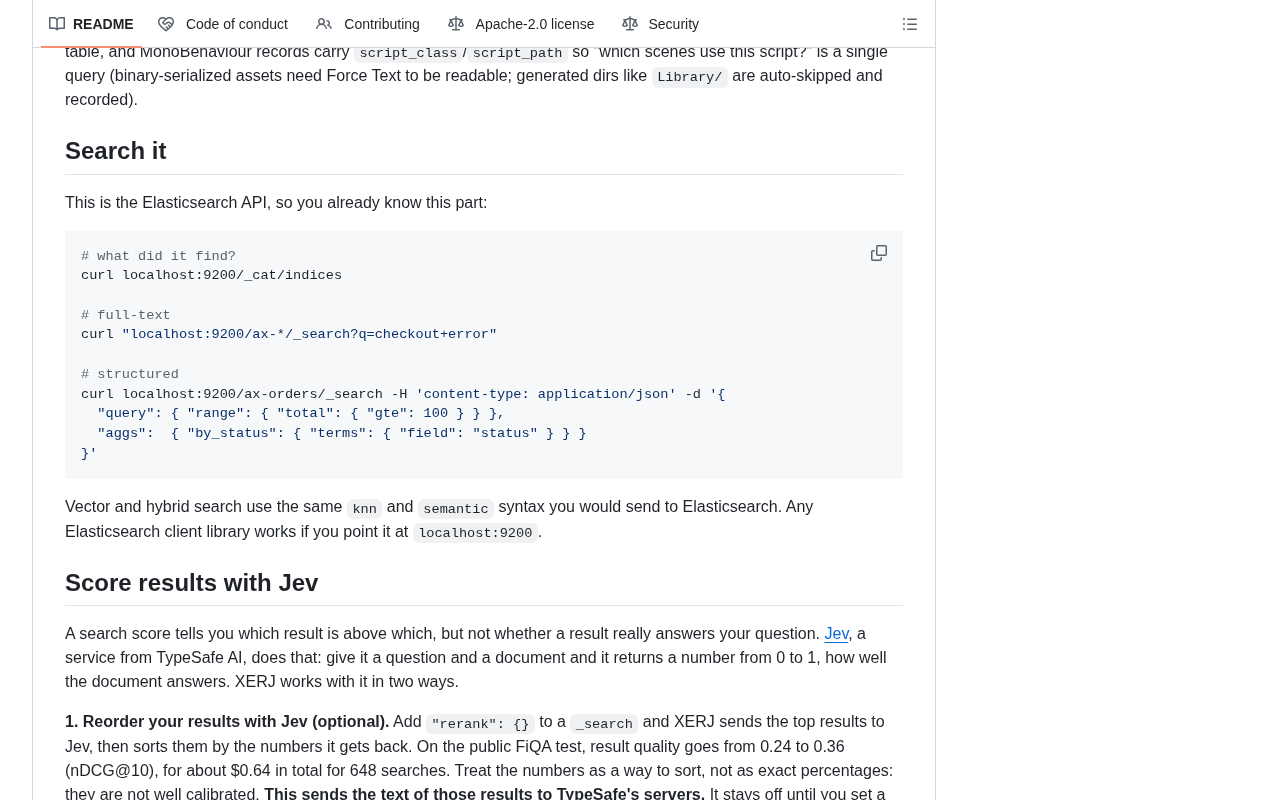
This means existing Elasticsearch clients can connect directly to XERJ without modification. For teams heavily using Elasticsearch for log analysis and full-text search, this eliminates the technical friction of migration. You don't need to rewrite query logic or replace client libraries — just swap the backend to gain XERJ's token efficiency improvements.
From an engineering perspective, this decision is quite pragmatic. Search infrastructure has become highly standardized, and building an entirely new protocol from scratch would only increase adoption costs. By remaining compatible with the existing ecosystem, XERJ can be directly embedded into existing tech stacks.
Elasticsearch is a distributed search and analytics engine built on Apache Lucene, widely used for log analysis (often in conjunction with the ELK stack), full-text search, and observability scenarios. Its core abstractions are indexes, documents, and a JSON-based query DSL, with a rich ecosystem of official and third-party client libraries. "Elasticsearch compatibility" typically means the target system can recognize Elasticsearch's REST API and query syntax, so existing clients, dashboards, and query statements can point to the new backend without rewriting. This compatibility strategy is common in the infrastructure space, as it downgrades the decision of "whether to adopt" from "rewriting the entire retrieval logic" to "changing a service address," significantly reducing the psychological and engineering costs of team evaluation and trial.
Multi-Scenario Coverage: From RAG to Agent Memory
The data types XERJ claims to support cover the mainstream needs of current AI applications:
- Code indexing: Enables AI coding assistants to quickly locate function, class, and variable definitions, reducing context occupation by irrelevant code
- Documents and PDFs: Provides an efficient retrieval layer for knowledge base Q&A and RAG
- Log retrieval: Targets operations and security auditing scenarios, quickly locating anomalous events
- Agent memory: Provides persistent information storage and retrieval capabilities for long-running agents
This "one tool covers multiple data sources" design reduces the burden of teams switching between multiple specialized tools. A single indexing command uniformly handles code, documents, logs, and PDFs, offering clear advantages in engineering efficiency.
Rust-Powered Performance Foundation
The project chose Rust as its implementation language, a reasonable technical choice for a tool that needs to handle large-scale data indexing and high-speed retrieval. Rust's advantages in memory safety and concurrency performance allow XERJ to maintain low runtime overhead when building indexes and executing queries.
However, Rust also means a higher contribution barrier. For an open-source project still in its early stages, whether the community can quickly accumulate contributors around the Rust ecosystem will affect its feature iteration speed.
Vector retrieval and hybrid search are two mainstream technical approaches for reducing agent data acquisition costs. Vector retrieval encodes text into high-dimensional vectors and recalls content by semantic similarity using approximate nearest neighbor (ANN) algorithms, excelling at fuzzy semantic matching; traditional keyword retrieval (such as inverted indexes) excels at exact matching and structured filtering. Hybrid search combines both, balancing semantic recall with keyword precision. XERJ's autoindex leans more toward the structured/inverted index route, emphasizing the use of precise indexing to reduce irrelevant content entering context. Different routes have different trade-offs: vector retrieval has strong semantic capabilities but requires embedding models and additional compute power, while structured indexing is lighter and more controllable but depends on index quality. Understanding this divide helps assess whether XERJ is more cost-effective than vector solutions in specific scenarios.
Competitive Landscape and Observations
XERJ is entering a heating-up track. As AI agents move from demos to production environments, token cost optimization has become an unavoidable engineering problem. Multiple projects are currently attempting to reduce agent data acquisition costs through vector retrieval, hybrid search, or structured indexing.
XERJ's differentiation lies in three points: first, explicitly benchmarking against grep with quantified token savings data; second, Elasticsearch compatibility to lower the adoption barrier; third, covering multiple data types with a single tool. Together, these form a relatively clear value proposition.
However, the project still needs more real-world use cases to verify the universality of the "40x" figure across different scenarios. Token savings may vary significantly under different data scales and query patterns. For teams considering adoption, it's recommended to run benchmark tests on your own real datasets before making a decision.
Project address: github.com/xerj-org/xerj
Related articles

Gemini 4 Argon Hands-On: AI Builds Board Games, Constructs Temples, and Trains Robots Autonomously
Gemini 4 Argon hands-on roundup: AI autonomously builds a desk racetrack and temple in Blender, writes a ray tracing engine, trains a humanoid robot to sink 7 shots, plus API pricing and developer access.

The Magic Octagonal Coin: Why Only 9% of People Can Predict Its Flip?
Only 9% of people can correctly predict the Magic Octagon coin flip. This article explains its spatial rotation mechanism, common cognitive pitfalls, and a new hypothesis based on Relevance Theory, exploring the limits of human spatial reasoning.

Sam Altman: AI Is Entering the Era of Scientific Discovery — Math Breakthroughs Will Replicate in Biology and Energy
Sam Altman says AI is entering the era of scientific discovery — math breakthroughs will replicate in biology, materials science, and energy to help develop new drugs and energy sources.