Xiaomi MiMo-V2.6 Review: Tops Global Open-Source Rankings at a Fraction of the Competition's Price

Xiaomi MiMo-V2.6 PRO tops global open-source AI rankings at a fraction of flagship model costs.
Xiaomi released MiMo-V2.6 on September 22, 2025 — a full-modality model whose Pro variant scored 46 points on an independent international leaderboard, ranking #1 globally among open-source models and surpassing the previous generation's 26-point score by 20 points. Priced at ~¥2.9 per million input tokens, Xiaomi claims it costs just 1/20th to 1/60th of comparable overseas flagships. The release also open-sources the technical report, RL training environment, and code, along with a $3.47M RL training cost breakdown. Real-world demos highlight 3D content generation, physics simulation robotic arm control, and game code generation — including a full F1 drift scene generated for under ¥0.20.
Xiaomi surprised the industry on September 22 with the release of MiMo-V2.6, a full-modality large language model that has been dubbed the "new crown jewel of domestic open-source AI." It claimed the top spot on a major global open-source benchmark while driving inference costs down to a fraction of comparable flagship models. When people talk about open-source LLMs, DeepSeek or Alibaba's Qwen have traditionally come to mind first — but Xiaomi's name now belongs on that list.
Benchmark Breakthrough: A 20-Point Leap in a Single Generation
On an independent international governance leaderboard, MiMo-V2.6 PRO scored 46 points, surpassing Kimi K3 and Qwen 3.8 Max to claim the global open-source #1 position. Across the entire industry, only five models score higher — and every single one is a proprietary overseas flagship from the Claude or GPT tier.
For context, the previous generation MiMo-V2.5 PRO scored just 26 on the same leaderboard — meaning this release represents a 20-point jump in a single iteration. Xiaomi's own benchmark comparison tells an even clearer story: on real-code repair tasks, the previous generation scored 19, while this generation leaps to 71.9; on real-world workplace task evaluations, it ranks third — above GPT-6 Astra; on automated workflow benchmarks, it ranks second, again outpacing both GPT-6 Astra and Claude Ops 5.
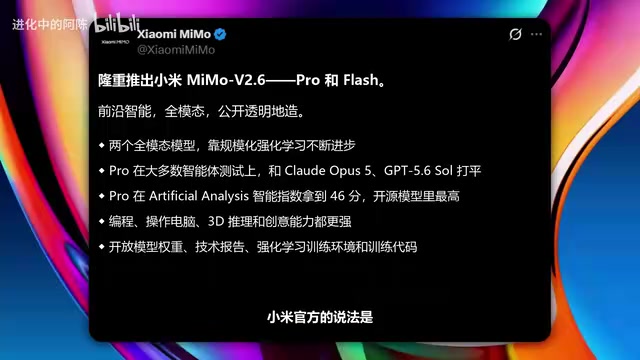
Xiaomi claims that on most agent benchmarks, MiMo-V2.6 can directly compete with flagship models in the Claude Ops 5 tier. The weaknesses are equally transparent — on CLI-based tasks it scores only 34.9, compared to GPT-6 Astra's 59.6, a significant gap.
Pricing Strategy: Comparable Intelligence at a Fraction of the Cost
Plot "intelligence level" against "cost per query" on a chart, and MiMo-V2.6 sits firmly in the smart-and-cheap corner, while the top proprietary overseas models cluster in the most expensive region.
Xiaomi's approach is to deliver more capability at unchanged pricing, maintaining parity with the previous generation: the Pro version costs approximately ¥2.9 per million input tokens and ¥5.9 per million output tokens. Xiaomi claims that at equivalent intelligence levels, its cost is just one-twentieth to one-sixtieth of leading overseas models. Running the same tasks on Qwen 3.8 Max — which MiMo-V2.6 now outperforms — costs roughly 40 times as much.
The Pro version also features an exceptionally large 1-million-token context window and offers a Turbo variant capable of up to 20× faster output, though at 10× the price. The lightweight MiMo-V2.6 Flash is known for its exceptional speed and is currently available for free testing on international platforms.
About tokens: A token is the basic unit for billing and context calculation in large language models, roughly corresponding to fragments of Chinese characters or English words (approximately 1 Chinese character ≈ 1.5 tokens; 1 English word ≈ 1–2 tokens). "Price per million tokens" is the industry-standard pricing metric. A 1-million-token context window means the model can process roughly 750,000 Chinese characters in a single conversation — equivalent to a mid-length novel — which is critical for developers analyzing large codebases, legal documents, or complex multi-turn tasks. The 20× speed boost at 10× the price reflects an engineering trade-off between latency and throughput in inference infrastructure: acceleration typically requires allocating more parallel compute resources per request, raising marginal costs accordingly.
Training Costs and Open-Source Depth: Full Transparency
One of the most transparent aspects of this release is that Xiaomi published the full bill for the reinforcement learning stage: a total of $3.47 million USD (approximately ¥23 million), covering 1.5 million samples and 156.4 billion tokens. The model's benchmark scores climbed steadily through RL deployment, following a self-evolution technical approach.
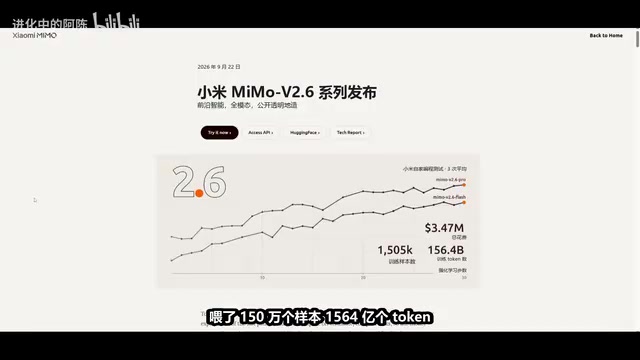
Critically, the open-source release goes beyond the model weights themselves — the technical report, RL training environment, and training code are all included. For the broader open-source ecosystem, this means other teams can reproduce, improve, and continue training within the same framework, significantly lowering the barrier to entry.
About reinforcement learning: Reinforcement Learning (RL) is a training paradigm where a model continuously self-optimizes through trial-error-feedback loops. Unlike traditional supervised fine-tuning (SFT), it doesn't rely on human-annotated ground-truth answers — instead, the model evaluates its own behavior based on reward signals after completing tasks. Since DeepSeekAd-R1 and similar models demonstrated large-scale RL application to reasoning capability improvements, this approach has been widely validated: models can develop more complex reasoning chains through self-exploration alone, without additional human demonstrations. Xiaomi's decision to publicly disclose its $3.47M RL training bill and release the training environment and code is relatively rare in the LLM open-source community — training environments are often harder to reproduce than model weights and represent a significant commercial moat.
3D Spatial and Physical Reasoning: From Robotic Arms to Open Worlds
The official demonstrations push 3D spatial and physical reasoning to the forefront. A dense castle rendered progressively from pencil sketches, a starry night scene, and the light-and-shadow details of a carousel and Ferris wheel are all faithfully reproduced. A 3D open world built in collaboration with domestic game engine Unity China lets users ride a horse across open grasslands with snow-capped mountains in the distance — reviewers estimated this kind of content would take a game developer months to produce, while the model generated it in days.
In NVIDIA's physics simulation environment, the model simultaneously processes feeds from two cameras — one on the wrist, one on the tabletop — to compute in real time where to move and how to rotate, autonomously planning and controlling a robotic arm to place red and blue blocks in their designated positions with precision. From 3D platformer jumping games to tank combat in real-time strategy games, to a turntable product render showing a dust cover being lifted, a vinyl record placed, and the speed selector being switched — all generated autonomously by the model.
About NVIDIA's physics simulation environment: This refers to platforms like Isaac Sim, a robotics simulation environment that precisely models physical laws including gravity, friction, and collision in a virtual world, enabling AI to undergo large volumes of manipulation training without physical hardware. Combining large language models with physics simulation represents a mainstream technical path toward Embodied AI — where models don't just process text or images, but understand 3D spatial relationships and output executable action sequences. Multi-camera fusion perception (as seen here with simultaneous wrist and tabletop views) is a common configuration in industrial robotic arms and service robots, reducing occlusion blind spots from any single viewpoint and improving spatial reasoning accuracy. Xiaomi's demonstration in this context suggests its model has achieved a preliminary closed-loop capability from visual perception to motion planning — a critical step toward real-world robotics applications.
Developer Tests: From Sonic-Style Platformers to F1 Drifting
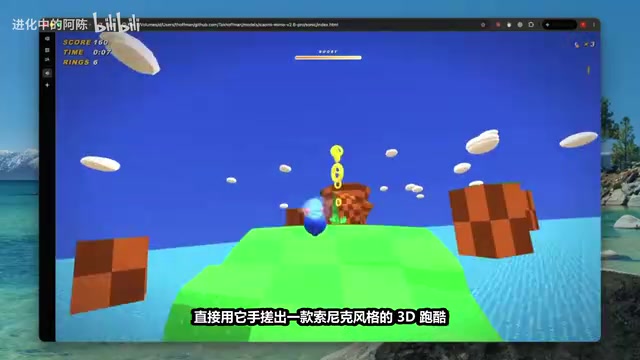
No matter how polished official demos look, third-party hands-on tests are the real measure. An international developer used MiMo-V2.6 to build a Sonic-style 3D parkour game from scratch — complete with a green checkerboard track, golden rings, springboard jumps, and a scoring system — fully playable in the browser.
On a dedicated AI evaluation platform, it generated a product page for the NVIDIA RTX 5090, rendering a fully rotatable 3D GPU in pure code with animated internal heat spreaders and cooling airflow channels. The platform's AI judge noted it was "ambitious but ultimately fell short" — the code grew too long and was truncated, leaving several interactive features non-functional.
The most jaw-dropping demo was an F1 car performing a street burnout in circles: a single webpage file output over 43,000 tokens in one go, generating a red car throwing a tail-slide with tire smoke, skid marks on the asphalt, multi-angle camera cuts, drift scoring, and slow-motion replays — the entire generation cost less than ¥0.20.
System Recreation and Aesthetic Performance
For complex system simulation, it fully recreated the classic Windows 95 desktop — complete with the Start menu, My Computer, Minesweeper, and even functional retro web pages and a DOS command line. Reviewers admitted that this level of detail was something they'd only expected from top-tier proprietary models like GPT-6 Astra or Claude Fable.
There were shortcomings: when handling a complex New York Harbor animation, it placed a bridge that should have spanned the river on top of a building, making cars appear to fly across rooftops. But within a 90,000+ token budget, it achieved a scrollable timeline showing moon phases, tidal changes, and traffic flow from sunrise to midnight.
Visual aesthetics were equally impressive: editorial landing pages with magazine-style layouts, animated oil paintings with floating branches, and particle-swirl art canvases — a complete departure from the cookie-cutter templates typical of AI-generated content. The island management game President's Island, built by the model itself, lets players build categorized structures, manage finances, and track citizen approval ratings across a 3D tropical island.
Conclusion: Disrupting the Industry by Making Intelligence Affordable
The true significance of MiMo-V2.6 isn't just topping a leaderboard — it's compressing the cost of high-level intelligence by an order of magnitude while open-sourcing the full training environment and code. When domestic open-source models begin autonomously reasoning about physical space, handcrafting 3D games, and commanding robotic arms in simulated environments, a new path has been forged for the open-source ecosystem. The second half of the race toward artificial general intelligence may well belong to those who can genuinely make intelligence affordable — and bring it into everyday life.
Related articles

NVIDIA's 30,000 Developers Use Cursor, Code Commit Volume Triples
Cursor engineer Chris Diaz breaks down five organizational gaps blocking enterprise AI coding scale—strategy, risk tiering, governance, metrics, and operating model. NVIDIA's 30,000 developers use Cursor daily, tripling code commits while defect rates stay flat. The key: rewrite the SDLC, not add tools.

Ponytail: Giving AI Coding Agents a Senior Engineer's Mindset
Ponytail is a free GitHub tool that injects a senior engineer's mindset into AI coding agents, making them ask whether code is even necessary first. According to TamilDeck, it can compress 200 lines of AI-generated code to 30, cutting token costs, with support for Cursor rules and Claude Code skill integration—though security review still requires human oversight.

Complete Guide to Connecting Cursor AI to the GitHub MCP Server
A step-by-step guide to connecting Cursor AI to the GitHub MCP server: create a personal access token, configure mcp.json, store the token in the ENV block, and verify with a PR query.