Xreal Aura Unveiled: A Wired Android XR Headset Starting at $1,279

Xreal launches the Aura, a wired headset running Android XR, starting at $1,279, pivoting toward spatial computing.
Xreal has officially released the Aura, a new wired headset running Google's Android XR platform, starting at $1,279. This marks Xreal's transition from a lightweight viewing glasses manufacturer to a full spatial computing device maker. The Aura taps into the open Android XR ecosystem, allowing developers to follow a development path close to Android, with content sources not limited to its own store. The wired design means computing and power may be externalized to reduce headset weight and thermal pressure, but it also limits mobility. Pricing enters the mid-to-high-end range, with competitors no longer just AR glasses. Multiple XR-exclusive launch apps will be available, but key parameters such as display specs, field of view, and weight have not been announced, and the actual experience remains to be verified.
Xreal has officially launched the Aura, a new wired headset running on the Android XR platform, with a starting price of $1,279. In terms of product positioning, Xreal is shifting its focus from lightweight viewing glasses to full-fledged spatial computing devices, and the Aura is the flagship product that marks this pivot.
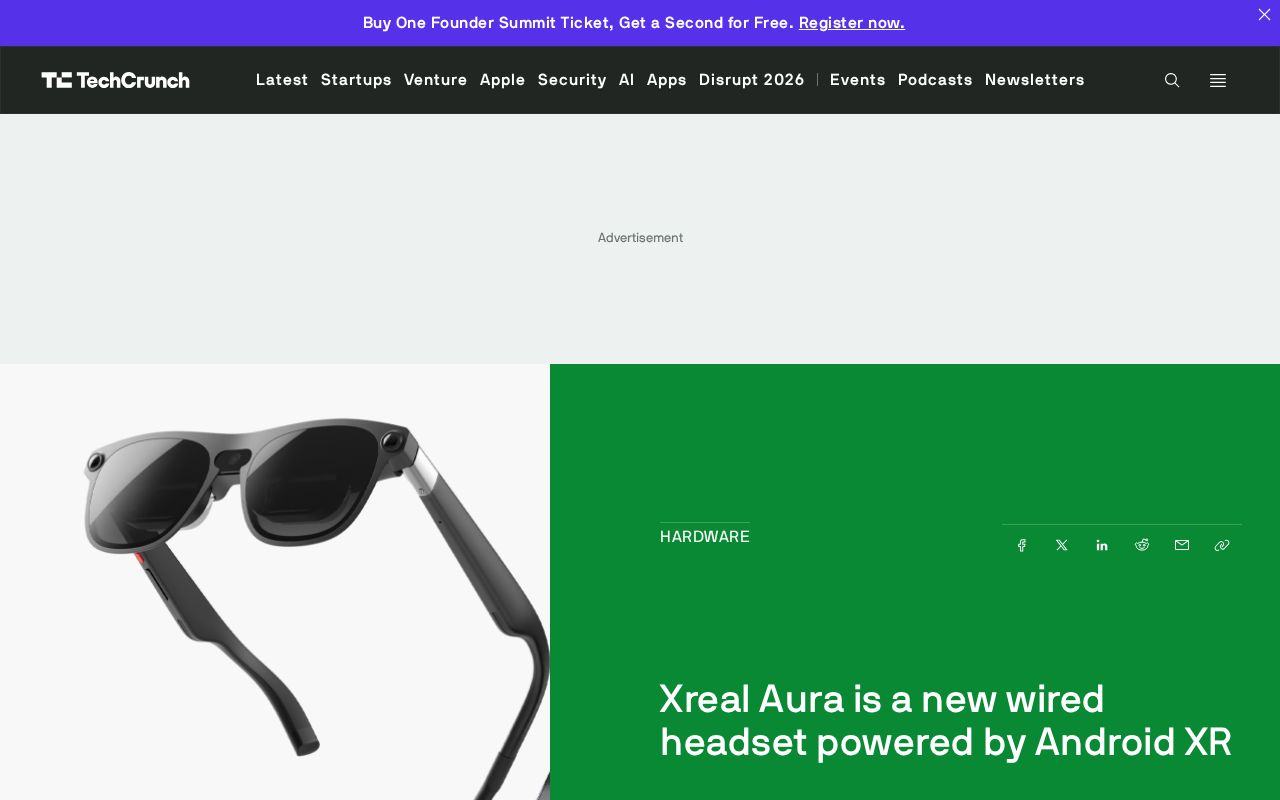
Android XR Gains Another Member
The core selling point of the Aura is its Android XR integration. This means it is not a closed, custom system but rather part of the XR ecosystem led by Google. For developers, Android XR offers a development path that is much closer to the Android app ecosystem; for users, content sources are no longer limited to the manufacturer's own app store.
Xreal has previously accumulated experience in optics and lightweight design in the consumer AR glasses market. By choosing Android XR as the system foundation for the Aura, Xreal effectively delegates the challenge of the software ecosystem to the platform provider while focusing on hardware form factor and wearing comfort. This division of labor is becoming increasingly common in the XR industry and lowers the barrier for a single manufacturer to build a complete ecosystem.
Android XR is an operating system platform led by Google for extended reality devices, officially released in late 2024, with participation from manufacturers such as Samsung and Qualcomm. It was not built from scratch but is deeply customized based on the Android Open Source Project, so it naturally inherits Android's application framework, development toolchain, and distribution channels. For developers, this means they can use familiar Kotlin, Jetpack Compose, and OpenXR interfaces to build XR applications, with migration costs significantly lower than learning an entirely new system. Android XR also includes built-in interfaces for invoking AI capabilities such as Gemini, supporting voice and visual multimodal interaction. Compared with Meta's Horizon OS or Apple's visionOS, Android XR's strategy emphasizes open licensing, allowing different hardware manufacturers to share the same software foundation, which is a key reason why hardware-focused companies like Xreal chose it.
Wired Design and $1,279 Pricing
The Aura adopts a wired connection approach with a starting price of $1,279. This price falls into the mid-to-high-end range in the XR headset market and is noticeably higher than Xreal's previous product line focused on portable viewing. A wired form factor typically means the device delegates computing or power supply to an external host, thereby reducing the weight and thermal pressure on the headset itself.
The upward pricing also brings a real challenge: the Aura's competitors are no longer just similar AR glasses but also other Android XR devices and mature spatial computing products. Xreal needs to justify the premium with display quality, wearing comfort, and launch content.
In the XR headset space, wired versus wireless is not simply a difference in connection method but a route choice that directly determines product architecture. Wired solutions typically use a split design: the headset body retains only the display modules, optical lenses, and necessary sensors, while the computing chip and battery are externalized to a standalone host or powered via cable from a phone or PC. The advantage is significantly reduced headset weight, less heat generation, and breaking through the battery capacity constraints on performance; the cost is that the range of movement is tethered by the cable and portability is reduced. Currently, mainstream split-design products like Apple Vision Pro use an external battery pack, while the Xreal Aura's wired form factor is closer to the approach of early PC VR headsets, targeting relatively fixed usage scenarios rather than mobile wear.
Launch Lineup: Multiple XR-Exclusive Apps
Xreal states that the Aura will offer multiple XR-exclusive launch applications at release. Launch content is crucial for XR devices, as it determines whether users can immediately feel the difference from traditional screens when they get the device. The existence of exclusive apps also shows that Xreal has made targeted preparations at the software level, rather than just porting Android apps into the headset.
However, the official information disclosed so far focuses on price, platform, and the number of launch apps; key parameters such as display specifications, field of view, weight, and battery life (or power supply solution if wired) have not yet been detailed. These details will directly affect the evaluation of the Aura's actual experience.
The difference between XR-exclusive apps and ordinary Android apps mainly lies in whether they have been redesigned for spatial interaction and stereoscopic display. Ordinary apps ported into a headset often just run on a floating flat screen, essentially still a 2D experience; XR-exclusive apps typically utilize spatial anchoring, 6DoF tracking, gesture or eye-tracking interaction to spread content into three-dimensional space, such as multi-window workspaces, spatial video playback, or immersive games. For launch devices, the quantity and quality of exclusive apps are intuitive indicators of platform maturity, because early adopters most fear "buying a device with no content to use." Xreal's emphasis on having multiple exclusive apps at launch is intended to alleviate this concern, but the specific list and level of completion still need to be verified after release.
Market Significance and Open Questions
The emergence of the Aura makes the Android XR hardware lineup more complete and extends Xreal from an "AR glasses manufacturer" toward a "spatial computing device manufacturer." The $1,279 starting price and wired form factor indicate that this is a product for heavy-duty usage scenarios, not a portable viewing accessory.
Points worth watching going forward include: the content richness of the Android XR ecosystem at launch, the convenience trade-offs of the wired solution in actual use, and whether Xreal can use this product to establish a solid position in the high-end XR market. Public information is currently limited, and the product's real performance still awaits hands-on verification.
Related articles

Will GitHub Die? Open Source Maintainer Burnout and the Collaboration Crisis in the AI Era
Lex Fridman podcast discussion on open source maintainer burnout and GitHub's predicament: massive pull requests overwhelm core maintainers, and AI worsens code bloat. Using math journal peer review and Poincaré conjecture verification as analogies, the article analyzes why verification in knowledge production must be deliberately slow, and how open source communities can avoid the failure mode of maintainers exiting.

Stop Building Cookie-Cutter AI Websites: 3 Tools That Transform Your Coding Agent
Three tools that boost AI coding agents: FFmpeg skill for local video editing in Claude Code and Cursor, Hallmark's 50 design themes to fix cookie-cutter AI sites, and Jailbreaks' 25+ model prompts.

How America's Gerontocracy Squeezes the Younger Generation
Americans over 55 hold nearly three-quarters of national wealth, alongside an 80-year-old president and elderly congressional leaders. The Atlantic's Idrees Kahloon explains how gerontocracy drives up housing costs, squeezes opportunities for the young, and explores zoning reform and child poverty reduction as practical fixes.