XWiki Launches Open-Source MCP Server: Let AI Read Your Wiki

XWiki open-sources an MCP Server so AI coding assistants can read and write a self-hosted Wiki while keeping data control.
XWiki has released an open-source, self-hostable MCP Server extension that wraps its Wiki into a standard MCP server, letting AI agents like Claude Code, GitHub Copilot, OpenCode, Pi, and Codex query Wiki content, create and edit pages, and handle structured data. Its key selling point is "keeping control": the server runs on your own infrastructure, data flow is under your control, and open-source code ensures auditability, addressing compliance concerns about internal documents. It earned 113 votes and 30 comments on Product Hunt, placing 4th for the day—real demand but still early. Its differentiation is betting on an open protocol rather than a proprietary plugin; its limitation is that its value depends heavily on already using XWiki.
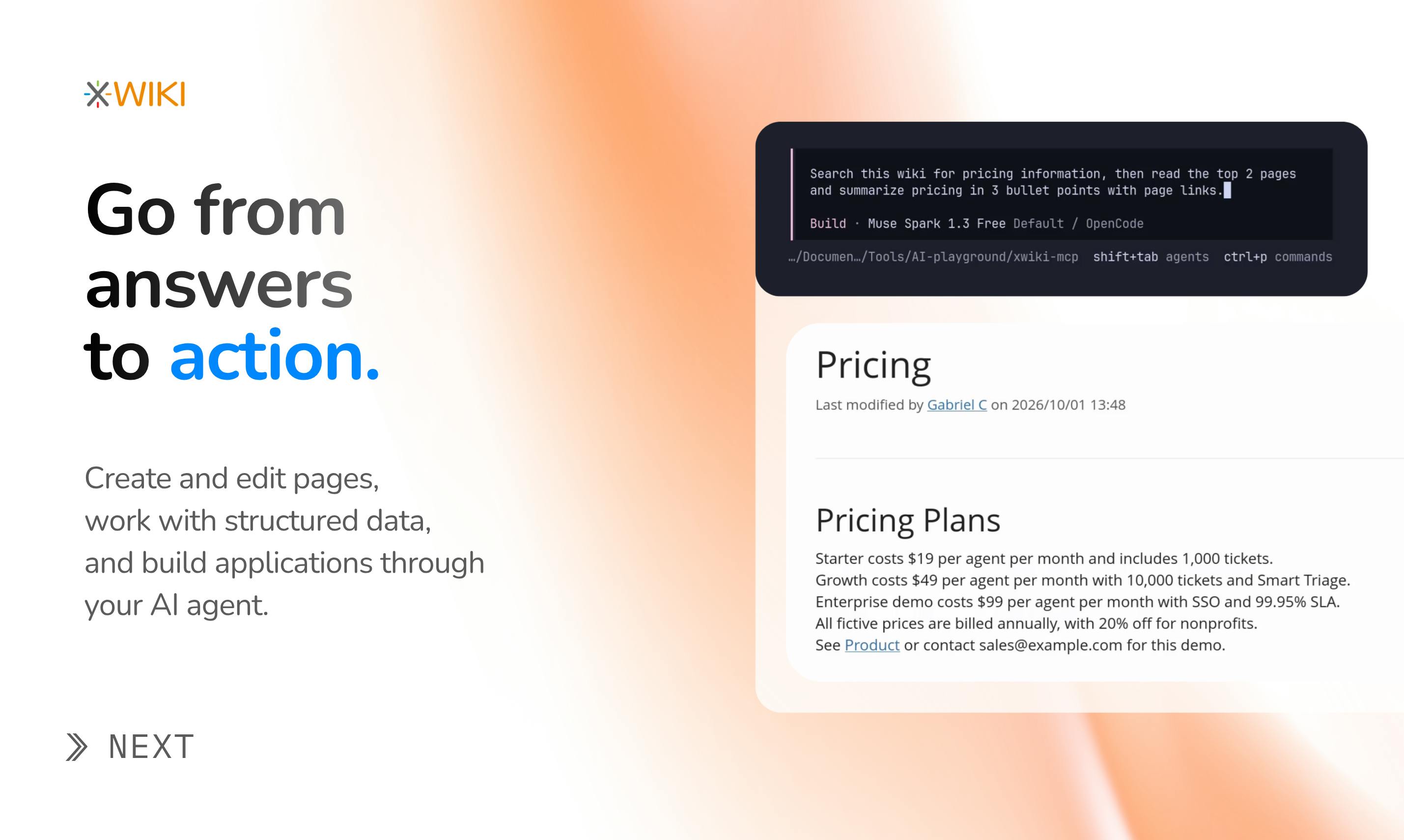
A long-standing invisible wall exists between enterprise knowledge bases and mainstream AI coding assistants: tools like Claude Code and GitHub Copilot can read code repositories, but they can't read the Wiki pages a team has built up over years. XWiki's newly open-sourced MCP Server extension is aimed squarely at that wall. It debuted on Product Hunt with the tagline "Hand your Wiki knowledge to AI while keeping control," earning 113 votes and 30 comments to place 4th for the day.
What Is XWiki MCP Server
MCP (Model Context Protocol) is an open protocol that lets AI agents access external tools and data sources. What XWiki has done is wrap its own Wiki platform into a standard MCP server, so any AI client that supports the protocol can connect.
According to the official description, this is an open-source, self-hostable extension. Supported AI agents already include mainstream options such as OpenCode, Pi, Codex, Claude Code, and GitHub Copilot. In other words, you don't have to lock into any single vendor's AI, and you don't have to host Wiki data on a third-party cloud—the server runs on your own infrastructure.
MCP (Model Context Protocol) was proposed and open-sourced by Anthropic in late 2024, using a client-server architecture: AI applications (such as Claude Desktop or IDE plugins) act as clients and connect to various MCP servers through a standardized interface, with servers responsible for exposing tools, resources, and prompt templates. Compared to the old approach of writing a separate plugin for each data source, MCP abstracts "how AI invokes external capabilities" into a unified protocol, so the same server can be reused by multiple AI clients. The protocol itself doesn't dictate deployment: servers can run locally or be hosted remotely, with authentication and data boundaries determined by the implementer.
Three Core Capabilities: Query, Edit, Structured Data
In the current version, the extension exposes three types of operations:
- Knowledge base Q&A: AI agents query Wiki content directly, answering questions based on the documentation the team has built up rather than relying on the model's general training knowledge.
- Page creation and editing: AI can not only read but also write. It can create new pages or modify existing content in the Wiki, capturing conclusions from conversations back into the knowledge base.
- Structured data handling: Beyond plain-text pages, it can also operate on structured data in XWiki, meaning AI can help maintain table-type and field-type information entries.
Combined, these three capabilities effectively turn the Wiki from a "read-only reference document" into a read-write node in AI workflows.
Why "Keeping Control" Is the Keyword
The official tagline deliberately emphasizes keeping the control—and it's not marketing speak. For organizations that treat internal documentation as a core asset, feeding Wiki content to cloud AI raises natural compliance concerns.
The self-hosted model solves this: the MCP server is deployed on your own infrastructure, the data flow path is under your control, and which AI client connects is your decision too. Open source further guarantees auditability—teams can review the code to confirm how data is read and written.
This echoes a common tension in enterprise AI adoption today: you want AI to use internal knowledge, but you don't want to migrate the entire knowledge base to an external platform. The MCP protocol happens to provide the middle layer, and XWiki has chosen to occupy that position with an open-source implementation.
Data sovereignty refers to an organization's ultimate authority over where its data is stored, how it is accessed, and how it is used. In AI scenarios, this manifests concretely as: whether inference requests leave your own infrastructure, which fields the model can read, and whether write operations are logged and auditable. A self-hosted MCP server narrows the data egress to a boundary the team controls, and with open-source code review, you can confirm there are no hidden outbound channels. This is especially critical for teams bound by industry regulation (such as finance or healthcare) or internal compliance policies—and it's the concrete meaning of "keeping control" translated from a slogan into engineering practice.
Competitive Landscape and Product Positioning
Connecting Wikis to AI is nothing new—knowledge management tools across the board are trying it. XWiki's differentiation lies in two points: first, it bets on the open MCP protocol rather than a proprietary plugin, raising the ceiling for compatibility; second, it is fully open-source and self-hostable, targeting technical teams sensitive to data sovereignty.
The 30 comments and 113 votes on Product Hunt show genuine demand for this direction, though it's hardly a blockbuster. In the launch copy, the team directly solicited improvement ideas from the community—a pragmatic stance, since the current version is more a usable starting point than a finished product.
Who It's For
If your team already uses XWiki to accumulate documentation and some people use Claude Code or GitHub Copilot for daily development, the value of this extension is most direct: it saves the back-and-forth copying and pasting between the Wiki and AI tools.
If your team doesn't use XWiki yet, its appeal diminishes—the MCP server is tied to a specific Wiki platform, and switching platforms means switching implementations. This also points to a broader trend: MCP is becoming the standard exit for knowledge management systems to connect to AI, and whoever gets the protocol working first is more likely to become a default option in AI workflows.
XWiki has taken this step; what remains is to see which capabilities community feedback can help fill in.
XWiki is an open-source Wiki platform dating back to 2004, licensed under LGPL, known for structured data (classes, objects, properties) and scriptable extensions. It's commonly used for internal enterprise knowledge bases, document collaboration, and lightweight application building. Compared with commercial products like Confluence, its advantages are being fully open-source, privately deployable, and having a flexible extension mechanism; the trade-off is that its ecosystem and out-of-the-box experience depend relatively heavily on the community. The MCP Server is released as an extension, continuing its plugin tradition—without modifying the core, new capabilities are mounted through extensions, lowering upgrade and maintenance costs.
One-line Summary
XWiki's open-source MCP Server lets AI coding assistants read and write a self-hosted Wiki while keeping data control.
Paragraph Summary
XWiki has released an open-source, self-hostable MCP Server extension that wraps its Wiki into a standard MCP server, enabling AI agents such as Claude Code, GitHub Copilot, OpenCode, Pi, and Codex to query Wiki content, create and edit pages, and handle structured data. Its core selling point is "keeping control": the server is deployed on your own infrastructure, data flow paths are under your control, and open-source code ensures auditability, addressing enterprises' compliance concerns about internal documents leaking out. The product earned 113 votes and 30 comments on Product Hunt, placing 4th for the day—demand is real but the product is still early. Its differentiation lies in betting on an open protocol rather than a proprietary plugin, raising the ceiling for compatibility; its limitation is that its value depends heavily on the team already using XWiki.
Related articles

A New Paradigm for Text Editing in Compose: TextFieldState Replaces the Old API
Jetpack Compose introduces the TextFieldState API to fix dropped characters and cursor jumps from async input. The old value/onValueChange callbacks will be deprecated in 1.13. This article covers InputTransformation, OutputTransformation, four state hoisting patterns, and new formatted text editing capabilities.

Remote Compose: A New Document-Driven Paradigm for Cross-Platform UI on Android
Remote Compose transmits compact binary documents instead of screen pixels, enabling efficient UI rendering on remote surfaces like Wear OS and widgets. This article covers its document creation API, expression animations, size optimization techniques, and Wear OS progress.

How Crashlytics Eliminates Android Memory and Responsiveness Issues
Through the Chroma Clip case study, this article explains how Firebase Crashlytics uses Application Exit Info, Profiling Manager, GWP ASAN, and ARM MTE to pinpoint ANRs, OOMs, memory limit terminations, and native memory corruption—solving the challenge of stack traces that don't point to the real culprit.