YABAI: Learn Authentic Japanese Slang Through Giant Typography Flashcards

YABAI teaches authentic Japanese slang through 308 cultural flashcards, built entirely with AI agents.
YABAI is a mobile app focused on Japanese slang and internet vocabulary, featuring 308 real-world entries. Each card covers meaning, example sentences, a vibe check, and word origin. Unlike most language apps, it ditches streaks, quizzes, and XP in favor of a browsable "living dictionary." Built by developer Yuichi Sato using Claude Code AI agents, it supports 13 languages and works fully offline. When word origins are unclear, the app says so honestly rather than fabricating stories — a rare quality in the age of AI-generated content.
Japanese Beyond the Textbook
Classroom Japanese rarely makes it past the classroom door — polite, proper, and a far cry from real conversations, internet slang, and the specialized vocabulary of anime fandoms. A new app called YABAI, freshly launched on Product Hunt, aims to fill that gap: it collects 308 authentic slang terms, internet expressions, and fan community words, presenting each one as a card built around oversized Japanese typography.
The app's name, YABAI (ヤバい), is itself the perfect example — a word that can mean "terrible" or "dangerous" just as easily as "amazing" or "incredible," with context determining everything. It's an ideal name, because it points directly at the product's core idea: real language is ambiguous, alive, and unpredictable.
Every Card Tells a Complete Story
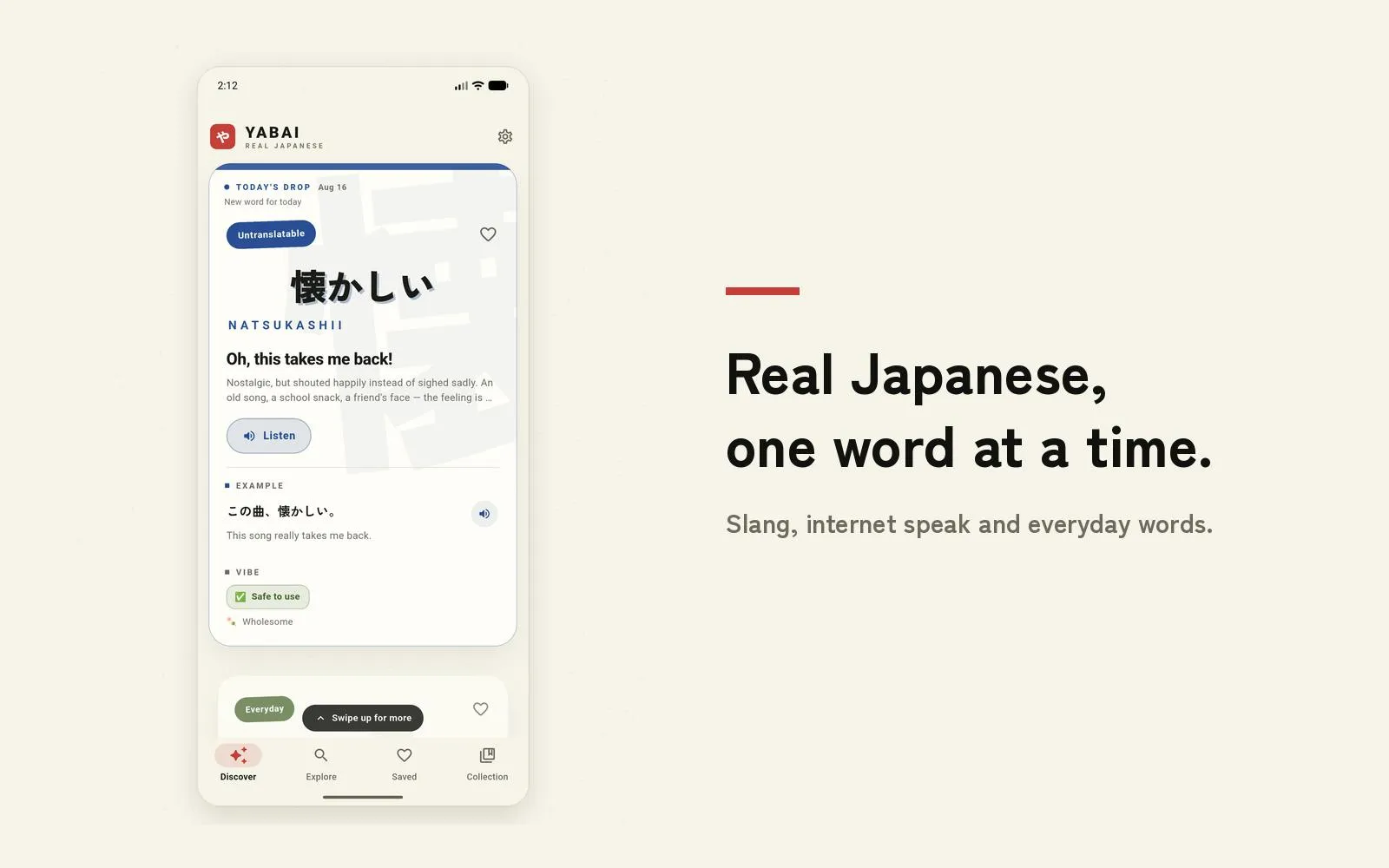
YABAI's design philosophy transforms vocabulary learning from rote memorization into something closer to reading a short story. Each entry covers four dimensions: the word's meaning, example sentences in real-world contexts, a "vibe check," and the story behind the word's origin.
The "vibe check" is a particularly clever touch. It tells you whether a word is safe to use freely, only appropriate among friends, or something to handle with care. For learners, this addresses one of the most common pitfalls of slang acquisition — using a word in the wrong setting. Something that sounds warm and casual in a group chat can come across as quite rude in a formal context.
Even more commendable is the app's commitment to honesty: when a word's origin is disputed or simply unknown, YABAI labels it as such rather than inventing a plausible-sounding backstory. In an era when AI-generated content is notorious for confidently fabricating information, this kind of restraint is actually a meaningful source of credibility.
Built End-to-End by AI Agents
YABAI's other technical highlight is how it was built. According to developer Yuichi Sato, the entire product was constructed end-to-end in Claude Code using AI agents. This is another real-world example of a growing trend — AI-assisted full-stack development — and a finished, multi-language app available on the app store demonstrates just how much a solo developer can accomplish with AI coding tools.
The feature set isn't trivial: the app supports 13 languages and works completely offline, giving users full access to every entry without an internet connection. Offline capability is especially valuable for language learning apps, making them usable during commutes, travel, and anywhere else connectivity isn't guaranteed.
Claude Code is a command-line AI coding tool from Anthropic that lets developers collaborate with Claude in a terminal environment to write, debug, and refactor code using natural language. "End-to-end" here means the entire workflow — from project initialization and feature implementation to packaging for release — was AI-assisted, rather than just using AI for code snippet completion. This differs meaningfully from traditional AI code completion tools like GitHub Copilot, which primarily offer line-by-line suggestions. Claude Code supports AI agents that can autonomously plan and execute multi-step tasks, with the developer acting more as a director of requirements than a line-by-line programmer. For indie developers, this model dramatically lowers the time and skill threshold required for a single person to ship a complete iOS/Android app. YABAI is increasingly cited as a signal of how mature this kind of workflow has become.
An Anti-Gamification Learning Philosophy
In sharp contrast to most language learning apps on the market, YABAI explicitly claims: no streaks, no quizzes, no XP.
This is a deliberate, opinionated trade-off. Products like Duolingo have pushed gamification to its logical extreme, using win streaks, points, and leaderboards to drive engagement — but they're also frequently criticized for encouraging users to "study for the sake of the streak" rather than actual learning. YABAI goes the other direction, positioning itself as a living dictionary you can browse at any time based on curiosity, not a daily task list demanding a check-in.
For learners who have a clear goal — genuinely understanding Japanese internet culture and slang in context — this pressure-free design may be a better fit. Whether the absence of feedback and reward mechanisms affects long-term retention remains to be seen.
Gamification refers to the design strategy of applying game mechanics — points, badges, leaderboards, streak rewards — to non-game contexts to boost user engagement. Duolingo is the most iconic example in language learning: its streak mechanic (consecutive days of study) has been shown to significantly drive daily active retention, but has also drawn scrutiny from researchers who note that user motivation gradually shifts from "learning the language" to "not breaking the streak" — an anxiety-driven usage pattern. Behavioral scientists call this "goal displacement," where the means becomes the end. YABAI's choice to abandon this system is essentially a bet on a different type of user motivation: intrinsic curiosity and cultural interest rather than external rewards. Neither approach is universally superior, but for more advanced learners who already have a foundation in Japanese and are actively exploring cultural context, the pressure-free design is arguably a stronger fit.
Takeaway
YABAI currently has 69 upvotes on Product Hunt and ranks 12th for the day, listed under Android, Education, and Language categories. Its value isn't in technical complexity — it lies in precisely targeting a need that mainstream textbooks consistently overlook: learning Japanese slang in authentic, culturally grounded context. The bold typographic visual design, the honest labeling of uncertain word origins, and the anti-gamification product philosophy together form a clear point of differentiation. For intermediate and advanced Japanese learners, or anyone interested in Japanese pop culture, this is a small tool worth trying.
Related articles

Why Does the Tesla Roadster Need to Fly? A Deep Dive into Musk's Wild Demo
Tesla's Roadster launch showed wall-climbing, upside-down driving, and flying stunts—but The Vergecast notes the demo car may lack a battery, the Rocket version is invite-only and not street-legal, and the website terms don't guarantee delivery. After nine years of delays, why does this car still need to exist?

AI Is Not a Replacement: Human-AI Collaboration Through the Lens of Factory Root Cause Analysis
Starting from factory root cause analysis, this article explains how AI accelerates evidence chain construction rather than replacing human experts, exploring the pragmatic implementation logic and business value of 'AI supporting people rather than replacing them.'

AI Agent Decision Auditing: Building an Evidence Chain in Regulated Workflows
Starting from a Reddit discussion, this article analyzes three core issues in AI agent decision auditing within regulated workflows: what fields audit records should contain, how to handle feedback latency for erroneous decisions, and how to continuously calibrate LLM judge consistency with human judgment.