yaml-cpp: The Go-To Open Source Library for Parsing YAML in C++

yaml-cpp is the leading open-source C++ library for parsing and emitting YAML with full YAML 1.2 support.
yaml-cpp is a pure C++ YAML parser and emitter that fully supports the YAML 1.2 specification. It offers an intuitive Node-based API, custom type conversion via template specialization, and seamless CMake integration. Widely adopted by projects like ROS, it is the de facto standard for YAML handling in C++.
Overview
YAML is a human-readable data serialization format widely used for configuration files, data exchange, and persistence. YAML (YAML Ain't Markup Language) uses a recursive acronym that reflects its core design philosophy: emphasizing human readability, expressing hierarchy through indentation rather than angle brackets or curly braces.
YAML was born in 2001, co-designed by Clark Evans, Ingy döt Net, and Oren Ben-Kiki. Its name underwent a notable transformation — from the original "Yet Another Markup Language" to "YAML Ain't Markup Language" — a change that highlights its fundamental difference from markup languages like XML: YAML is designed for data serialization, not document markup. Compared to XML's verbosity and JSON's lack of comment support, YAML's concise and intuitive syntax has won over a large number of developers.
Worth noting: the YAML 1.2 specification (officially released in 2009 and currently the most widely implemented version) formally unified compatibility with JSON — every valid JSON document is also semantically valid YAML, enabling smooth interoperability between the two formats in practice. In the C++ world, jbeder/yaml-cpp has become one of the de facto standard libraries for working with YAML data.
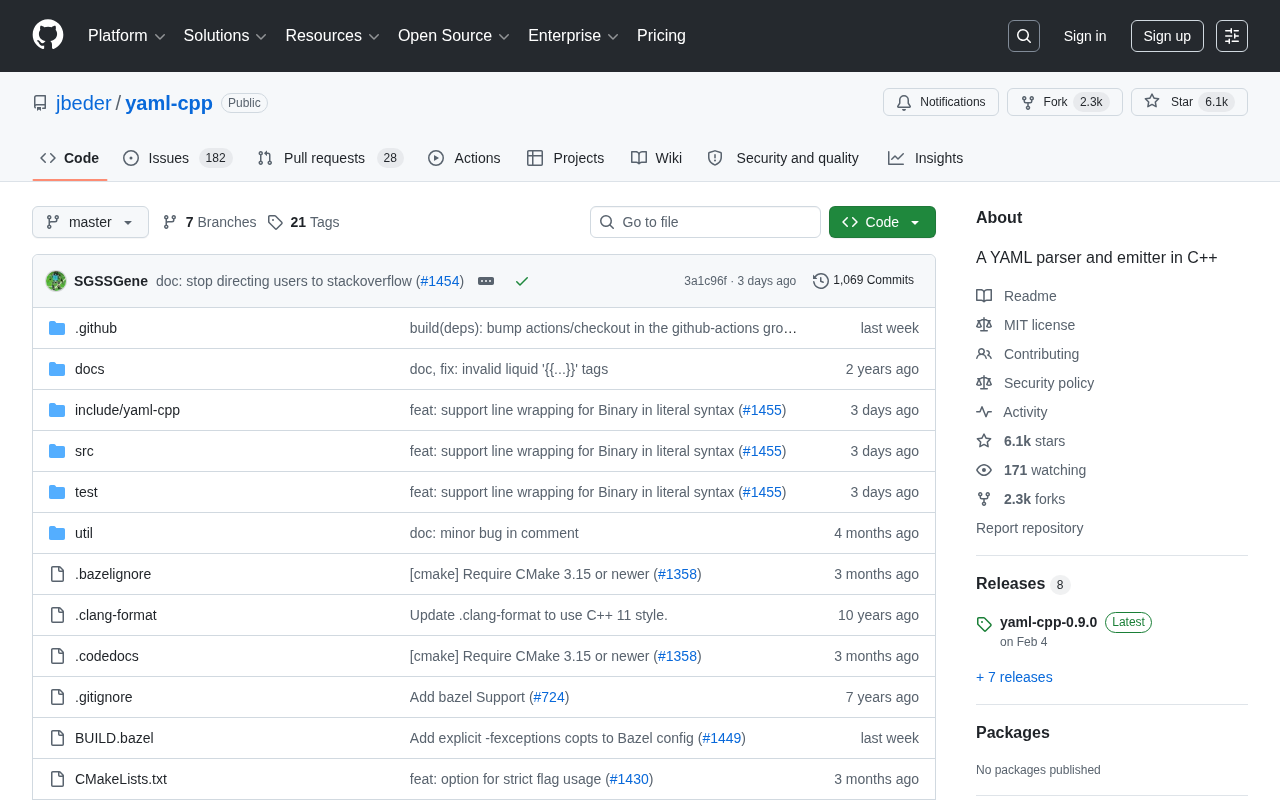
The project has accumulated over 6,000 stars and 2,250 forks on GitHub, with continued momentum — a testament to its solid standing in the C++ community.
What Is yaml-cpp
yaml-cpp is a pure C++ implementation of a YAML parser and emitter, with full support for the YAML 1.2 specification. The project is led by Jesse Beder, released under the MIT license, and can be freely integrated into commercial or open-source projects with virtually no licensing burden.
Its core capabilities fall into two categories:
Parsing
Reads YAML text and converts it into structured C++ objects in memory. yaml-cpp provides an API centered on YAML::Node, which loads scalars, sequences, and maps into a tree structure in memory for convenient programmatic access.
YAML anchors (marked with &) and aliases (referenced with *) are important advanced features that distinguish YAML from JSON, allowing nodes within the same document to be reused and avoiding redundant definitions. For example, a deployment configuration covering dozens of microservices can define shared database connection parameters once using an anchor and reference them across service nodes via aliases — eliminating redundancy while maintaining consistency. yaml-cpp's complete support for these features makes it especially reliable when handling complex configuration files.
Emitting
yaml-cpp also supports serializing C++ data structures into well-formed YAML text. Through YAML::Emitter, developers can fine-tune output formatting, including indentation, and switching between flow style and block style. Flow style (e.g., {key: value}) is suited for compact output, while block style is more readable and easier to diff in version control systems.
Typical Usage
One of yaml-cpp's most appreciated design choices is its intuitive node access interface. Here's an example of loading a configuration file:
#include <yaml-cpp/yaml.h>

YAML::Node config = YAML::LoadFile("config.yaml");

std::string name = config["name"].as<std::string>();
int port = config["server"]["port"].as<int>();

for (const auto& item : config["list"]) {
    std::cout << item.as<std::string>() << std::endl;
}
Node supports chained access via key names or indices, and type conversion is handled through the templated as<T>() method, significantly reducing the cognitive overhead of processing configuration data in C++. Under the hood, as<T>() leverages C++ function template instantiation — the compiler generates a separate conversion path for each target type, ensuring type safety is enforced at compile time.
Custom Type Conversion
yaml-cpp allows developers to specialize the YAML::convert<T> template to implement bidirectional conversion between custom structs and YAML nodes. This mechanism is backed by C++'s explicit template specialization — developers simply implement two static methods, encode and decode, for their custom type, seamlessly integrating it into the entire serialization system without modifying the library itself.
Unlike runtime reflection, template specialization dispatches types entirely at compile time, delivering zero runtime overhead and exposing all type mismatch errors at compile time. This design philosophy echoes the to_json/from_json ADL (argument-dependent lookup) mechanism of nlohmann/json — where the compiler automatically discovers user-defined functions with matching names in the user's namespace. Both approaches involve trade-offs, but fundamentally represent the idiomatic C++ pattern for achieving elegant serialization in the absence of language-level reflection support. This makes serialization and deserialization of complex objects clean and unified — a key reason many large projects choose yaml-cpp.
Key Advantages
C++ has long lacked language-level reflection and a standard serialization mechanism — although C++23 has begun introducing static reflection discussions, the standardization process is still ongoing. Conversion between structs and external formats has historically relied heavily on third-party libraries. yaml-cpp fills an important gap in configuration management within this context:
- Strong specification compliance: Full support for YAML 1.2, correctly handling advanced features like anchors and aliases. This gives it a clear edge over lightweight libraries that only support a subset of YAML when dealing with complex documents.
- Modern, developer-friendly API: Chained access and template-based conversion keep code concise and readable, aligned with modern C++ idioms.
- Easy integration: Supports CMake builds and can be easily introduced via submodules or package managers (such as vcpkg or Conan), integrating seamlessly with mainstream C++ project toolchains.
- Mature ecosystem: Already adopted by well-known open-source projects including ROS (Robot Operating System), with stability validated through extensive real-world use. ROS is the dominant robot software framework, initiated by Willow Garage in 2007 and now maintained by Open Robotics. Its Parameter Server and launch file system rely heavily on YAML for configuration. This means yaml-cpp has been battle-tested in demanding scenarios such as real-time control, sensor fusion, and multi-node distributed communication — earning broad recognition from robotics engineers for its memory safety and parsing correctness.
Usage Considerations
Performance evaluation: YAML parsing carries some inherent overhead — compared to JSON, YAML's indentation-sensitive syntax and rich feature set make lexical analysis more complex. In scenarios involving extremely high-frequency calls or very large files (tens of MB or more), evaluate performance in advance and consider caching parsed results if necessary. Configuration loading is typically a low-frequency operation, so the impact is generally limited.
Exception handling: as<T>() throws a YAML::TypedBadConversion exception on type mismatch, and LoadFile throws YAML::BadFile if the file doesn't exist. Proper error handling and fault tolerance should be implemented in production code — especially when parsing externally provided configurations where malformed input is a real risk. It's recommended to wrap critical paths with try-catch, or perform defensive checks using IsDefined() and IsNull() before accessing nodes.
Dependency management: As a C++ project, compile-time dependency management and ABI compatibility issues still need to be handled according to standard C++ practices. ABI differences between compiler versions or standard library implementations can cause linking problems. Integrating the library as source code (e.g., via CMake FetchContent or Git submodules) is recommended to avoid compatibility risks associated with precompiled binaries.
Summary
yaml-cpp has become the go-to tool for C++ developers working with YAML data, thanks to its specification completeness, developer-friendly API design, and mature community ecosystem. Whether you're building configuration-driven server applications, robotics systems, or any application that requires a human-readable data exchange format, it delivers a reliable and elegant solution. For any team that needs to read or write YAML in a C++ project, this actively maintained open-source library is well worth adding to your technology shortlist.
Key Takeaways
Related articles

The Truth Behind Codex 'Build a Website in 5 Minutes': AI Isn't Creating Sites—It's Helping You Copy Them
Exposing the truth behind viral Codex 5-minute website videos: creators aren't building original sites with AI—they're copying shared prompts or scraping others' work. Learn AI coding tools' real limits.

Getting Started with AI Agent Development: A Complete Guide from Concept to Practice
A comprehensive guide to AI Agent architecture and development, covering automated marketing, intelligent customer service, and investment analysis scenarios with single and multi-agent collaboration.

The Truth Behind Codex 'Build a Website in 5 Minutes': AI Isn't Creating Sites — It's Helping You Copy Them
Exposing the truth behind viral Codex 5-minute website videos: creators aren't building original sites with AI — they're copying shared prompts or scraping others' work.