Yoroll: Build Playable Interactive Stories with AI, No Game Engine Required
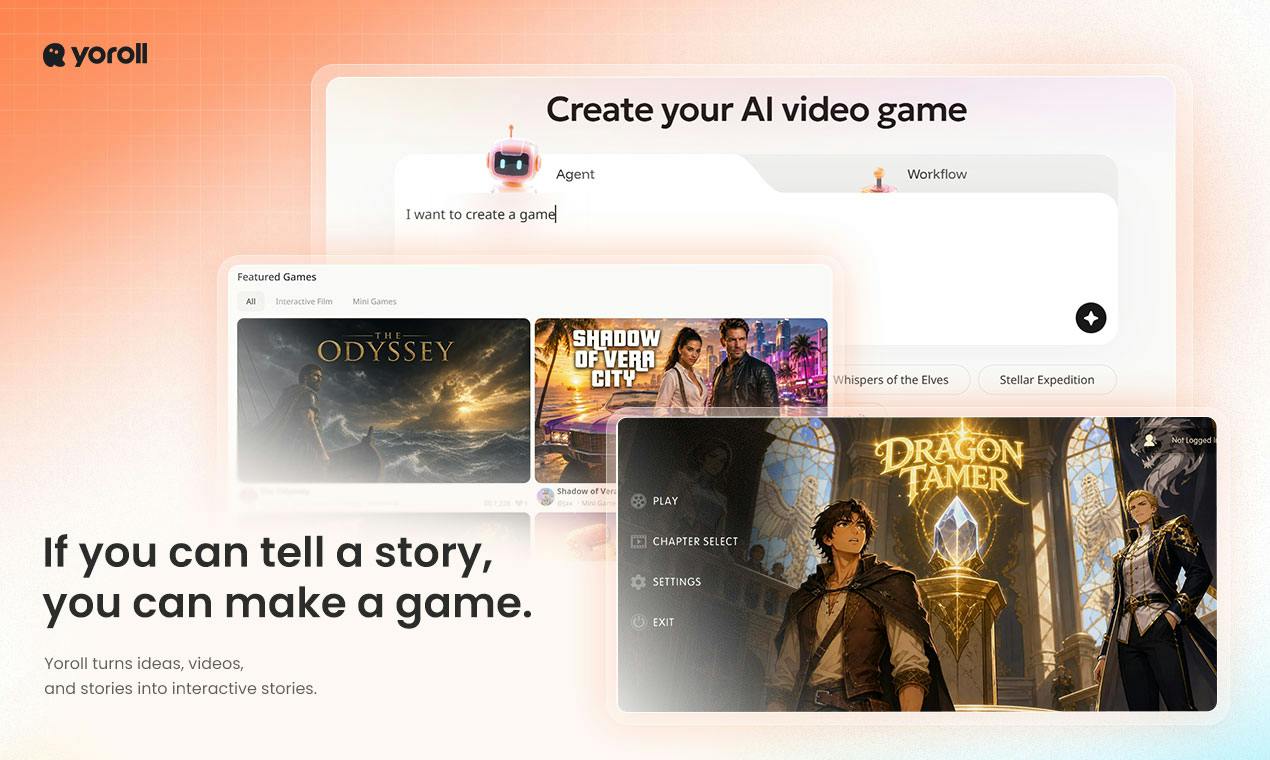
Yoroll uses AI to turn scripts or videos into playable branching interactive stories—no engine, no code.
Yoroll is the second-ranked new product on Product Hunt, pitched as "build playable stories without a game engine." Users start from a script, image, or video, arrange scenes like a director, and set choice points and branching endings while AI integrates the material into a shareable interactive experience. It's closer to an interactive movie than a traditional game, bypassing engines like Unity and Unreal. Its limits are choice-driven plot stories, not real-time physics, complex combat, or multiplayer. It targets writers and short-video creators with narrative ambitions but no development experience. It got 122 upvotes and 15 comments on launch day, showing market interest, though AI integration quality and branch controllability still need hands-on evaluation.
The barrier to game development is being lowered even further by AI. Yoroll, the second-ranked new product on Product Hunt, is built around the slogan "build playable stories without a game engine": users simply start from a script, an image, or a video clip, then arrange scenes like a director, add player choices, and build branching storylines with different endings. AI handles turning the raw material into a shareable interactive experience.
From Script to Playable Experience: How Yoroll Works
Yoroll positions itself less as a game programming tool and more as a way to "direct your own interactive movie." The official description emphasizes that the entire process requires no coding and no traditional game engines like Unity or Unreal. The starting point users provide is remarkably lightweight—a text script, a still image, or a video clip can all serve as the beginning of a story.
From there, the creator makes the narrative-level decisions: how scenes transition, where players make choices, and which branching endings different choices lead to. AI takes on the engineering work of stitching the material into a complete experience. This division of labor strips out the more technical parts of game production and puts the creative focus back on the story itself.
What Going Engine-Free Means
Traditionally, producing interactive narrative works involves engine setup, scripting, state management, and many other steps—a real barrier for independent creators. Yoroll bypasses the engine entirely and organizes content directly around the "story" as its basic unit, which brings two immediate changes.
First, the learning curve is shorter. Creators don't need to learn an engine's operating logic first; they start from material they already have—many people already have scripts or videos and simply lack a tool to turn them into an interactive form. Second, the content format leans more toward cinematic expression. The word "cinematic" appears repeatedly in the product description, indicating that the goal is not to replicate complex game mechanics but to emphasize shot composition, scene staging, and narrative pacing.
This trade-off also defines Yoroll's limits: it's suited to interactive stories driven by choice-based plot, not game genres that require real-time physics, complex combat systems, or large-scale multiplayer networking.
Game engines are foundational software frameworks such as Unity and Unreal used to build games, typically providing a full toolchain including rendering, physics simulation, audio, animation, and scripting systems. Developers must write code on top of them to define game logic and manage assets and state. Although traditional interactive narrative works don't involve complex gameplay, they still rely on engines to set up scenes and implement branching choices and state transitions, which poses a real barrier for non-technical creators. Yoroll bypasses the engine, meaning it encapsulates underlying work such as rendering, interaction logic, and state management into AI-driven services, so creators only need to describe their narrative intent without touching the engine's interface or programming APIs.
Branching Narrative: AI Fills the Integration Gap
Another capability Yoroll emphasizes is branching plot—players make choices at different points, and the story leads to different endings. This structure is nothing new in interactive narrative, but the cost of maintaining multiple storylines has always been high: each branch needs corresponding scenes, assets, and transition logic.
Yoroll's approach is to have AI participate in integration, organizing the scattered material creators provide into a coherent interactive experience. For individual creators, this means they can test the waters with a multi-ending story using a relatively small amount of material, without having to prepare complete content for every branch from the start.
Branching narrative is an interactive storytelling structure in which the story offers players choices at key points, with different choices leading to different subsequent plots and endings. Its core challenge lies in managing "state"—the system needs to record the choices a player has made and correctly connect the corresponding content in later scenes. Traditional implementations rely on state machines or script variables, and each branch requires its own scenes, assets, and transition logic; the more branches there are, the more exponentially production and maintenance costs rise. Yoroll's use of AI in integration essentially hands the engineering work of state management and asset connection to the model, thereby lowering the cost of prototyping multi-ending stories.
Who Should Use Yoroll
Judging by its positioning, Yoroll targets people who have a desire to tell stories but lack game development experience: writers, short-video creators, independent narrative enthusiasts, and anyone who wants to quickly validate an interactive story idea. Launch information shows the product received 122 upvotes and 15 comments, ranking second on Product Hunt that day, indicating that the combination of "zero code + AI + interactive narrative" has some market interest.
It's worth noting that the quality of AI-integrated material, the degree of control over branching logic, and the sharing and distribution mechanisms for finished works will all directly affect the actual creative experience. These aspects cannot be fully assessed from the product description alone and require hands-on testing.
The Barrier to Interactive Narrative Is Disappearing
Yoroll isn't the first product to try to lower the barrier to interactive content creation, but it explicitly puts "no engine" at the core of its pitch, pointing to a clear trend: creative tools are shifting from "providing capabilities" to "hiding complexity." When engines and code are folded into the background, creators are left facing only the story itself—and that may be the real precondition for interactive narrative to reach the mainstream.
For creators who want to try interactive stories, Yoroll offers a low-barrier entry point; for industry observers, it's yet another signal: AI is gradually handing the expressive power that once belonged to professional developers to ordinary creators.
Product Hunt is a global platform for launching and discovering new products, ranking each day's launches by user votes. Its rankings are often seen by startup teams as a bellwether for early market attention. The "122 upvotes, 15 comments, second place that day" mentioned in the article reflects the product's immediate popularity on the platform on its launch day, not long-term user retention or paid conversion data. When interpreting such metrics, note that Product Hunt's voting audience consists mainly of tech professionals and early adopters, whose preferences may not represent true mass-market demand—but they can serve as a reference signal that the "zero code + AI + interactive narrative" direction is drawing industry attention.
One-line Summary
Yoroll lets AI turn scripts or videos into playable branching interactive stories, with no engine and no code.
Paragraph Summary
Yoroll is the second-ranked new product on Product Hunt, built around "build playable stories without a game engine." Users start from a script, an image, or a video, then arrange scenes like a director, set player choice points and branching endings, while AI integrates the material into a shareable interactive experience. The product is closer to an interactive movie than a traditional game, bypassing engines like Unity and Unreal to strip out the technical engineering and let creators focus on the narrative itself. Its capabilities are limited to choice-driven plot stories, not real-time physics, complex combat, or multiplayer networking. It targets writers, short-video creators, and others who have a desire to tell stories but lack development experience. It received 122 upvotes and 15 comments on launch day, showing some market interest in this direction, though the quality of AI integration and branch controllability still need hands-on evaluation.
Related articles

Building an AI Side Business from Scratch with Claude: 10 Monetization Paths Explained
Explaining 10 paths to build an AI side business from scratch with Claude alone: voice agents, digital products, data annotation, enterprise automation, and vertical industry tools, with a realistic assessment of barriers and feasibility for each.

Rankhog: AI-Powered Reddit Lead Generation — Balancing Compliance and Efficiency
Rankhog is an AI tool that finds Reddit leads and generates replies, with manual approval or autopilot modes and MCP support for Claude, ChatGPT, and Cursor. We analyze how it works, MCP integration value, and community compliance risks.
Daymaker: Opening Sales Doors with Personalized Gifts
Daymaker is a sales development tool that researches prospect interests, recommends and ships personalized branded gifts to help sales secure meetings. It offers a done-for-you service with guaranteed meetings and ranks fourth on Product Hunt.