You.com Launches Inference Router: 12 Open-Source Models + 99.9% Availability SLA

You.com launches OpenAI-compatible Inference Router, aggregating 12 open-source models with a 99.9% availability SLA.
You.com has released Inference Router, an OpenAI-compatible inference routing service that aggregates 12 open-weight models and differentiates with a 99.9% availability SLA, zero data retention, 100% US hosting, and server-side web search, using a no-platform-fee, usage-based billing model. The article analyzes the value of the routing layer as infrastructure once multi-model strategy becomes the default: behind a unified endpoint, the platform handles model distribution, failover, and capacity scheduling. It also notes challenges facing independent routing platforms, such as insufficient engineering accumulation in inference optimization and the high replaceability of the routing layer, requiring moats built on SLA fulfillment and compliance capabilities. Finally, it provides a developer evaluation checklist covering the true extent of API compatibility, SLA compensation terms, data retention boundaries, model versioning strategy, and search billing methods.
You.com Launches Inference Router: 12 Open-Source Models + 99.9% Availability SLA
According to MarkTechPost, You.com has officially launched Inference Router—an OpenAI-compatible API service that aggregates 12 open-weight models and promises a 99.9% availability SLA. For development teams looking for alternatives to closed-source APIs, several of this product's design choices are worth carefully unpacking.
Product Core Specifications at a Glance
Inference Router positions itself as an "inference routing layer": developers can switch between 12 open-weight models using the same OpenAI SDK call pattern. The officially disclosed key parameters include:
- OpenAI-compatible API: Existing code built on the OpenAI SDK can largely be ported over, with low migration cost
- 12 open-weight models: Covering different scales and capability tiers (the original article did not fully list the specific models)
- 99.9% availability SLA: Committed as a service-level agreement, not just a verbal "high availability" claim
- Zero data retention: Request and response data are not retained
- 100% US-hosted: Meets data residency and compliance requirements
- Server-side web search: Models can invoke online retrieval capabilities during inference
- No platform fee: Billed only on inference usage, with no extra routing "toll"
This combination clearly targets a specific customer profile: enterprise development teams that are sensitive about data sovereignty but don't want to be locked into a single model vendor.
Open-Weight Models refer to models whose weight parameters are publicly released in downloadable or accessible form after training is complete, such as the Llama, Mistral, and Qwen series. It is not entirely equivalent to "open source": public weights do not mean the training data, training code, or full license are equally open, and some models only permit commercial use under restricted conditions. For inference service providers, open weights mean they can deploy on their own or rented GPU clusters without relying on the model vendor's hosted API, thereby gaining pricing autonomy and fault isolation capabilities; for customers, it means they can migrate the same model across different platforms, reducing single-vendor lock-in risk. The 12 models aggregated by Inference Router belong to this category, so its routing capability is essentially "scheduling the same set of portable weights across different hosting environments."
Zero Data Retention is a type of commitment in the data compliance field, typically meaning the provider does not persistently store prompts, model outputs, or metadata that can be linked to specific users after request processing is complete. It is often tied to regulatory requirements, such as the storage limitation principle in GDPR, HIPAA's constraints on handling protected health information, and financial industry reviews of cross-border and retention of customer data. In practice, the boundaries of "zero data retention" need to be confirmed item by item: whether it covers access logs, error tracking, monitoring metrics, and inference caches; whether short-term de-identified copies may be retained for abuse detection; and whether query strings generated by server-side web search are also included in the non-retention scope. The article places this commitment alongside US hosting precisely because it primarily serves procurement reviews in regulated industries.
Why "Routing" Has Become the New Battleground for Infrastructure
Over the past year, multi-model strategy has shifted from "optional" to "default." The reason is not complicated: no single open-source model dominates across all tasks—code generation, long-document summarization, and structured extraction each have their own strong performers. If teams maintain a separate integration codebase and billing account for each model, the engineering burden quickly balloons.
The value of products like Inference Router lies in abstracting "model selection" into routing decisions. Developers face a unified endpoint, behind which the platform handles model distribution, failover, and capacity scheduling. A 99.9% SLA commitment only makes sense under a multi-model, multi-cluster routing architecture—a single model on a single cluster would struggle to provide such a guarantee.
One detail: the simultaneous appearance of "zero data retention" and "US hosting" shows that You.com has placed compliance narrative at the center of product design. For teams in regulated industries such as finance and healthcare, this often carries more decision weight than model benchmark scores.
The Three-Way Game in Open-Weight Model Hosting
The launch of Inference Router reflects the current three-way landscape of the inference market:
The first party is model vendors' own APIs, whose advantage is the latest models and deepest optimization, and whose disadvantage is single-vendor risk; the second party is cloud vendors' managed inference services, whose advantage is mature infrastructure and compliance systems, and whose disadvantage is that model choices are limited to the cloud vendor's catalog; the third party is independent routing platforms like You.com, whose selling points are model neutrality, unified interfaces, and flexible billing.
The challenges for independent routing platforms are equally obvious. Inference optimization for open-weight models (quantization, batching, KV caching) requires deep engineering accumulation; otherwise, latency and throughput will lag behind cloud vendors. On the other hand, the routing layer itself is highly replaceable, so platforms need to build moats with SLAs, compliance commitments, and value-added capabilities such as search. You.com's choice to differentiate with the trio of "zero data retention + US hosting + server-side search" is a reasonable approach, but whether it can ultimately retain customers depends on the actual performance of inference.
Service-Level Agreement (SLA) is a formal contractual term between a service provider and a customer regarding availability, performance, or support response time, not merely a technical metric. A 99.9% monthly availability target translates to roughly 43 minutes of allowed unavailability per month; calculation methods typically exclude scheduled maintenance, customer-side errors, and force majeure. What truly determines an SLA's value is the compensation mechanism: whether fees are refunded proportionally to the duration of underperformance, or whether there is a cap on service credits; who bears the burden of proof for fault determination and how long the appeal window remains valid; and whether customers may exit without penalty if targets are missed for consecutive months. For routing platforms, the SLA also involves whether failures from upstream model suppliers or cloud infrastructure count as the platform's own responsibility, which determines whether the commitment can be fulfilled under multi-layer dependencies.
How Developers Should Evaluate Such Services
If you are considering shifting business traffic to Inference Router or similar platforms, it is advisable to verify along the following dimensions:
The true extent of API compatibility. OpenAI compatibility usually means aligned request/response formats, but edge behaviors such as streaming output, tool calling, and structured output may differ, so regression testing with actual business requests is needed.
The SLA's compensation terms. 99.9% means roughly 43 minutes of allowed downtime per month; the key is to look at the compensation ratio and determination process after a breach, not just the number itself.
The boundaries of data retention. "Zero data retention" requires confirmation of whether it covers logs, monitoring metrics, and cache layers, as well as how query content generated by server-side web search is handled.
The model list and versioning strategy. The specific composition of the 12 models, whether fixed versions are supported, and whether there is an advance notice period for model retirement all directly affect production environment stability.
How search capability is billed. Server-side web search is a differentiating feature, but whether its calls are billed separately and how much latency overhead it adds need to be confirmed through stress testing before launch.
Conclusion
The launch of Inference Router is not a technical breakthrough in itself, but it precisely hits the engineering pain points of the multi-model era: unified interfaces, compliant hosting, and availability commitments. For teams that don't want to be locked into a single model vendor but lack the capability to build their own inference clusters, such routing services offer a pragmatic middle option. The real test lies in inference performance and SLA fulfillment—commitments are written in contracts, while reputation is written on latency curves.
Background Supplement
KV Cache is one of the key mechanisms for large model inference optimization. During autoregressive generation, the model needs to store the key (Key) and value (Value) tensors in the attention mechanism for each token already processed, avoiding repeated computation of historical context at each step. KV cache can significantly reduce generation latency after the first token, but it consumes substantial GPU memory and grows linearly with context length. Common optimization techniques used by inference service providers include paged KV cache management (such as vLLM's PagedAttention), prefix cache reuse, and cache quantization. For routing platforms that aggregate multiple models, KV cache strategy directly affects throughput cost and concurrency limits, and is also one of the core engineering areas where they can differentiate performance from cloud vendors' inference services.
One-line Summary
You.com launches OpenAI-compatible Inference Router, aggregating 12 open-source models and promising a 99.9% availability SLA.
Related articles
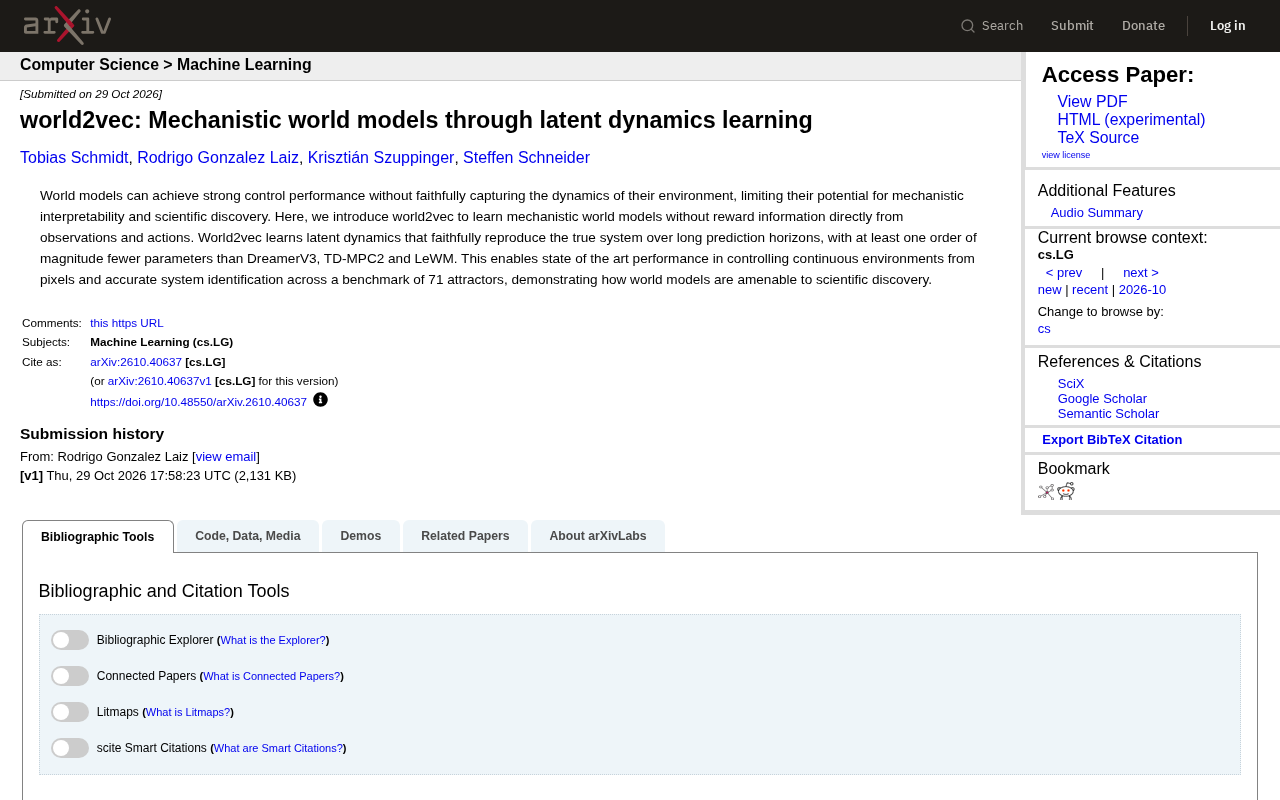
world2vec: Building Mechanistic World Models with Latent Dynamics Learning
world2vec proposes a reward-free method for learning mechanistic world models via latent dynamics, faithfully reproducing systems over long horizons with at least an order of magnitude fewer parameters than DreamerV3, TD-MPC2, and LeWM, and achieving accurate system identification on 71 attractor benchmarks.

A New KL-DRO Paradigm: Adaptive Scenario Generation Around a Learned Density Model
KL-DRO research proposes centering the KL ball on a learned density model instead of the empirical distribution, with adaptive scenario generation guiding sampling toward the worst case. Experiments show lower cost under distribution shift when records are scarce and the model can extrapolate, with comparable in-distribution cost.

ODE Samplers for Discrete Diffusion Models: Exponential Residual Flows Accelerate Generation
Discrete diffusion models lack deterministic ODE sampling? This article introduces Exponential Residual Flows (ERFs), which introduce continuous residual variables per token to construct piecewise ODEs for deterministic sampling and support consistency distillation acceleration. Superior to prior methods on code and text generation tasks.