YouTube Denies Testing a Hidden Dislike Button: The 'Experiment' Controversy Sparked by Users

Users posted screenshots showing YouTube's dislike button tucked into a menu, but the company denied testing a hidden dislike button.
This week, users shared screenshots showing YouTube videos' dislike button moved into the three-dot menu, sparking speculation about whether the platform was testing a hidden dislike button. Since YouTube hid the public dislike count in 2021, users are especially sensitive to changes involving negative feedback. A YouTube spokesperson later explicitly denied to The Verge that it was testing a hidden dislike button, but the brief statement did not explain the screenshots. The article suggests the phenomenon may have stemmed from A/B testing, a three-dot menu redesign experiment, modified clients, or cache differences, or that the screenshots may have been misinterpreted. Although it was a false alarm, the incident exposed the trust rift between users and the platform caused by opaque feedback mechanisms and reminds people to be cautious with social media screenshots before official responses.
Incident Recap: Users Notice the Dislike Button Is Missing, Sparking Speculation About Testing
On Tuesday, users on X (formerly Twitter) shared screenshots showing that YouTube videos' "dislike" button had been moved into the three-dot menu instead of appearing directly next to the like button as usual. At least two users posted similar screenshots, quickly fueling community speculation: Is YouTube testing a hidden dislike button?
This speculation didn't come out of nowhere. Since YouTube removed the public dislike count in 2021, users have remained sensitive to whether the platform might further weaken negative feedback. The screenshots seemed to provide new "evidence," leading many to believe that YouTube was quietly running a new round of testing.
YouTube's Official Response: We Are Not Testing a Hidden Dislike Button
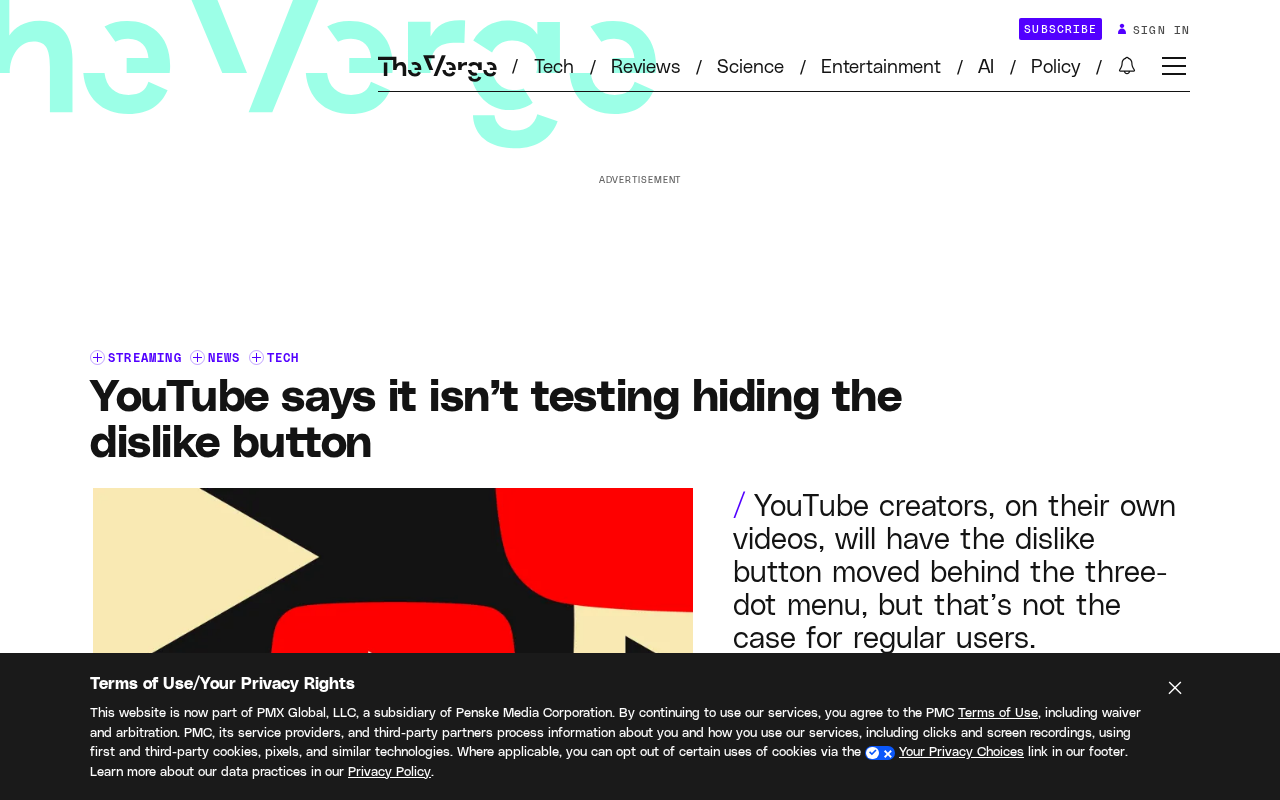
Faced with the growing rumors, a YouTube spokesperson issued a statement to The Verge on Wednesday, clearly saying: "We are not testing a hidden dislike button." This response directly denied the earlier speculation but did not explain why some users saw the button moved into the menu.
Interestingly, YouTube's response was very brief and provided no further details. That left two key questions: Are these screenshots real? And if they are, what caused the button's position to change?
Possible Causes: UI Experiments, A/B Testing, or a Glitch?
Although YouTube denied testing a "hidden dislike button," the interface changes users saw may stem from other mechanisms. Tech companies frequently run small-scale A/B tests or UI experiments, and sometimes even inadvertent glitches occur.
One possibility is that YouTube was testing a redesigned three-dot menu, and the dislike button was temporarily moved into it as part of the experiment, but the goal was not to hide it. Another possibility is that some users were using modified clients or browser extensions, causing interface abnormalities. In addition, it's also possible that the screenshots were altered or misinterpreted.
Regardless of the cause, this incident highlights users' sensitivity to platform interface changes and the speed at which information spreads on social media. Before official confirmation, speculation can easily be spread as fact.
A/B testing is a product experimentation method commonly used by tech companies: users are randomly divided into several groups, each shown a different version of the product interface or feature, and data comparisons are then used to determine which approach works better. This kind of testing usually happens during staged rollout, with coverage ranging from one in a thousand to tens of percent, so the same app may look different in different users' hands. A/B testing itself does not mean a feature will ultimately launch; many experiments are rolled back after validation. For this reason, it is not contradictory for individual users to see the dislike button moved while the company says it is "not testing"—the platform may have been testing the menu layout rather than deliberately hiding the dislike button.
Beyond planned group experiments, interface abnormalities can also come from version inconsistencies during staged rollout, differences in server-side configuration delivery, client caches not being updated, or users installing modified clients and browser extensions. These factors can all create the phenomenon of "the same feature, different interfaces," and they also explain why only a small number of users reproduced the layout in the screenshots.
User Reaction and the Platform Trust Problem
This controversy also reflects the delicate trust relationship between users and platforms. Since the dislike count was hidden, many users have worried that their feedback is being ignored. As a result, any change involving the dislike button triggers alarm.
YouTube's quick denial helped ease some concerns, but a brief statement may not be enough to fully dispel users' confusion. If the platform could explain the mechanics of UI experiments more transparently, it might reduce similar misunderstandings.
In 2021, YouTube made the public "dislike" count private. Viewers can still click the dislike button, but only creators can see the cumulative number in the backend; the public can no longer see the specific figure. The platform's rationale at the time was to protect small creators from malicious dislike campaigns, and it said data showed the change did not significantly affect overall engagement. However, the decision was highly controversial among users: opponents argued that it weakened viewers' ability to express negative evaluations and removed one reference point for identifying low-quality content. Because of this history, any interface change related to the dislike button is easily interpreted as a signal that the platform is further weakening negative feedback, and this is the psychological basis for the rapid spread of these screenshots.
Conclusion: A False Alarm, but the Lesson Remains
What is certain now is that YouTube officially denied testing a hidden dislike button. The interface changes users saw may simply have been a limited experiment or a technical issue. For tech platforms, how to maintain clear communication with users while pursuing interface optimization remains a topic worth considering.
For ordinary users, this incident reminds us that when we see screenshots on social media, we might want to wait for an official response before drawing conclusions. After all, a small change in the interface can trigger a considerable controversy.
One-line Summary
Users shared screenshots claiming YouTube's dislike button had been tucked into a menu, but the company denied testing a hidden dislike button.
Paragraph Summary
This week, users posted screenshots showing that YouTube videos' dislike button had been moved into the three-dot menu, sparking speculation about whether the platform was testing a hidden dislike button. Given that YouTube has hidden the public dislike count since 2021, users are especially sensitive to any change involving negative feedback. A YouTube spokesperson later explicitly denied to The Verge that it was testing a hidden dislike button, but the brief statement did not explain the screenshots. The article suggests that the phenomenon may have stemmed from technical causes such as A/B testing, a three-dot menu redesign experiment, modified clients, or cache differences, or that the screenshots may have been misinterpreted. Although the incident was a false alarm, it exposed the trust rift that has accumulated between users and the platform due to opaque feedback mechanisms, and it also reminds people to treat social media screenshots cautiously before an official response.
Related articles

Gemini 4 Argon Hands-On: AI Builds Board Games, Constructs Temples, and Trains Robots Autonomously
Gemini 4 Argon hands-on roundup: AI autonomously builds a desk racetrack and temple in Blender, writes a ray tracing engine, trains a humanoid robot to sink 7 shots, plus API pricing and developer access.

The Magic Octagonal Coin: Why Only 9% of People Can Predict Its Flip?
Only 9% of people can correctly predict the Magic Octagon coin flip. This article explains its spatial rotation mechanism, common cognitive pitfalls, and a new hypothesis based on Relevance Theory, exploring the limits of human spatial reasoning.

Sam Altman: AI Is Entering the Era of Scientific Discovery — Math Breakthroughs Will Replicate in Biology and Energy
Sam Altman says AI is entering the era of scientific discovery — math breakthroughs will replicate in biology, materials science, and energy to help develop new drugs and energy sources.