Zed Editor Releases v1.26.2-pre Pre-release Version

Zed releases v1.26.2-pre pre-release, a minor version iteration with GitHub signature verification.
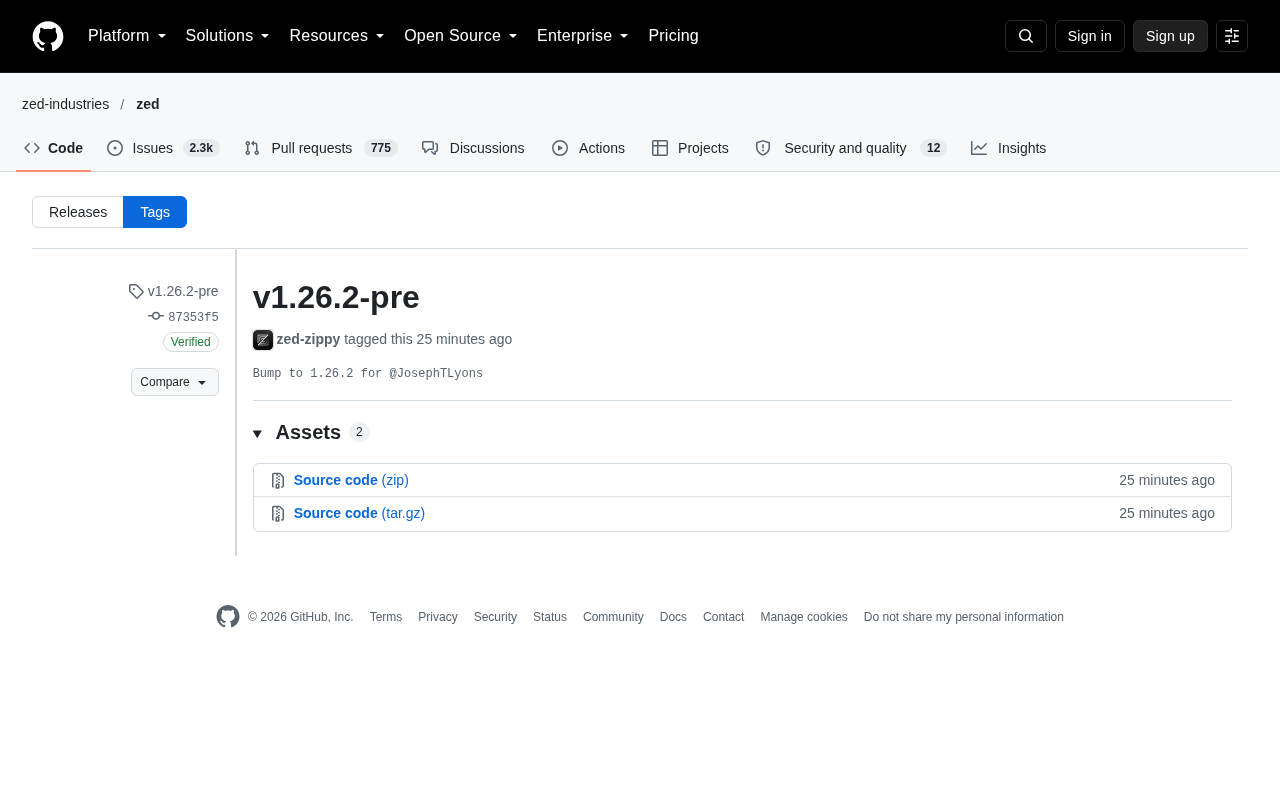
Zed editor published the v1.26.2-pre pre-release version on GitHub, with commit hash 87353f5, led by developer JosephTLyons, and the commit message "Bump to 1.26.2", indicating the version number has advanced from 1.26.1 to the pre-release stage of 1.26.2. The article explains that the `-pre` suffix represents a pre-release version, aimed at developers willing to try new things early, less stable than the official release, and production environment users should wait for the official release. This commit carries a GitHub verified signature, GPG key ID B5690EEEBB952194, which can reduce the risk of supply chain attacks. This update is mainly a version number bump, and the announcement did not disclose specific feature changes or fixes. The article advises backing up configuration before using the pre-release version, downloading the platform-specific artifact from the Releases page, and submitting an issue for feedback if problems occur.
Zed editor has recently published the v1.26.2-pre pre-release version on GitHub, with commit hash 87353f5. This update was led by developer JosephTLyons, and the commit message reads "Bump to 1.26.2", indicating that the version number has officially advanced from 1.26.1 to the pre-release stage of 1.26.2.
What a Pre-release Version Means
Zed uses the -pre suffix to mark pre-release versions, a common practice in open-source projects. Pre-release versions are typically aimed at developers willing to try new things early, used to collect feedback and verify fixes; they are less stable than official releases. Users in production environments are advised to wait for the official release before upgrading.
SemVer (Semantic Versioning) is a version numbering specification widely adopted by open-source projects, with the format major.minor.patch. A major version change represents incompatible API changes, a minor version change represents backward-compatible feature additions, and a patch version change represents backward-compatible bug fixes. Zed advancing from 1.26.1 to 1.26.2, according to this specification, is a patch version increment, typically corresponding to bug fixes and small-scale adjustments rather than major feature introductions. Suffixes like -pre are "pre-release identifiers" in SemVer, with lower precedence than the official release of the same version number, meaning 1.26.2-pre ranks before the official 1.26.2. Package managers and auto-update channels generally treat them differently and will not push pre-release versions to users on the stable channel.
Commit Signing and Supply Chain Security
This commit carries a GitHub verified signature, with GPG key ID B5690EEEBB952194. GitHub's verified signature mechanism can confirm that the commit indeed comes from the repository maintainer, reducing the risk of supply chain attacks. For a rapidly iterating editor project like Zed, such verification mechanisms provide users with an extra layer of trust assurance.
GPG (GNU Privacy Guard) is an encryption and signing tool based on the OpenPGP standard. A developer's commit can be signed with their own private key, and the verifier checks it with the corresponding public key, thereby confirming that the commit content has not been tampered with and was indeed signed by the key holder. The B5690EEEBB952194 mentioned in the article is the short format of a GPG key ID, i.e., the last 16 hexadecimal characters of the key fingerprint, which can be used to locate and verify the complete public key on a key server. GitHub's "Verified" badge is determined by comparing the commit signature with the GPG public key registered in the developer's account. It should be noted that signature verification only guarantees that "a certain commit was signed by a certain key"; if the private key is leaked or the account is compromised, it could still be misused. Therefore, it is one part of supply chain security, not the whole.
Observations on Version Iteration Cadence
Judging from the commit message, this update is mainly a version number bump, constituting a minor version iteration. As a high-performance code editor written in Rust, Zed has recently maintained a relatively fast update frequency. However, this pre-release announcement itself did not disclose specific feature changes or fixes; for detailed changes, one needs to consult the repository's commit records and release notes.
Rust is a systems programming language initiated by Mozilla and now maintained by the Rust Foundation. Its ownership and borrow-checking mechanisms eliminate data races and a large number of memory safety issues at compile time, and it requires no garbage collector, so it is often used for native applications sensitive to performance and responsiveness. Zed builds its core with Rust and uses GPU-accelerated rendering for the interface, which is the technical foundation for its emphasis on "high performance." In addition, Zed's collaboration and multi-user editing capabilities rely on a self-built real-time synchronization service, and the editor itself also includes extensible plugins and language service integration. Understanding this technology stack helps to judge: minor version iterations often focus on stability and performance details, while underlying architecture changes usually appear in minor or major versions.
What Developers Can Do
Before using a pre-release version, it is recommended to back up your current configuration first. You can download the build for your platform from the GitHub Releases page. If you encounter problems, you can submit an issue on Zed's GitHub repository. For regular users, continuing to use the current stable version is the safer choice.
Additional Background
GitHub Releases is a release management feature provided by GitHub for repositories, where maintainers can create release entries for specific tags, accompanied by change descriptions and pre-built artifacts (binaries, installers, etc.). For cross-platform desktop applications, the Releases page is usually the most direct channel for regular users to obtain build artifacts, and users can choose the corresponding file by operating system and CPU architecture. Alongside this are release notes and changelogs, the latter typically automatically compiled from commit history or pull requests. If a release entry only says "Bump to 1.26.2" without listing changes, the most reliable approach is to compare the commit differences between two adjacent tags, or consult the discussion records of the corresponding pull request, to confirm the actual scope of changes.
One-line Summary
Zed releases v1.26.2-pre pre-release, a minor version iteration with GitHub signature verification.
Paragraph Summary
Zed editor published the v1.26.2-pre pre-release version on GitHub, with commit hash 87353f5, led by developer JosephTLyons, and the commit message "Bump to 1.26.2", indicating the version number has advanced from 1.26.1 to the pre-release stage of 1.26.2. The article explains that the -pre suffix represents a pre-release version, aimed at developers willing to try new things early, less stable than the official release, and production environment users should wait for the official release. This commit carries a GitHub verified signature, GPG key ID B5690EEEBB952194, which can reduce the risk of supply chain attacks. This update is mainly a version number bump, and the announcement did not disclose specific feature changes or fixes. The article advises backing up configuration before using the pre-release version, downloading the platform-specific artifact from the Releases page, and submitting an issue for feedback if problems occur.
Related articles

OpenAI Partners with Shield: How the Astra Agent Revolutionizes IT Troubleshooting
OpenAI and Shield launch the Astra agent, which autonomously logs into computers and legacy systems to fix IT issues in real time, 35-40% faster than traditional models, with humans involved only when judgment is needed.

iPhone Duo Battery Life Tested: One Charge a Day Is Unavoidable, and the Large Screen Is the Culprit
iPhone Duo battery test: heavy use needs at least one charge a day, and about 30% remains after 6.5 hours of screen-on time. How often the large screen is unfolded is key; a MagSafe battery pack helps, and long-term degradation is also worth watching.

Kimi K3.1 Pro Open-Sourced: 2.8 Trillion Parameters Close In on Opus
Moonshot releases the open-source MoE model Kimi K3.1 Pro, with 2.8T total parameters and 104B activated, trailing Opus 5.5 by under 1 point on Terminal Bench 4.0.