Zed Editor Releases v1.28.0 Stable Version
Zed releases v1.28.0 stable version with a standardized process but no specific change entries disclosed.
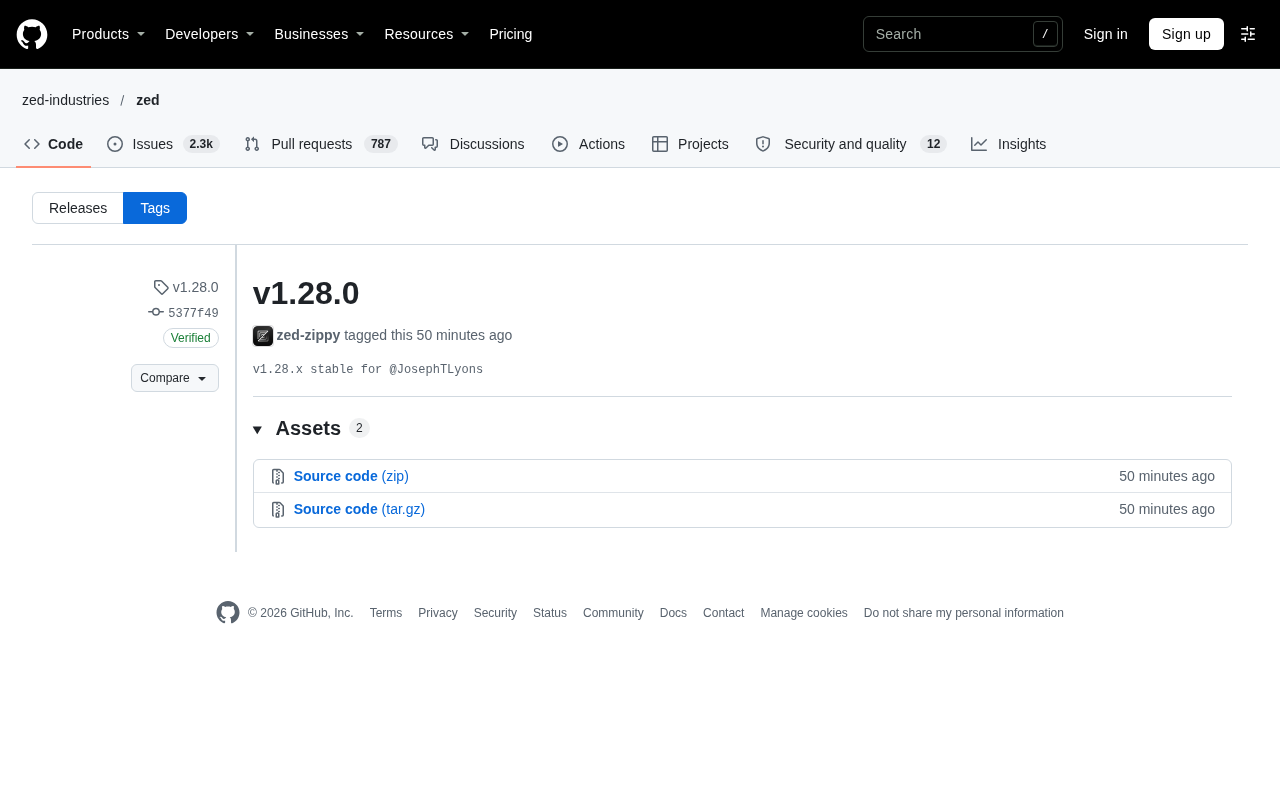
Zed releases v1.28.0 with extremely minimal public information: the tag was applied by zed-zippy on November 11, marked as the stable version of the v1.28.x series for @JosephTLyons, with 2 download assets. v1.28.x means this is a continuously maintained stable line where subsequent patches accumulate. The release commit has GitHub signature verification and a GPG key ID, reflecting supply chain security practices. Since no change entries are officially listed, specific changes must be traced through commit 5377f49 linked from the Compare entry. The article recommends checking change records before upgrading; the value of a stable tag is reproducibility, not feature surprises.
A Low-Key Stable Release
The code editor Zed has released version v1.28.0. Unlike many editors that heavily promote new features, the public information for this release is extremely minimal—the tag on GitHub was applied by user zed-zippy on November 11 at 15:20, the commit record carries a GitHub verified signature (GPG key ID: B5690EEEBB952194), and it is explicitly marked as the stable version of the v1.28.x series for @JosephTLyons.
Judging from the information structure of the release page, this looks more like a routine stable iteration than a major feature release. The asset list shows that this version comes with 2 download files, consistent with Zed's usual multi-platform distribution approach.
The Significance of the Stable Branch
Zed uses a branch naming convention like v1.28.x, which means 1.28 is a continuously maintained stable line, and subsequent patch versions will accumulate on this branch. For developers who use Zed daily, the existence of a stable branch means they can lock in a verified version without having to follow the high-frequency changes of the main branch.
The release information specifically mentions @JosephTLyons, which typically corresponds to the person responsible for version maintenance or the release process. This practice of directly naming the maintainer in the tag description is relatively common in small but active open source projects, and it also reflects the Zed team's lean size and direct release pipeline.
In Git workflows, naming like v1.28.x is a branch/version-line convention: 1.28 is the minor version under the major version number, and x indicates that there will be multiple patch revisions on that line (such as 1.28.1, 1.28.2). Maintainers typically only merge bug fixes and security patches into that branch, while new features go into the main branch or the next minor version. This is consistent with the Semantic Versioning (SemVer) approach—minor versions may introduce features, while patch versions only contain fixes. For users, locking onto a stable branch provides a predictable upgrade cadence, at the cost of not getting the latest features.
Commit Signing and Supply Chain Security
One detail worth noting is the verification status of the commit. The commit is verified by GitHub signature and is annotated with a GPG key ID. As open source software supply chain security receives increasing attention, having release commits with signature verification has become standard practice for mature projects. For enterprise users, being able to trace the signature status of release commits is a plus when assessing the risk of adopting a third-party editor.
As a high-performance collaborative editor built with Rust, Zed's standardized release process is consistent with its technical positioning.
GPG (GNU Privacy Guard) signature verification is a common integrity verification method in open source release processes. Developers sign commits or tags with a private key, and anyone holding the corresponding public key can verify that the content was indeed generated by the private key holder and has not been tampered with. GitHub displays a "Verified" badge for signed commits and shows the ID of the key used for signing. It is important to note that commit signing itself only proves origin and integrity; it does not mean the code has undergone a security audit. Teams with higher supply chain security requirements typically also combine dependency locking, reproducible builds, and artifact hash verification for a comprehensive assessment.
How to Understand This Update
Since the official release notes do not list specific change entries, the actual changes in v1.28.0 need to be referenced from the repository's comparison view or the full changelog. From the "Compare" entry on the release page, you can see that the tag is associated with the specific commit 5377f49, and developers can trace the complete changes through that commit.
For users who wish to upgrade, it is recommended to first check the change records corresponding to that commit before deciding whether to switch the team environment to the new version. The value of a stable tag lies in reproducibility, not in feature surprises.
GitHub's "Compare" view is used to compare the differences between two references (tags, branches, or commits), listing all commits and file changes in between. When release notes are missing, comparing the commit range between the previous stable tag and the current tag is a common way to reconstruct the changes. However, the comparison view shows commit-level differences, which is not the same as a user-facing changelog; if commit messages are non-standard, you still need to combine PR descriptions and linked issues to judge the actual impact.
Summary
Zed v1.28.0 is a standard stable release: signature verification, a designated maintainer, dual-asset distribution, and a clear process. It won't make headlines, but for developers who use Zed as their primary editor, these kinds of stable iterations are what daily productivity actually relies on.
One-line Summary
Zed releases v1.28.0 stable version with a standardized process but no specific change entries disclosed.
Paragraph Summary
Zed releases v1.28.0 with extremely minimal public information: the tag was applied by zed-zippy on November 11, marked as the stable version of the v1.28.x series for @JosephTLyons, with 2 download assets. v1.28.x means this is a continuously maintained stable line, and subsequent patches will accumulate here. The release commit carries GitHub signature verification and is annotated with a GPG key ID, reflecting supply chain security practices. Since the official release does not list change entries, specific changes need to be traced through the commit 5377f49 linked from the Compare entry. The article recommends checking the change records before upgrading; the value of a stable tag lies in reproducibility rather than feature surprises.
Related articles

S&P Weighs Downgrading Nvidia's Credit Rating: Governance and Key Man Risk in Focus
S&P is considering downgrading Nvidia's credit rating to AA-, citing corporate governance and key man risk rather than financial performance. We analyze the drivers, potential impact, and the broader trend of governance scrutiny for large tech companies in the AI era.

Generating a 3D Stacking Game from a Few Prompts: Hands-on with the Playground Experimental Platform
Playground lets users generate the 3D stacking game One More Pie from a few text prompts. This article examines the capabilities and limits of prompt-based web game generation.
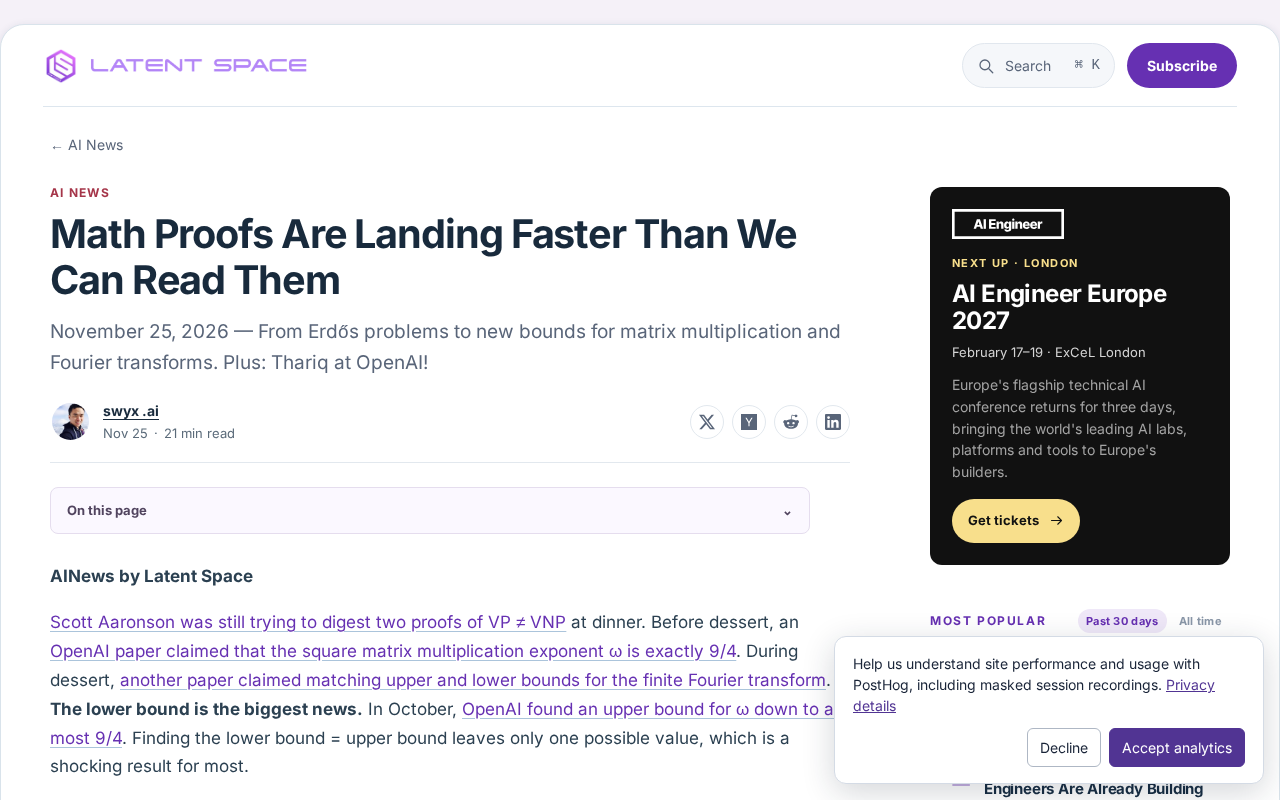
AI Math Proofs Are Exploding: Humans Can't Read Fast Enough
AI math proof output now outpaces human reading speed. AINews roundup covers Erdős problems, new matrix multiplication bounds, and Fourier transform bounds—verification is the new bottleneck.