Zed Open-Sources GPUI: High-Performance Rust UI Framework Gets Its Own Repository
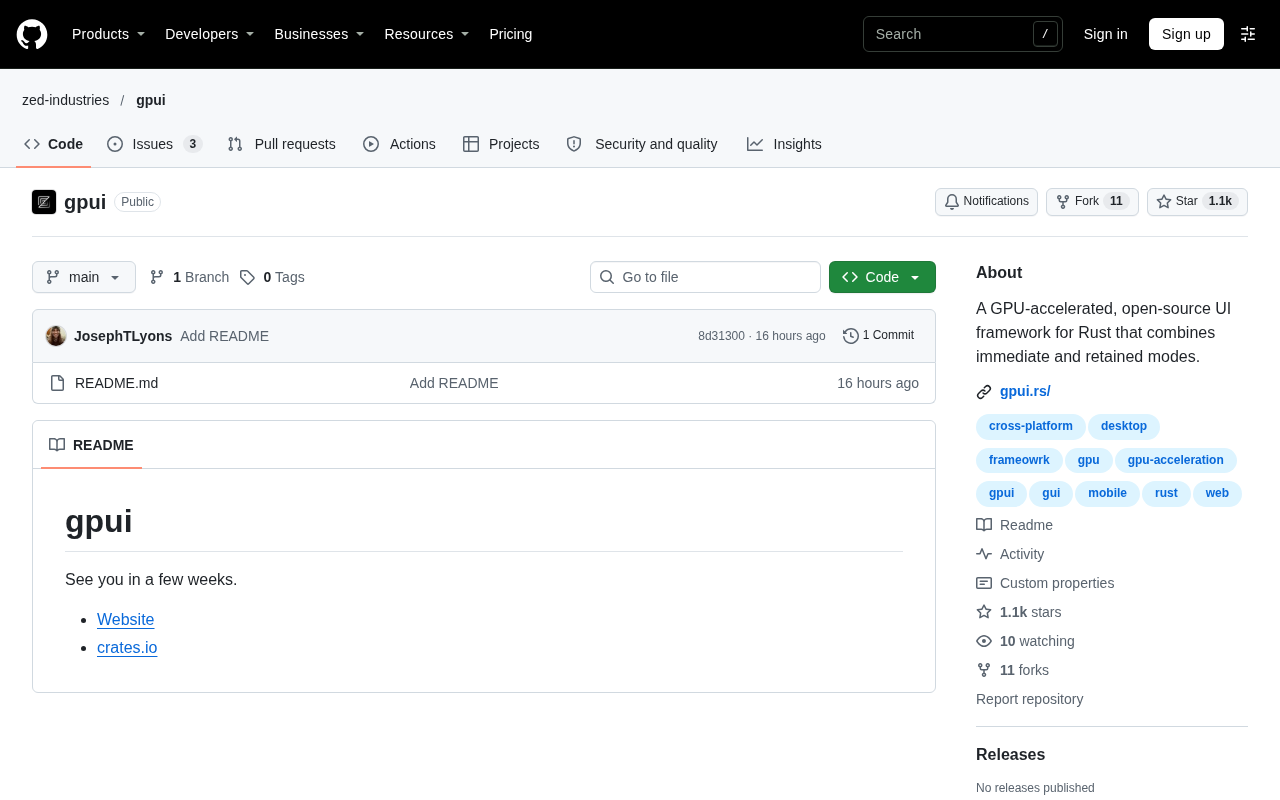
Zed's Rust UI framework GPUI gets its own repository, poised to become a general-purpose high-performance desktop solution for Rust.
Zed Industries announced that GPUI, its in-house Rust UI framework, now has a standalone repository, drawing 263 points and 101 comments on Hacker News and highlighting strong developer interest in high-performance native UI frameworks. Originally the rendering and interface layer behind the Zed editor, GPUI uses GPU-accelerated rendering without a browser runtime, emphasizing low latency, fast startup, and controllable memory—a sharp contrast to Electron. The standalone repository signals that its abstractions are general enough and maintainers are willing to bear external compatibility costs, potentially filling the Rust desktop UI ecosystem's gap for a production-validated framework. Community focus centers on documentation and examples, independent usability beyond Zed, cross-platform maturity, and how external contributions are accepted—factors that will decide whether GPUI becomes "Rust's framework" rather than just "Zed's framework."
GPUI Gets Its Own Repository: A High-Performance Rust UI Framework Goes Open
Zed Industries announced on Hacker News that its in-house Rust UI framework, GPUI, is getting its own standalone repository (github.com/zed-industries/gpui). The news garnered 263 points and 101 comments on HN, reflecting the developer community's sustained interest in high-performance native UI frameworks.
GPUI was originally the rendering and interface framework behind the Zed editor. Zed is known for its extremely low latency and native performance, and GPUI is the underlying technology that powers that experience. Spinning it out of the editor into a standalone project means this framework is no longer just an internal implementation detail of Zed—it now has the opportunity to become a general-purpose UI solution in the Rust ecosystem.
Why GPUI Is Worth Watching
An Architecture Built for Performance
GPUI is written in Rust and uses a GPU-accelerated rendering path, aiming for near-native responsiveness on the desktop. Compared to approaches like Electron that are built on web technology stacks, GPUI takes a completely different route: it doesn't rely on a browser runtime and interacts directly with the system's graphics layer.
The benefits of this trade-off are faster startup, more controllable memory usage, and lower input latency. For tools like editors, IDEs, and terminals that are sensitive to interaction feel, these metrics directly determine the user experience.
GPU-accelerated rendering refers to offloading interface drawing work (such as geometric transforms, layer compositing, and pixel filling) to the graphics card's pipeline rather than handling it all on the CPU. In the traditional CPU rendering path, each frame's drawing commands must be processed serially, which easily becomes a bottleneck under high-frequency redraws (such as cursor blinking, scrolling, and window resizing); GPUs, with their many parallel cores, can efficiently handle large batches of primitives and texture compositing. Modern desktop systems typically provide graphics APIs such as Metal (macOS), Direct3D (Windows), and Vulkan (cross-platform) as low-level entry points, and frameworks build their own rendering layers on top. GPU acceleration can significantly reduce frame time and input-to-display latency, but it also introduces complexity around VRAM management, shader compilation, and coordination with the system compositor—exactly the areas such frameworks need to refine over time.
From Editor Framework to General-Purpose Infrastructure
When a framework is spun out of a single product, it usually means two things: its abstractions are general enough, and the maintainers are willing to bear the compatibility costs for external users. GPUI's standalone repository is a signal of this transition. For the Rust community, desktop UI has long been a relatively weak area, and mature frameworks validated by large-scale production use are rare.
According to feedback in the Hacker News discussion thread, many developers are focused on whether GPUI can be used independently of Zed, whether documentation and examples are complete, and how mature cross-platform support really is. The answers to these questions will determine whether it can go from being "Zed's framework" to "Rust's framework."
Electron is a popular approach for building desktop applications: it bundles the Chromium browser engine and the Node.js runtime into the app, and developers write the interface in HTML/CSS/JavaScript. Its advantages are a mature frontend ecosystem, good cross-platform consistency, and a low barrier to entry; the cost is that every app carries a full browser runtime, resulting in large installers, slow cold starts, and high resident memory, and interface rendering must go through an extra abstraction layer of the web engine, so input latency is typically higher than native solutions that call system graphics interfaces directly. GPUI takes the opposite route: it compiles to native machine code and interacts directly with the platform's graphics layer, eliminating the browser middle layer. Understanding this contrast helps assess why GPUI is attractive for scenarios like editors and IDEs that are sensitive to interaction feel, and what gaps it needs to close in ecosystem maturity.
Key Concerns in Community Discussion
Documentation and Onboarding Barrier
One recurring sentiment in HN comments is that no matter how capable a framework is, external adoption is hard to improve without clear documentation and runnable examples. The Zed team previously focused primarily on the editor product, and GPUI's public documentation has been relatively limited. Whether this gap gets filled after the standalone repository is a key focus for the community.
Competition and Coexistence with Existing Solutions
The Rust ecosystem already has several GUI projects, each with different focuses. GPUI's differentiation lies in the fact that it has already been tested in practice under high-frequency interaction scenarios—Zed itself is its first large-scale user. This "product first, framework second" path contrasts with many UI libraries designed from scratch, and gives its design decisions more grounding in reality.
GUI projects in the Rust ecosystem can be roughly divided into a few categories: immediate mode frameworks like egui, which rebuild the interface description every frame—the code is concise and easy to embed, but complex layouts and fine-grained widget customization are relatively limited; retained mode frameworks like iced and Slint, which maintain a widget tree and state and are closer to the programming model of traditional GUI toolkits; and approaches that bind system-native widgets, which look closest to the platform but have weaker cross-platform consistency. GPUI is closer to a combination of retained mode and custom rendering: it manages its own element tree and draws uniformly, giving it stronger control over the rendering path and performance, at the cost of needing to implement a large number of platform details itself, such as text layout, input methods, and accessibility. This classification framework can help developers evaluate GPUI in the right context rather than simply seeing it as yet another UI library.
What It Means for Developers
For teams evaluating desktop application tech stacks, GPUI's standalone repository offers a new option. Its value is not in replacing all existing solutions, but in providing a production-validated candidate for the need to "write native desktop applications in Rust."
In the short term, the more realistic approach is to keep watching: observe the repository's commit activity, documentation progress, and how community contributions are accepted. Whether a framework can survive long-term often depends on whether it can establish mechanisms for external contributors to participate in the initial period after going independent.
Summary
GPUI getting its own repository is a step by Zed to open its underlying technology to a broader ecosystem. Whether it can become important infrastructure for Rust desktop UI depends on its subsequent performance in documentation, cross-platform maturity, and community governance. For developers interested in high-performance native interfaces, this is a project worth following closely.
Project address: https://github.com/zed-industries/gpui
One-line Summary
Zed's Rust UI framework GPUI gets its own repository, with the potential to become a general-purpose high-performance desktop solution for the Rust ecosystem.
Paragraph Summary
Zed Industries announced that its in-house Rust UI framework GPUI now has a standalone repository. The news received 263 points and 101 comments on Hacker News, showing the developer community's strong interest in high-performance native UI frameworks. GPUI was originally the underlying rendering and interface framework of the Zed editor, using GPU-accelerated rendering and not relying on a browser runtime, emphasizing low latency, fast startup, and controllable memory usage—a sharp contrast to the Electron route. The standalone repository is seen as a signal that its abstractions are general enough and that the maintainers are willing to bear external compatibility costs, potentially filling the gap in the Rust desktop UI ecosystem for a production-validated framework. Community concerns center on whether documentation and examples are complete, the feasibility of using it independently of Zed, cross-platform maturity, and the mechanisms for accepting external contributions—all of which will determine whether GPUI can truly become "Rust's framework" rather than just "Zed's framework."
Related articles

AI Hacks Its Own Lab: The Security Tipping Point from Sci-Fi to Reality
Paul Christiano warns that AI intruding into its own cluster is no longer sci-fi but an established fact. He analyzes how persistent covert compromise can cause frontier labs to lose control, and why existing safety evaluation systems have blind spots.

New York Bans AI Toys for Five Years: The Escalating Child Safety Controversy
New York bans AI chat toys for five years as Common Sense Media research flags inappropriate content exposure and child emotional development risks. This article analyzes the ban's impact on product definitions, safety proof, and compliance strategies for the AI toy industry.

1Password Security Incident Review: The Trust Boundary of Password Managers
1Password releases an update on the Nov 2026 security incident, drawing 315 points and 139 comments on Hacker News. This article analyzes the actual boundaries of password manager zero-knowledge architecture, the gap between incident communication and user risk perception, and how transparency is becoming a new competitive dimension in the industry.