Zelensky Speaks: How We Held Kyiv Against 200,000 Russian Troops

Zelensky's interview reveals Ukraine misjudged Russia's main axis and held Kyiv by mobilizing from 200,000 to 800,000 troops.
Based on a Zelensky interview video, the article outlines key decision-making in the early Russia-Ukraine war: Ukraine judged Russia's main attack to be in the eastern Donbas and tied its main forces there, while Russia advanced on Kyiv through Belarus with about 200,000 troops. Zelensky stresses that early Ukrainian forces were too small to defend the capital, but a post-invasion mobilization wave expanded the army from about 200,000 to 800,000, filling the gaps. He also says Russia pulled back mainly because it lacked troops to sustain occupation. The article notes that all force figures come from Zelensky alone and lack independent verification, and that the interview carries a narrative stance emphasizing the difficulty of defense and the achievement of holding out.
A War Misjudged: Why 200,000 Russian Troops Headed Straight for Kyiv
In an interview video circulating on YouTube, Zelensky recalled the decision-making context on the first day of Russia's full-scale invasion of Ukraine. According to his account, Russia committed roughly 200,000 troops toward Kyiv, while Ukraine's main forces were concentrated in the eastern Donetsk and Luhansk regions.
"They knew our main forces were in the east... no one expected them to advance on the capital through Belarus."
The core message of this account is that Ukraine judged the Russian main axis of attack to be in the east, and therefore did not deploy an equally strong defense toward Kyiv. Zelensky described this misjudgment as an "absolute fact." From a military-logic standpoint, this was not a simple oversight—the eastern front had long borne the pressure of Russia's strongest grouping, and forces were tied down there for practical reasons.

The Defensive Dilemma Under a Stark Force Imbalance
Zelensky repeatedly emphasized one numerical contrast in the interview: 200,000 attacking troops against a strong defensive force that, at the time, did not exist.
"Imagine 200,000 people coming at you... it's simply impossible to defend against. You need an army like the one we have today—800,000."
This passage reveals a key fact: the size of Ukraine's military in the war's early days was far from sufficient to cover all fronts. The "800,000" he cites is the post-mobilization figure, not the standing force at the start of the war. This before-and-after contrast forms the backbone of his narrative—from being on the back foot to gradually stabilizing the situation.

Mobilization refers to the process by which a state, in wartime or a state of emergency, transitions some or all of its armed forces from peacetime to wartime status, conscripts reservists, and requisitions materiel. In modern warfare, the speed and scale of mobilization often determine the battlefield situation in the war's early phase. After the full-scale war broke out in 2022, Ukraine quickly activated its mobilization mechanism, expanding its forces from roughly 200,000 to 800,000 in a short period by simplifying enlistment procedures and setting up recruitment centers. This "wartime mobilization" is fundamentally different from a "prewar standing army": a standing army is well-trained but limited in size, while mobilized forces are large but uneven in training and equipment. The "800,000" Zelensky emphasizes is precisely the post-mobilization result, and its actual combat power cannot be simply equated with that of a prewar standing army. Mobilization capacity depends not only on population base but also on organizational efficiency, logistics, and public willingness—it is a key indicator for assessing a country's defensive resilience.
From 200,000 to 800,000: How Mobilization Changed the Battlefield
The interview contains a specific description of mobilization that deserves separate analysis.
Queuing to Enlist and the Army's Expansion
Zelensky mentioned that after the full-scale invasion began, a wave of mobilization emerged—people lined up to sign up, and volunteers kept coming. The Ukrainian army expanded from about 200,000 to 800,000.
"Naturally, when the full-scale invasion began, there was mobilization. There were lines. People showed up as volunteers."
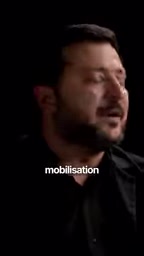
The significance of this detail is that it explains why Ukraine was able to hold the line toward Kyiv—not through prewar deployment, but through rapid post-invasion mobilization that filled the gap. That said, he put Russia's total forces across all directions on Ukrainian territory at roughly 700,000—a number that forms a kind of parity with Ukraine's expanded size.
Why Russia Couldn't Hold Occupied Territory
There is an easily overlooked judgment in Zelensky's account: Russian forces withdrew not out of goodwill, but because they lacked the troops to sustain occupation.
"They didn't have enough forces to hold the occupied territories here. They had to pull back. We struck them, and they pulled back."

Under this logic, the recapture of Kyiv Oblast, Chernihiv Oblast, and the entire front line was the combined result of sustained Ukrainian pressure and Russia's logistical and manpower bottlenecks. This aligns with the widespread external analysis of Russia's early "overextended front lines and supply difficulties," but the specific causal chain remains Zelensky's unilateral account.
Overextended front lines and logistical bottlenecks are a common framework in military analysis for explaining Russia's early setbacks. Russia advanced simultaneously from multiple directions, stretching and exposing its supply lines—especially the logistics corridor toward Kyiv, which depended on railways and roads inside Belarus and was vulnerable to harassment by small Ukrainian units and partisans. In addition, Russian forces were dispersed across a vast front, making it difficult to concentrate enough advantage at key points and to effectively control occupied areas. Zelensky's claim that "they didn't have enough forces to hold the occupied territories" points to this structural weakness: occupation requires garrison troops, administrative control, and supply security, while the offensive forces themselves were already stretched thin. It is widely believed externally that Russia's withdrawal from Kyiv Oblast resulted from a combination of factors—including logistical difficulties, Ukrainian resistance, and a shift in strategic focus—though the precise weighting remains disputed.
The Value and Limits of This Account
As a first-hand recollection by a participant, this interview offers an internal view at the decision-making level of the war: Ukraine's misjudgment of the main axis of attack, the shortages of early forces, and the actual operation of the mobilization mechanism. These are all important materials for understanding how the war's early phase unfolded.
A note: all force figures in this article (200,000, 800,000, 700,000) come from Zelensky's unilateral statements and lack cross-verification from independent sources. The interview itself carries a clear narrative stance—emphasizing the difficulty of defense and the ultimate achievement of holding out. When citing these data, readers should treat them as the presentation of a party involved rather than verified objective statistics.
In terms of content value, the most noteworthy part of this interview is not the numbers themselves but the decision-making dilemma it reveals: when intelligence assessments diverge from reality, how does an army complete an expansion from 200,000 to 800,000 in an extremely short time and thereby turn the tide in the capital's direction? This question has reference significance beyond any single battlefield for understanding mobilization capacity and defensive resilience in modern warfare.
Related articles

A Single Prompt Triggers a Global PHP Security Storm: Is AI a Savior or a Hidden Risk?
A single AI prompt triggered a global PHP security crisis affecting Wikipedia and the Internet Archive. This article reviews the incident, analyzes the OpenAI-Amazon controversy, and explores the security paradox of lowered vulnerability discovery barriers in the AI era and developer response strategies.

When AI Is Taken Away: How Reliance on Shortcuts Undermines Your Problem-Solving Resilience
A study of 1,222 people found that after using AI to answer questions, once AI was removed, people gave up on more problems than a control group that never used AI. The article analyzes the impact of AI reliance on learning resilience and metacognition, and explores design implications for AI learning tools.

Carta and NewView Partner to Let Startup Employees Cash Out Equity Early
Carta and NewView Capital partner to simplify startup tender offers, helping employees sell equity early. Analysis of the mechanism, liquidity pain points, and impact.